




Types of catamaran to hire in Greece
Close to 1,000 multihulls are based in Greek marinas, from the family-friendly 38-footer to the high-end luxury yacht. Three main families stand out:
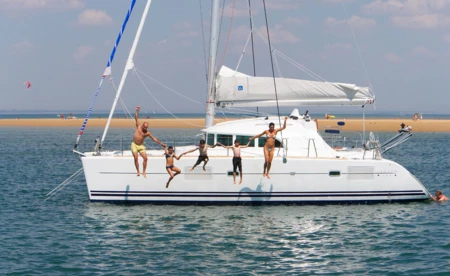
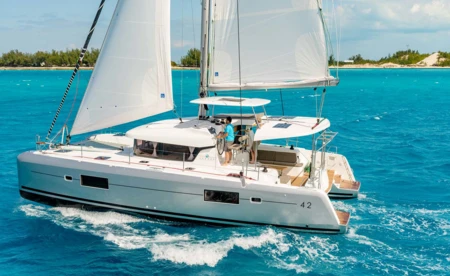
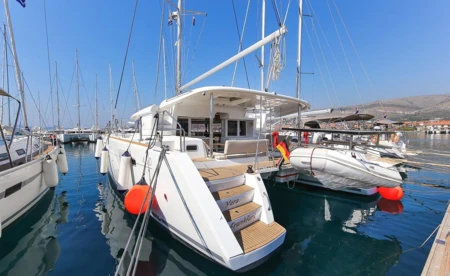
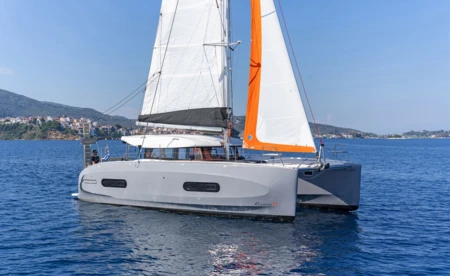
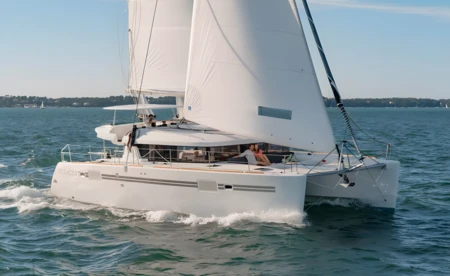
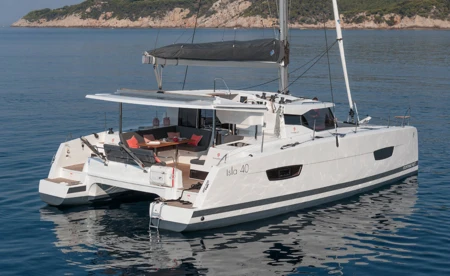
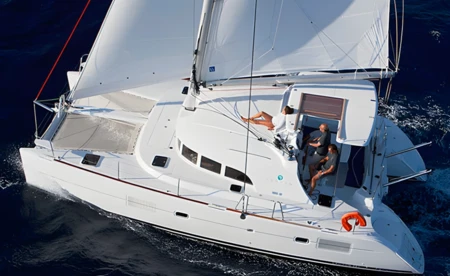
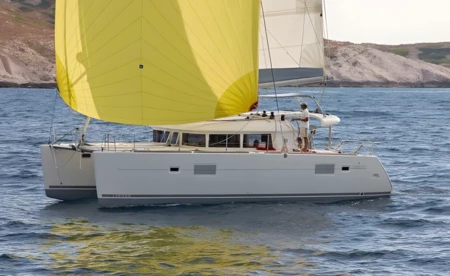
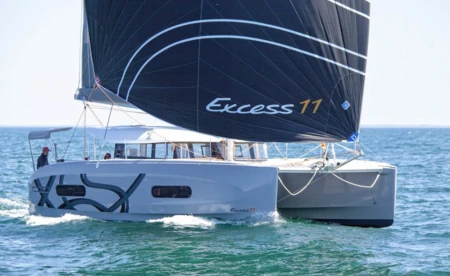
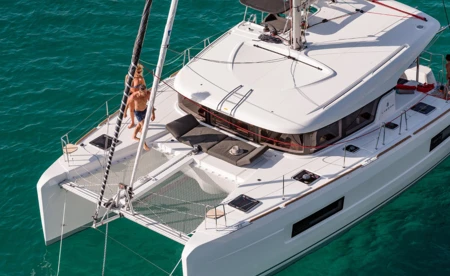
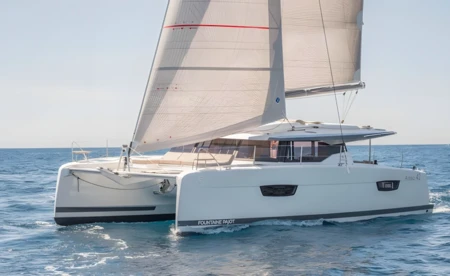
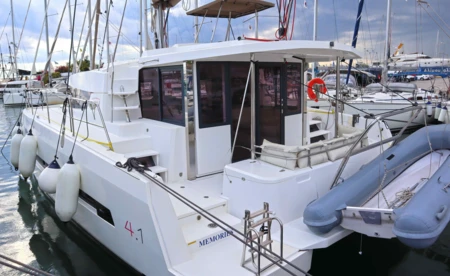
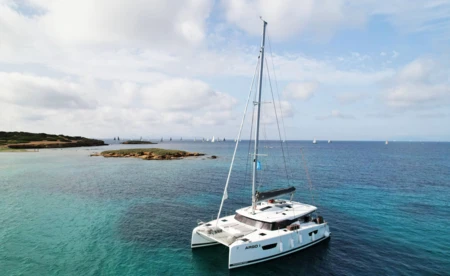
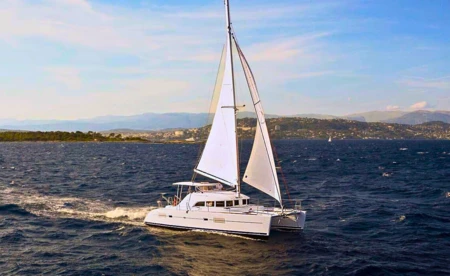
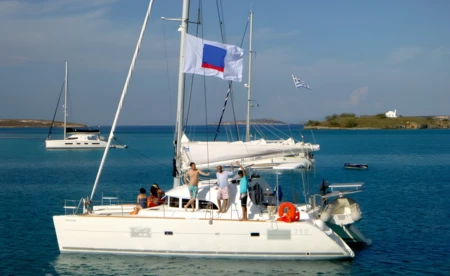
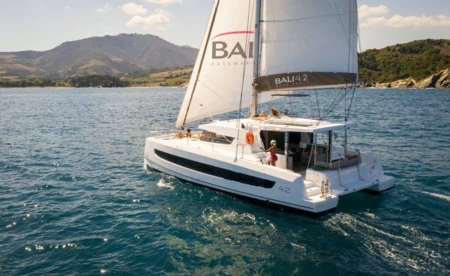
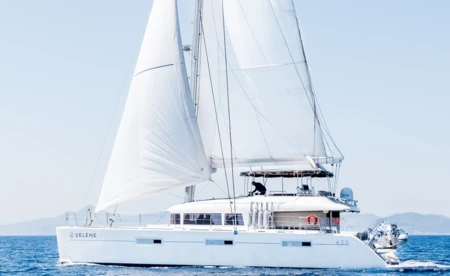
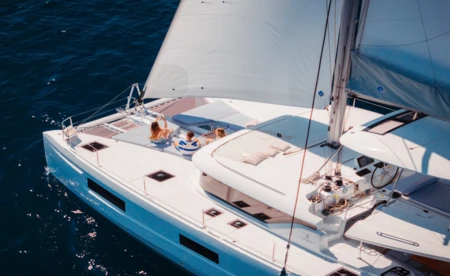
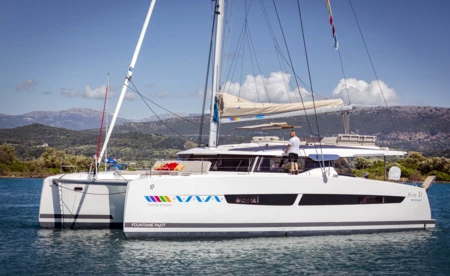
- The sailing catamaran: it makes up the vast majority of the fleet available in Greece, with recent models from Lagoon, Bali, Excess, Astrea and Nautitech. Two hulls, a walk-through saloon, a huge aft cockpit and trampolines forward: this is the boat that turns a week afloat into a real floating home, with no heel and no roll at anchor.
- The power catamaran: less common but in strong demand in areas where you move on every day. It frees you from the wind pattern and lets you reach an island at the end of the day even when the breeze dies. A good compromise for crews who want to cover distance without handling sails.
- The large catamaran over 15 metres: beyond that size, the hire always comes with a crew. Flybridge, owner's cabins, a powerful tender and a full set of water toys: this is the format to go for on an upmarket cruise shared between several families.
A handful of trimarans also round out the Aegean offering for crews looking for a thrill under sail.
Services available for your catamaran hire in Greece
Four options are available in this destination, depending on your experience and what you are looking for:
- Bareboat catamaran hire: the most affordable and the most independent option. You are the skipper, you pick the course over breakfast and nobody sets your schedule. It does require one crew member to hold the certificates demanded by the Greek authorities (see below).
- Skippered catamaran hire: a professional joins you on board, takes responsibility for the navigation and shares his detailed knowledge of the anchorages, the village tavernas and the weather windows. A reassuring choice in the Cyclades, where the meltemi sometimes forces you to rethink the plan mid-week.
- Crewed catamaran hire: skipper, hostess and chef depending on the size of the boat. Meals, upkeep and logistics are taken care of: all you have to do is enjoy it. It is the standard on larger yachts and an option on some models between 12 and 15 metres.
- Cabin cruise on a catamaran : you book a cabin rather than the whole boat, sharing with other travellers and with a crew in charge. A small-scale format designed for couples or solo travellers who would rather not pay to hire a boat outright. Find all our departure dates on our page dedicated to sailing cruises in Greece.
How much does it cost to hire a catamaran in Greece?
The price of a multihull in Greece depends first and foremost on its size and on the season you pick. The table below gives a ballpark figure for a week's hire, excluding extras and mandatory fees. Differences from one model to another remain significant depending on the build year, the home base and the level of equipment.
| Catamaran size | High season July and August | Mid season May, June and September | Low season April and October |
|---|---|---|---|
| 38 to 40 foot catamaran (3 to 4 cabins) | €7,900 | €7,120 | €3,300 |
| 40 to 45 foot catamaran (4 cabins) | €9,300 | €7,650 | €5,600 |
| 45 to 50 foot catamaran (4 to 5 cabins) | €11,000 | €8,600 | €4,500 |
| Catamaran over 50 feet (crewed) | €16,200 | €14,900 | €6,000 |
The price includes: use of the catamaran, its rigging and sails, the onboard electronics, the tender and its outboard, bedding and tableware for the whole crew.
The price does not include: additional insurance, fuel, harbour and mooring fees, the usually mandatory end-of-hire pack (cleaning, sheets and towels), the skipper's or hostess's wages, provisioning and water toys such as a paddleboard or a kayak.
For larger yachts and crewed catamarans, the price range is too wide to sum up in a table. Get in touch with us directly: Lina, our specialist for exceptional yachts and crewed hires, will send you a selection matched to your plans.
Two forms of cover are worth a look before you leave. Cancellation insurance taken out with us protects every crew member named on the contract, whereas an individual policy or the one attached to your bank card only covers the holder. Damage waiver insurance, meanwhile, really earns its keep in Greece: stern-to berthing manoeuvres and anchoring over changeable seabeds are the leading cause of reported damage, and this cover saves you from watching a deposit of several thousand euros disappear over a scraped rudder or a lost anchor.
Where to sail a catamaran in Greece?
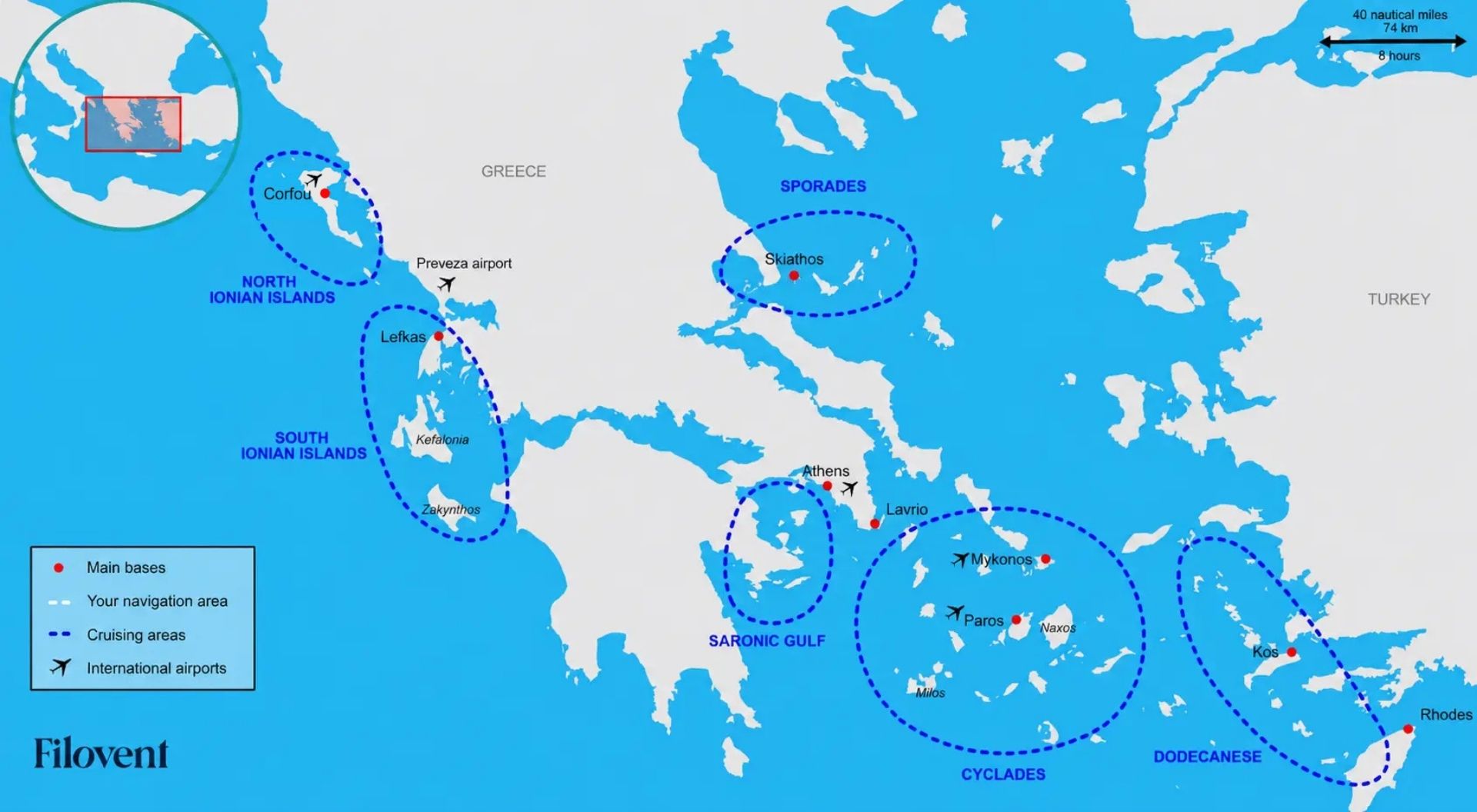
Five main sailing areas share the Greek coastline, each with its own character:
- The Ionian Islands, to the west. From Corfu or Lefkas, you sail a green, sheltered basin with short hops. Meganisi, Ithaca, Kastos and Kefalonia are only a few hours apart and the afternoon thermal breeze stays manageable: this is the ideal area for a first family cruise. Do not miss the bay of Paleokastritsa, north-west of Corfu, with its clear water ringed by wooded cliffs.
- The Saronic Gulf, on the doorstep of Athens. From Athens or Lavrion, head for Aegina and its temple of Aphaia, Hydra and its car-free harbour, Poros or Spetses. Short distances, plenty of shelter and archaeological heritage at every stop.
- The Cyclades, in the middle of the Aegean. This is postcard Greece: whitewashed villages, windmills and volcanic cliffs. From Paros or Mykonos you can link Naxos, Delos, Milos and Santorini. A superb area, but exposed to the meltemi, best kept for seasoned crews or for sailing with a skipper. If you would rather hand the helm to a professional, our Cyclades cruise departures cover the archipelago from May to October.
- The Dodecanese, along the Turkish coast. Rhodes and Kos open the way to Symi and its ochre neoclassical houses, Patmos and its fortified monastery, or Leros. The anchorages are well sheltered and the season runs into November.
- The Sporades, to the north. Skiathos, Skopelos and Alonissos form a wooded archipelago bordered by the first marine park in the Mediterranean, where the monk seal can still be spotted. The meltemi blows more gently here than in the Cyclades.
Still torn between two archipelagos, or between a multihull and a monohull? Our full boat hire in Greece offering is available online, covering every area and every format.
When to sail a catamaran in Greece?
The Greek sailing season opens in April and closes at the end of October. Each period has something going for it:
- High season, July and August: water at 26 °C, guaranteed sunshine, a festive atmosphere in the harbours and full fleets at every base. It is also the most expensive and the busiest time of year, and the one when the meltemi blows hardest in the Aegean.
- Mid season, May, June and September: the best balance of conditions and prices. Temperatures stay summery, anchorages free up and September still holds the sea at 25 °C. This is the window we recommend most often.
- Low season, April and October: prices drop sharply and you have the coves almost to yourself. In return, the water is still cool for swimming and some island tavernas have yet to open or are already closing.
Here are the average temperatures recorded in recent years around Athens, which are representative of the whole basin:
| Temperatures | Jan | Feb | Mar | Apr | May | Jun | Jul | Aug | Sep | Oct | Nov | Dec |
|---|---|---|---|---|---|---|---|---|---|---|---|---|
| Air min (°C) | 6° | 6° | 8° | 11° | 16° | 20° | 23° | 23° | 20° | 16° | 12° | 8° |
| Air max (°C) | 13° | 14° | 16° | 20° | 25° | 30° | 33° | 33° | 29° | 24° | 18° | 14° |
| Sea water (°C) | 15° | 15° | 15° | 16° | 19° | 23° | 26° | 26° | 25° | 22° | 19° | 17° |
Sailing conditions in Greece
The Greek wind pattern comes in two parts. In the Aegean, the meltemi settles in from mid-June to mid-September: a dry, steady northerly to north-easterly wind that usually builds mid-morning and drops at sunset. It ranges between force 4 and force 6, with stronger gusts in the funnels between the Cyclades islands. Nothing insurmountable on a well-handled catamaran, but it dictates which way round you plan your route: you run downwind, motor back up or plan short hops.
In the Ionian, the picture is far gentler. The westerly to north-westerly thermal breeze sets in during the early afternoon, blows 10 to 15 knots and fades in the evening. Mornings are often calm, crossings are made within sight of land and shelter is never far away.
Greek seabeds drop away fast: 20 to 30 metres just off a beach is not unusual. Anchoring therefore happens in deeper water than in the Adriatic, with plenty of chain out, and berthing in port is almost always stern-to on your own anchor. Worth practising before you set off if your crew is not used to it. Tides are negligible, but keep an eye on ferry traffic, which is heavy and fast around the larger islands.
Documents required to hire a catamaran without a skipper in Greece
Greek regulations require two qualified crew members on board. The skipper must produce a recognised certificate of competence: a Day Skipper certificate as a minimum, a Coastal or Yachtmaster endorsement or an ICC for areas where crossings take you more than 6 miles from shelter, which is often the case in the Cyclades and the Dodecanese. A Short Range Certificate (SRC) is required to use the VHF, and a sailing CV usually goes with the file sent to the charter company.
The second crew member, known as the co-skipper, does not need a certificate in most cases but must be able to show sailing experience and appear on the crew list. Port authorities may ask for a signed statement confirming that experience. We set out all the accepted certificates, the special cases and the processing times in our FAQ on all the formalities for sailing in Greece.
Useful information for your catamaran hire in Greece
What language is spoken in Greece?
Greek is the official language. English is widely spoken in charter bases, marinas and tourist shops, and you will always be welcomed in English when you check in for your catamaran.
What currency is used in Greece?
Greece is part of the eurozone (€). Cards are accepted in marinas and in most tavernas, but bring cash for small island harbours and for mooring fees paid on the quay.
How do you get to Greece?
Athens (ATH) is served all year from most major UK cities and is the gateway to the Saronic Gulf and Lavrion. For the Ionian, aim for Corfu (CFU), Preveza-Aktion (PVK) or Kefalonia (EFL). The Cyclades are reached via Mykonos (JMK), Paros (PAS) or Santorini (JTR), the Dodecanese via Rhodes (RHO) or Kos (KGS), and the Sporades via Skiathos (JSI). Direct flight options expand considerably from April to October.
Is there a cruising tax in Greece?
Yes, TEPAI is a monthly tax calculated on the length of the boat and payable by any pleasure craft sailing in Greek waters. On a hire it is paid by the charter company and already built into the contract: there is nothing for you to do.
Can you sail to Turkey from a Greek base?
It is possible from the Dodecanese, where only a few miles separate Kos or Rhodes from the Turkish coast, but it remains subject to the charter company's prior agreement and to customs formalities on the way out and back in. Most hire contracts prohibit it: check this point with your advisor before building your itinerary.
How do I finalise my catamaran booking in Greece?
Once we have your enquiry, an advisor calls you to pin down your sailing plans, your experience and your dates. He then emails you a selection of catamarans. Once you have settled on the boat, paying the deposit from your customer area confirms the hire and holds the yacht in your name.
Good to know
| Number of available boats | 987 |
|---|---|
| Services types | Skipper, Hostess, Chef, Sailor |
| Average price per week | 8 384 € |
| Minimum price per week | 1 200 € |
| Maximum price per week | 85 145 € |