







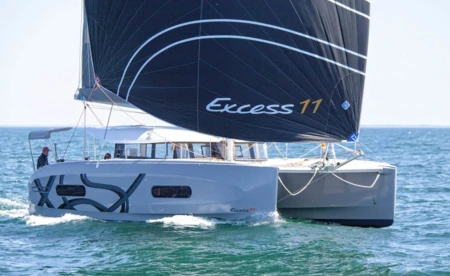
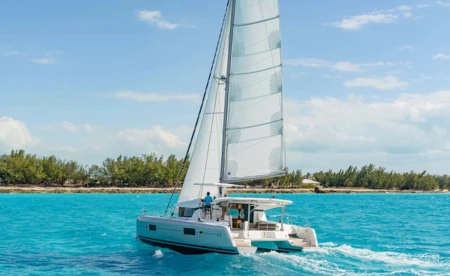



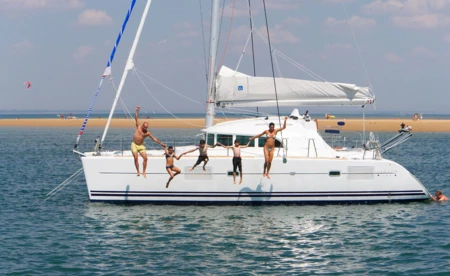
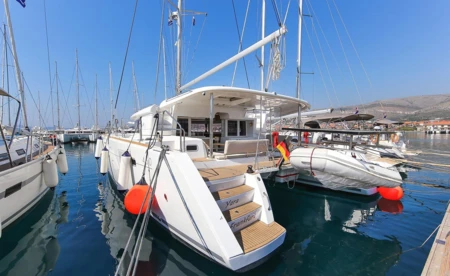

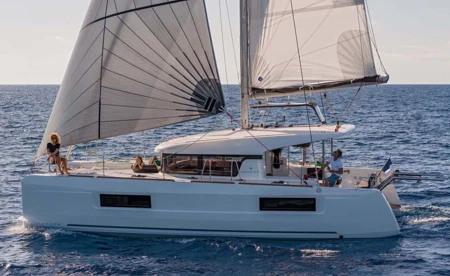
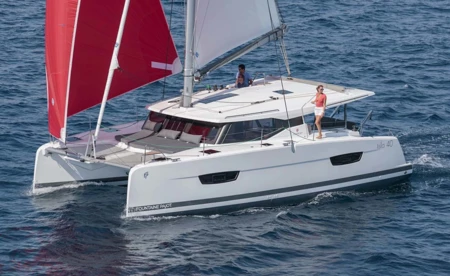


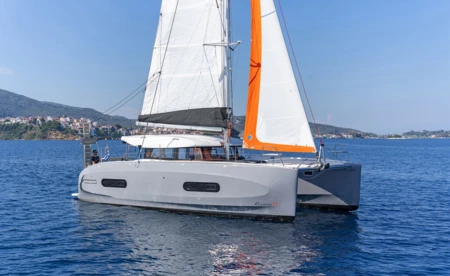

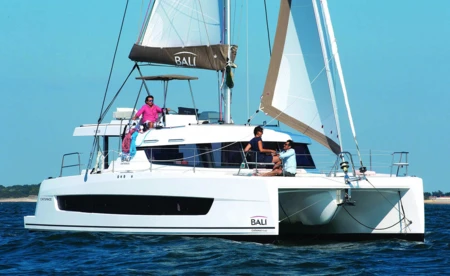

Catamaran hire gives you a spacious saloon that opens straight onto the cockpit, a trampoline for soaking up the sun and a level of stability that puts the whole crew at ease, from children to complete beginners. Roomier and steadier than a monohull, which you can also book through our sailing yacht hire, a catamaran works just as well for a family week as for a month-long trip with friends.
For 30 years, Filovent has been comparing the fleets of professional charter companies in more than 80 countries. Thousands of sailing and power catamarans are available, with live prices and verified customer reviews. Booking a catamaran on Filovent takes just a few clicks, and a dedicated adviser is always on hand to help you choose.
How much does catamaran hire cost?
A week's bareboat catamaran hire in the Mediterranean costs from €2,500 in low season to €11,000 in high season. The price depends on the size of the boat, the year it was built, the destination and, above all, the season. As a guide, here are the average prices we see for a week, for example in catamaran hire in Sardinia.
| Catamaran size | Low season | High season |
| 9 to 12 m (30 to 40 ft) | €2,500 | €7,000 |
| 12 to 15 m (40 to 50 ft) | €3,500 | €11,000 |
Source: Filovent booking data.
In the Caribbean, the gap between seasons is less pronounced but starting prices are higher: for catamaran hire in Martinique, allow €5,500 to €12,000 a week depending on the size of the boat. Prices peak in July and August in the Mediterranean and over the Christmas and New Year holidays in the Caribbean. Setting off in early or late season remains the best way to stretch a tight budget: the sea is still warm and the anchorages are quieter.
What is and isn't included in the price
The price covers the boat hire, any extras booked through Filovent and booking fees. The following are at your expense and paid on site:
- fuel and cooking gas
- provisioning
- harbour nights away from the departure base and local taxes
- the end-of-charter cleaning fee, depending on the charter company
- the skipper's or hostess's fee and meals, where applicable
The amount for each item is set out in your quote. In harbour, catamarans are often charged a higher berthing fee because of their width.
Skippered or bareboat catamaran hire: which licence do you need?
Before choosing the boat, you need to know who will be at the helm. The right option depends on your crew's experience.
Bareboat: qualifications and sailing CV
For bareboat hire, most charter companies ask the skipper for at least an RYA Day Skipper practical certificate or an ICC, which the RYA issues to Day Skipper holders. Many destinations also require a VHF radio licence, the SRC in the UK. In every case, the charter company checks the skipper's experience through a sailing CV: trips completed, size of boats handled and sailing areas. Previous multihull experience is strongly recommended, as a catamaran doesn't handle quite like a monohull, especially in harbour. If the boat you have in mind is bigger than what you usually sail, ask your adviser to approve your CV before booking.
The rules vary depending on the country of departure. For catamaran hire in Greece, the skipper must hold a sailing qualification such as the ICC or Day Skipper and be accompanied by a second experienced crew member. In Croatia, a recognised qualification is required along with a VHF radio certificate. France is the exception: no licence is needed for a sailing catamaran, although a power catamaran does require one. Your adviser will tell you exactly what is needed for your destination.
Skippered: no experience needed
A professional skipper takes care of navigation, manoeuvres and choosing the anchorages. You can simply enjoy the cruise or pick up the basics of sailing alongside them. On a catamaran, the skipper usually sleeps in the forepeak cabin or in one of the boat's cabins. Allow an average of €150 to €250 a day depending on the destination, payable on site on check-in day, and remember to cover their meals.
Crewed: your own private cruise
A skipper, hostess or chef takes care of everything, from sailing to meals: all you have to do is pick your ports of call. On some crewed charters, particularly the largest yachts, an advance known as the APA, around 20 to 30% of the charter price, covers provisioning, fuel and harbour fees; any unspent balance is refunded to you. It is customary to leave the crew a tip of 5 to 10% of the charter price. If there are just two of you, a cabin charter on a crewed catamaran is a good alternative: with a catamaran cruise, you share a high-end boat and its crew with other travellers.
Which catamaran should you choose for your crew?
For 4 to 6 people, a 12 m catamaran with 4 cabins is ample; for more than 8 people, go for 13 m or more. A compact catamaran is easy to handle and finds a harbour berth more easily, while a large catamaran offers very generous living space but calls for a seasoned crew or a skipper. Above 15 m, luxury catamaran hire gives you access to recent yachts that come with a full crew.
| Length | Cabins | Berths | Ideal for |
| Under 12 m (40 ft) | 3 to 4 | 6 to 10 | Couples, small families |
| 12 to 13 m (40 to 43 ft) | 4 to 6 | 8 to 12 | Families, groups of friends |
| 13 to 15 m (43 to 50 ft) | 4 to 6 | 10 to 12 | Large groups, extra comfort |
| Over 15 m (50 ft) | 4 to 6 | 8 to 12 | Crewed cruises |
For a larger group, simply book several boats and sail as a flotilla: everyone keeps their privacy on board and the whole group meets up at anchor.
Sailing or power catamaran
Our selection also includes power catamaran hire, skippered or bareboat. A sailing catamaran remains the most fuel-efficient option and offers the pleasure of travelling at the pace of the wind. A power catamaran keeps the space and stability of a multihull but goes faster and doesn't depend on the weather, so you can fit more stops into a week. Its fuel consumption, however, weighs more heavily on the budget.
Our customers' favourite models
In Croatia, the Lagoon 40 is a regular in our customers' bookings: 11.74 metres, 4 double cabins and, in the charter version, 2 small forward cabins as well, an ideal layout for a family or two couples. Larger and sportier, the Excess 14 appeals to crews who want to keep the feel of the helm without giving up comfort.
In Greece and the Caribbean, the Excess 11 and the Isla 40 (Fountaine Pajot) are among the catamarans most highly rated by our customers. Bali models, such as the Bali 4.2 departing from Athens or the Bali Catspace in Martinique, are also very popular for their forward cockpit and saloon that opens wide onto the outside.
Where to hire a catamaran?
The main catamaran hire areas are the Mediterranean (May to October) and the Caribbean (December to May), followed by the Indian Ocean, Southeast Asia and the Pacific. Each sailing area has its ideal season and its own style of sailing.
| Sailing area | Best time | Sailing style | Main bases |
| Mediterranean | May to October | Island hopping along the coast | Split, Athens, Ajaccio, Palma |
| Caribbean | December to May | Steady trade winds, crossings between islands | Tortola (BVI), Le Marin, Pointe-à-Pitre |
| Indian Ocean | Varies by archipelago | Lagoons, swimming and diving | Mahé, Praslin |
| Southeast Asia | November to April | Limestone islands and sheltered anchorages | Phuket |
| Pacific | May to October | Atolls and wide open spaces | Raiatea |
In summer, catamaran hire in Croatia gives you access to more than 1,200 islands, islets and reefs, while Greece offers sheltered anchorages in the Ionian Islands or breezier sailing in the Cyclades with the meltemi. With a draught of around 1.2 m, compared with nearly 2 m for a monohull of the same size, a catamaran can anchor right off the beaches of Corsica, Sardinia or the Balearics.
Closer to home, catamarans are also available in France, from Marseille, La Ciotat, Hyères or Cannes on the Mediterranean, as well as from La Trinité-sur-Mer in Brittany.
In winter, head for the trade winds: from Le Marin in Martinique, St Lucia lies around 25 nautical miles away, half a day's sail, and the Grenadines can be reached in a few hops. In Thailand, the Andaman Sea is known for its limestone cliffs and the sheltered islands of Phang Nga Bay. Further afield, catamaran hire in the Seychelles or in French Polynesia lets you sail from lagoon to lagoon among granite islands or atolls.
How does catamaran hire work?
From booking to check-out, here are the main steps and the terms to know before you set sail.
Booking, deposit and cancellation
A 50% deposit is paid when you book. The balance is due between 6 and 12 weeks before check-in, depending on the charter company. If you cancel more than 90 days before departure, the deposit is retained; within 90 days, the full charter price is due. Flotillas of more than 3 boats and charters of more than 4 weeks cannot be cancelled. Cancellation insurance can be taken out when you book or from your customer account.
Check-in and check-out
The check-in time is shown on your booking voucher. The inventory and boat handover take a few hours, so you will often leave harbour the following morning. Check-out takes place on the morning of the last day, which means the boat must be back in harbour the evening before. Let the base manager know if you will be arriving more than 2 hours after the scheduled time. Many charter companies do not offer check-in on Sundays.
Security deposit and insurance
A security deposit is lodged with the charter company before check-in. It is at least equal to the boat's insurance excess: generally allow €2,500 to €5,000 for a catamaran, more for larger yachts, which is higher than for a monohull of the same length. It is refunded no later than one month after your return, provided the boat is handed back in good condition. Damage waiver insurance means you won't have to cover this excess if there is any damage; it is mandatory if you hire with a professional skipper.
Documents to prepare
Before departure, fill in the crew list in your customer account and check that every crew member has a valid passport or ID for the country you are sailing in. For bareboat hire, the skipper also brings their qualification (RYA Day Skipper or ICC), their SRC radio licence if required at the destination and their sailing CV.
FAQ: catamaran hire
Can you hire a catamaran without a licence?
Not bareboat, in most countries: you will need an ICC or RYA Day Skipper, often with an SRC radio licence. France is an exception for sailing catamarans. With a professional skipper, no licence or experience is needed.
What is the minimum hire period?
Most charters run for a week, and 7 days is often the minimum in high season. Some charter companies accept shorter charters, from 2 days, especially out of season. In the Seychelles, packages from 5 days are available all year round.
Can you hire a catamaran for a month?
Yes. Most charter companies accept charters of several weeks, and some offer a discount for longer periods. Bear in mind that charters of more than 4 weeks cannot be cancelled. Your adviser will explain the terms that apply at your destination.
How many people can a catamaran accommodate?
From 6 people on a compact catamaran to 12 on the largest yachts, with bareboat charters generally limited to 12 passengers. The crew must include at least 2 adults. For maximum comfort, plan on one berth fewer than the stated maximum capacity.
When should you book your catamaran hire?
As there are fewer catamarans than monohulls in charter fleets, they are often booked earlier. For July and August in the Mediterranean, for example for catamaran hire in Corsica, or for the Christmas and New Year holidays in the Caribbean, book 6 to 9 months ahead. In early and late season, a few weeks' notice is usually enough.
What happens if the weather is bad?
Weather is part and parcel of sailing: if the wind prevents you from going out, the boat stays in harbour, with no refund or postponement. Any resulting harbour nights are at your expense. Your base manager will advise you on the best areas to head for depending on the forecast.
Good to know
| Number of available boats | 2,928 |
|---|---|
| Services types | Skipper, Hostess, Chef, Sailor, Engineer, Mechanic, Masseuse |
| Average price per week | 23 538 € |
| Minimum price per week | 600 € |
| Maximum price per week | 98 709 872 € |