







A sailing yacht charter in Pointe-à-Pitre starts at Marina Bas-du-Fort, under four miles from the airport, and costs from €1,300 a week for a two-cabin monohull in low season to €9,500 for a 43 to 50 ft catamaran in high season. No licence is legally required to skipper a sailing yacht in Guadeloupe, yet every charter company asks for a coastal licence and a sailing CV. Les Saintes lie three to four hours away, Marie-Galante four to five.
Sailing yacht charter in Pointe-à-Pitre at a glance
| Base marina | Marina Bas-du-Fort, under four miles from Guadeloupe Pôle Caraïbes airport (PTP) |
|---|---|
| Best time to go | December to May, the dry season known locally as the carême |
| Weekly budget | From €1,300 (two-cabin monohull, low season) to €9,500 (43 to 50 ft catamaran, high season) |
| Licences and paperwork | No licence required by law for a sailing yacht, but charter companies ask for a coastal licence or ICC and a sailing CV |
| Professional skipper | €200 to €250 a day, food provided by the crew |
| First passages | Les Saintes (20 nm, 3 to 4 hrs), Marie-Galante (25 nm, 4 to 5 hrs) |
| Prevailing wind | Easterly to north-easterly trade wind, 15 to 20 knots, up to 25 knots from January to March |
Why start your charter in Pointe-à-Pitre?
Almost the entire sailing fleet of the archipelago is based at Marina Bas-du-Fort, between Pointe-à-Pitre and Le Gosier, one of the largest marinas in the Lesser Antilles. Its advantage is unusual: tucked at the head of the Petit Cul-de-Sac Marin, it guarantees a flat-calm first night aboard, with open water less than an hour away.
The second advantage is logistical. Guadeloupe Pôle Caraïbes airport sits under four miles from the marina, and flights from the UK route through Paris. Guadeloupe is French and EU territory: euros, working mobile coverage, pharmacies and supermarkets for provisioning. Sailing to Les Saintes, Marie-Galante or La Désirade involves no customs formalities at all.
Monohull or catamaran out of Pointe-à-Pitre?
Two broad families of yacht are available from Marina Bas-du-Fort:
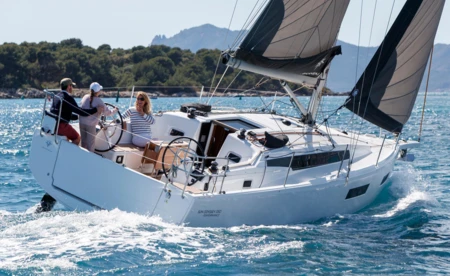
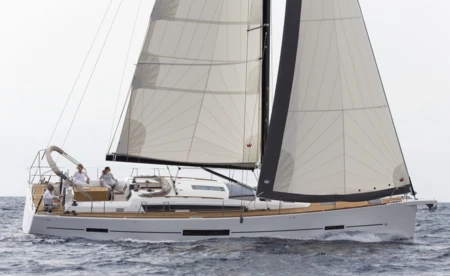
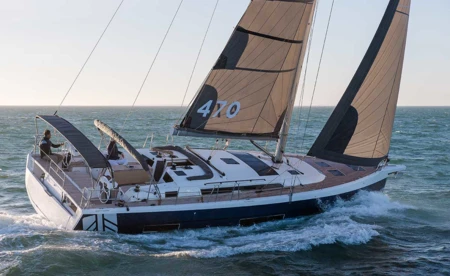
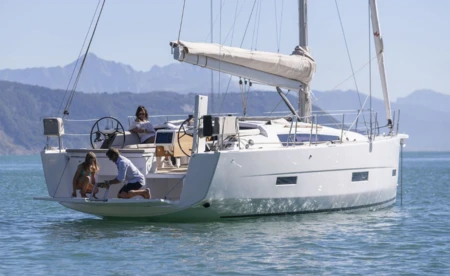
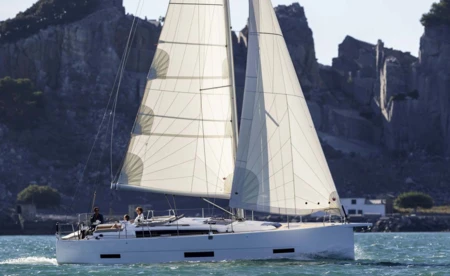
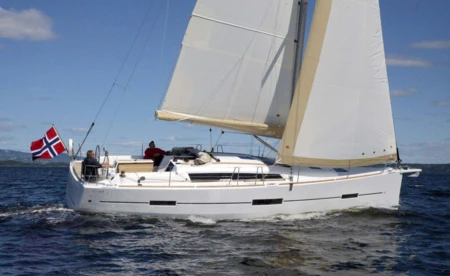
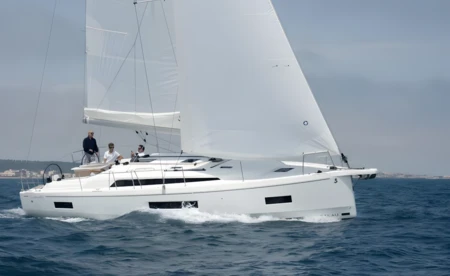
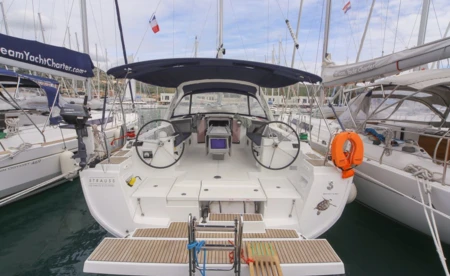
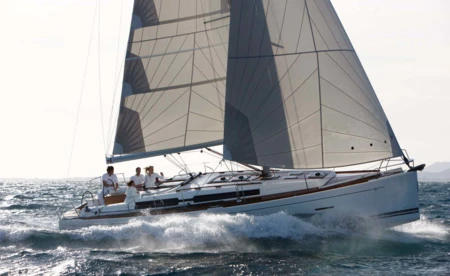
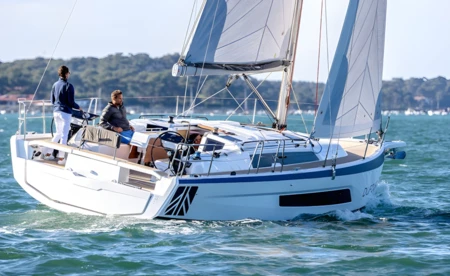
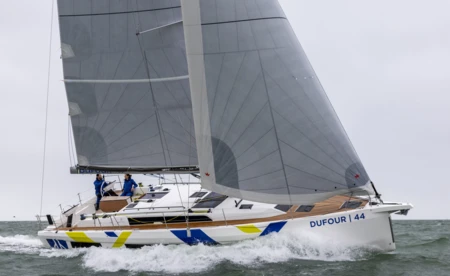
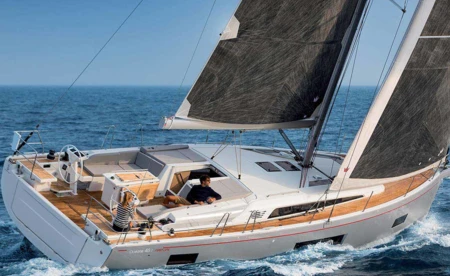
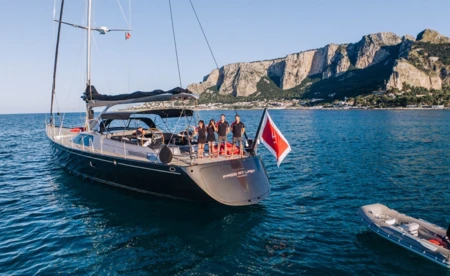
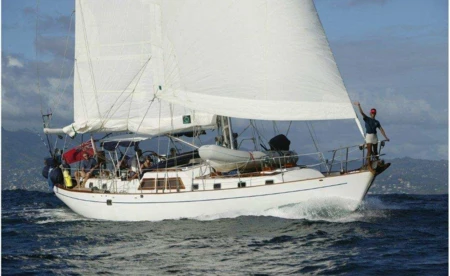
- A monohull yacht charter: the best balance of budget and sailing pleasure. With 15 to 20 knots of trade wind on a broad reach, the passages to Les Saintes or Marie-Galante take three to four hours on a single tack, without a gybe. Expect two to five cabins depending on the model, from the Dufour 37 to the Dufour 520 GL. Experienced crews who come mainly to sail choose this option.
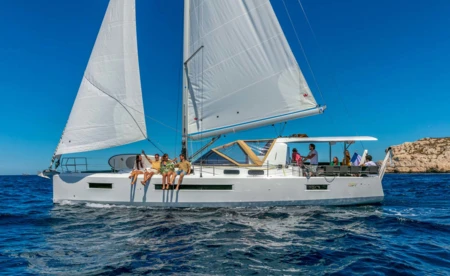
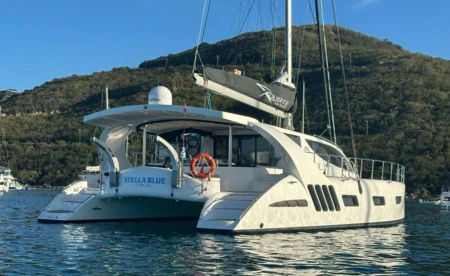
- A catamaran charter in Guadeloupe: twice the living space and a shallow draught of 1.20 to 1.40 m, against 1.90 to 2.20 m on a monohull of comparable length. That difference opens up the shallow anchorages of Petite Terre and the Grand Cul-de-Sac Marin, where you drop the anchor in 2 to 3 m of water. A catamaran does not roll at anchor, which transforms nights aboard once the easterly swell works into the bays. Budget 50 to 60 per cent more than a monohull of the same length.
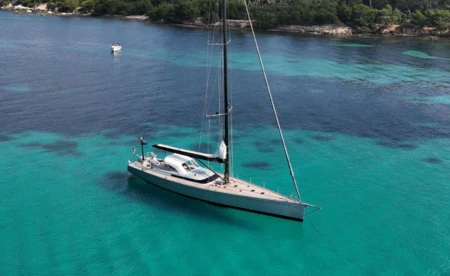
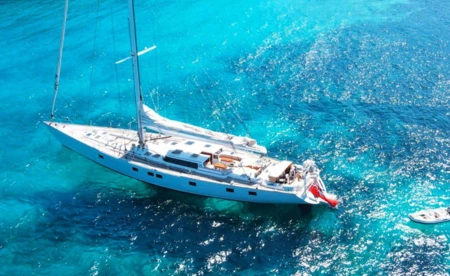
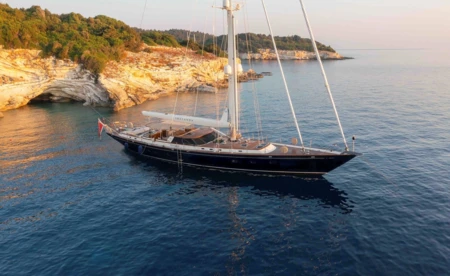
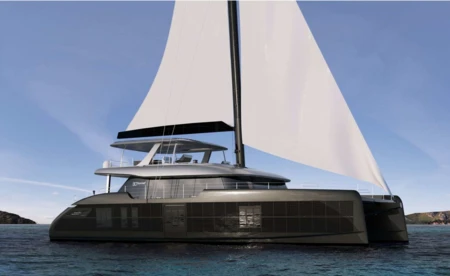
- A luxury yacht charter in Guadeloupe: above 18 m the yacht comes with her own crew, captain, cook and sometimes a deckhand.
| Criterion | Monohull | Catamaran |
|---|---|---|
| Weekly budget (high season) | €2,200 to €5,500 | €6,500 to €9,500 |
| Draught | 1.90 m to 2.20 m | 1.20 m to 1.40 m |
| Comfort at anchor | Noticeable roll in exposed bays | Stable platform, no roll |
| Feel under sail | Heel, a lively boat, proper downwind sailing | Level sailing, less demanding |
| Anchorages within reach | Standard bays and mooring buoys | Access to lagoons and shallows |
| Best suited to | Sailing crews, controlled budget | Families, two couples, non-sailors aboard |
Charter options available in Pointe-à-Pitre
Four options run side by side on this destination, from a fully private yacht you skipper yourself to a single cabin aboard a crewed catamaran. Your sailing experience and your budget per head decide which one fits:
- Bareboat charter: you are the skipper and the yacht is entirely yours. You will need genuine experience on a yacht of similar size, set out in a sailing CV approved before departure. This remains the cheapest and the freest option.
- Skippered charter: a professional who sails the area takes the helm. Beyond the comfort, the real value is local knowledge: he knows which anchorage holds in a settled easterly, where the seabed is still healthy, and what time to cross the Saintes channel. Reckon on €200 to €250 a day, plus his food.
- Crewed charter: skipper, hostess and cook. The crew comes as standard on larger yachts and as an option on some catamarans of 12 to 20 m. Our crewed and luxury yacht specialist handles these enquiries directly.
- Cabin charter: you book a cabin aboard a catamaran run by a professional crew and share the yacht with other travellers. The right answer if you are sailing as a couple, or if chartering a whole yacht is beyond your budget. Explore our Guadeloupe cruises.
What does a yacht charter in Pointe-à-Pitre cost?
Mind the Caribbean calendar: it runs opposite to the Mediterranean. High season falls in the European winter, when the archipelago is in its dry season. The table below gives an order of magnitude for one week's charter out of Pointe-à-Pitre.
| Type of yacht | High season December to April | Shoulder season May, June and November | Low season July to October |
|---|---|---|---|
| Monohull (2 cabins) | €2,200 | €1,700 | €1,300 |
| Monohull (3 cabins) | €3,000 | €2,200 | €1,500 |
| Monohull (4 cabins) | €4,000 | €2,900 | €2,000 |
| Monohull (5 cabins and over) | €5,500 | €4,000 | €2,800 |
| Catamaran (38 to 42 ft) | €6,500 | €4,500 | €3,000 |
| Catamaran (43 to 50 ft) | €9,500 | €6,500 | €4,200 |
Rates move with the year of the yacht, the operator and how early you book: over Christmas and February half-term the best yachts go a year ahead. Low-season deals, on the other hand, regularly drop below €1,300 a week, three-cabin monohulls included. The average price shown at the top of this page mixes every category, crewed yachts included, so it sits far above the rate of a standard cruising yacht.
Included in the price: the yacht and her full cruising inventory, sails, tender and outboard, bedding, galley equipment and navigation electronics.
Not included: the end-of-charter package (final clean, linen, gas), tourist tax, provisioning, mooring and harbour fees on the other islands, extras (paddleboard, watermaker and so on) and the skipper if you take one.
We recommend our cancellation insurance: it covers every member of the crew, whereas an individual policy or your bank card cover protects the holder alone. Between a transatlantic flight and a share of the yacht, each crew member often commits more than €1,500, so the difference in cover adds up quickly.
Damage deposit insurance is the other sensible reflex in this area, where deposits often run between €2,500 and €5,000. If you suffer damage while sailing, you recover most of it.
Where to sail from Pointe-à-Pitre
The real appeal of this base is the variety of islands within a few hours' sailing:
- Les Saintes, some 20 nm to the south, three to four hours on a broad reach. Terre-de-Haut and its listed bay, Terre-de-Bas, the anchorages off Pain de Sucre and in Anse à Cointe. An essential stop, ideally on a mooring buoy.
- Marie-Galante, to the south-east: 20 nm as the crow flies, 25 nm via the southern exit of the Petit Cul-de-Sac Marin, so four to five hours. The island of a hundred windmills, its rum distilleries and La Feuillère beach. The anchorage off Saint-Louis is the best sheltered.
- Petite Terre and La Désirade, to windward of the archipelago. A nature reserve, iguanas, turtles and a lagoon of rare clarity, anchoring in 2 to 3 m. The passage is close-hauled in the trade wind, so leave early and keep an eye on the current.
- The leeward coast of Basse-Terre, from Malendure to Deshaies. The Cousteau reserve, the Pigeon islets, volcanic seabeds and flat water. A rest day in any itinerary, provided you accept the wind shifts along the mountains.
- Dominica and Antigua, for self-sufficient crews with ten days or more. Reckon 22 nm from Les Saintes to Portsmouth and about 40 nm from Deshaies to Jolly Harbour. Leaving the area means clearing customs and getting the operator's prior approval.
A seven-day sailing itinerary from Pointe-à-Pitre
This one-week loop stays in French waters, with no formalities and legs of three to four hours:
- Day 1: board at Marina Bas-du-Fort in the late afternoon, provision and spend the night alongside.
- Day 2: Bas-du-Fort → Terre-de-Haut, Les Saintes (22 nm, 3 to 4 hrs on a broad reach).
- Day 3: around Les Saintes, anchoring off Pain de Sucre or Terre-de-Bas.
- Day 4: Les Saintes → Saint-Louis, Marie-Galante (16 nm close-hauled, 3 hrs).
- Day 5: a day on Marie-Galante, distilleries and Anse Canot, or the crossing to Petite Terre (17 nm close-hauled) on a reserve mooring buoy, subject to availability and the rules in force.
- Day 6: downwind back to Sainte-Anne or Îlet du Gosier (20 nm, 3 hrs) for a last swim.
- Day 7: back into Marina Bas-du-Fort (5 nm) and disembarkation.
Once Les Saintes are behind you, the loop runs with the wind. If the trade wind tops 20 knots, the leeward Basse-Terre variant is more comfortable.
When to sail from Pointe-à-Pitre
The cruising season runs from December to May, the dry season known locally as the carême: a steady trade wind, clear skies and a sea at 26 °C or above. Christmas, February half-term and Easter concentrate demand, with fleets fully booked. June and November remain excellent months, quieter and cheaper. Hurricane season officially runs from 1 June to 30 November, with the peak risk in August and September: from July to October part of the fleet is laid up and the yachts still available are offered at reduced rates with specific weather clauses.
Average temperatures recorded in Guadeloupe over recent years:
| Temperatures | Jan | Feb | Mar | Apr | May | Jun | Jul | Aug | Sep | Oct | Nov | Dec |
|---|---|---|---|---|---|---|---|---|---|---|---|---|
| Air min (°C) | 20 | 19 | 20 | 21 | 22 | 23 | 23 | 23 | 23 | 23 | 22 | 21 |
| Air max (°C) | 29 | 29 | 29 | 30 | 31 | 31 | 31 | 32 | 32 | 31 | 30 | 29 |
| Sea (°C) | 27 | 26 | 26 | 27 | 28 | 28 | 29 | 29 | 29 | 29 | 28 | 27 |
The sea never drops below 26 °C: a full wetsuit is unnecessary all year, and a shorty is enough for repeated dives.
Sailing conditions in the Guadeloupe archipelago
The trade wind blows from east to north-east with remarkable consistency, 15 to 20 knots. From January to March it can build to 25 knots in clean but predictable gusts. The sailing is muscular and rewarding, a long way from Mediterranean breezes: you genuinely sail, with one reef in and sometimes two.
Three local features to take on board before you leave:
- The inter-island channels, notably the Saintes channel and the Dominica channel, accelerate the wind and throw up a short cross sea. These are the most demanding stretches of any itinerary, so sail them in the morning.
- The mountains of Basse-Terre blanket the west coast for several miles. You will alternate between dead calm and gusts falling off the peaks, which means motoring or paying close attention to trim.
- The easterly swell works into exposed anchorages and wears out nights aboard, especially on a monohull. The mooring buoys off Les Saintes and along the leeward coast are far preferable, and often compulsory in protected zones.
Paperwork for a bareboat charter in Pointe-à-Pitre
Guadeloupe applies French regulations, under which no licence is legally required to skipper a sailing yacht. In practice every operator in Pointe-à-Pitre asks for a coastal licence — an ICC or RYA Day Skipper for British sailors — and above all a sailing CV documenting practice on a yacht of similar size. If the base manager judges your level insufficient at the briefing, he can insist on a professional skipper at your expense.
One point that is easily overlooked: a coastal licence becomes compulsory to drive the tender as soon as its outboard exceeds 6 hp (4.5 kW). On most cruising yachts the tender carries between 5 and 15 hp, so check the power on the inventory.
Also worth preparing:
- a passport for every crew member, essential if you plan to visit Dominica or Antigua;
- the full crew list, to be sent before departure;
- an SRC VHF certificate if you want to use the radio by the book: operators do not require it, but it is recommended;
- an offshore qualification for larger yachts and demanding passages, depending on the operator's terms.
Useful information for your charter in Pointe-à-Pitre
How much does a yacht charter in Pointe-à-Pitre cost?
From €1,300 a week for a two-cabin monohull in low season to €9,500 for a 43 to 50 ft catamaran in high season. A four-cabin monohull, the most requested format, sits around €4,000 in high season and €2,000 in low season. On top of that come the end-of-charter package, provisioning and harbour fees on the other islands.
Do you need a licence to charter a yacht in Guadeloupe?
No, French law requires no licence to skipper a sailing yacht, Guadeloupe included. In practice, operators in Pointe-à-Pitre ask for a coastal licence or ICC and a sailing CV proving your experience. Without enough experience, a skippered charter is the answer: the professional sails and no paperwork is asked of you.
Which is the best month to sail in Guadeloupe?
February and March offer the best conditions: a settled trade wind of 15 to 20 knots, air at 29 °C and very little rain. They are also the busiest months. For the same climate with fewer yachts about and lower rates, aim for May, June or November.
Monohull or catamaran in Guadeloupe: which should you choose?
The monohull to sail, with a budget 50 to 60 per cent lower and real sensation on a broad reach in the trade wind. The catamaran to live aboard: no roll at anchor, twice the space and a 1.20 m draught that opens up the lagoons of Petite Terre and the Grand Cul-de-Sac Marin. With children or non-sailors aboard, the catamaran makes the difference.
How long does it take to reach Les Saintes from Pointe-à-Pitre?
Reckon 20 to 22 nm from Marina Bas-du-Fort, three to four hours on a broad reach. Crossing the Saintes channel is the liveliest part: the wind accelerates and the sea runs across. Set off in the morning.
How do you get to Pointe-à-Pitre?
Guadeloupe Pôle Caraïbes airport (PTP) is served by direct flights from Paris; from the UK you travel with one connection in Paris. The marina is under four miles away, a quarter of an hour by taxi. Guadeloupe is four hours behind the UK in winter and five hours behind in summer.
What currency and language in Guadeloupe?
The currency is the euro (€), with cards accepted everywhere and cash machines in town. French is the official language and Guadeloupean Creole is spoken day to day. Check your mobile tariff before you leave, as Guadeloupe is not always included in UK roaming bundles.
Are there formalities when moving between islands?
None for Les Saintes, Marie-Galante, La Désirade and Petite Terre, all French territory. Yes for Dominica and Antigua: clearance in and out, entry fees payable locally, and prior approval from your operator, whose contract defines the sailing area.
How far ahead should you book?
For Christmas and February half-term, availability is settled 9 to 12 months out. For a departure in May, June or November, four to six months is usually enough.
How is the booking finalised with Filovent?
Once you enquire, an adviser calls to understand the plan: the crew's level, who is aboard, the itinerary you have in mind. He then sends a selection of available yachts with current rates. When your choice is made, a deposit paid through your client area holds the yacht, and our concierge team takes over until you are home.
Can you charter a yacht for a single day in Pointe-à-Pitre?
The standard format remains the week, Saturday to Saturday, in line with base turnarounds. Day sails and charters of three to five days exist on part of the fleet, outside the school holidays.
Good to know
| Number of available boats | 35 |
|---|---|
| Services types | Skipper, Hostess, Chef, Sailor |
| Average price per week | 12 864 € |
| Minimum price per week | 1 220 € |
| Maximum price per week | 112 000 € |