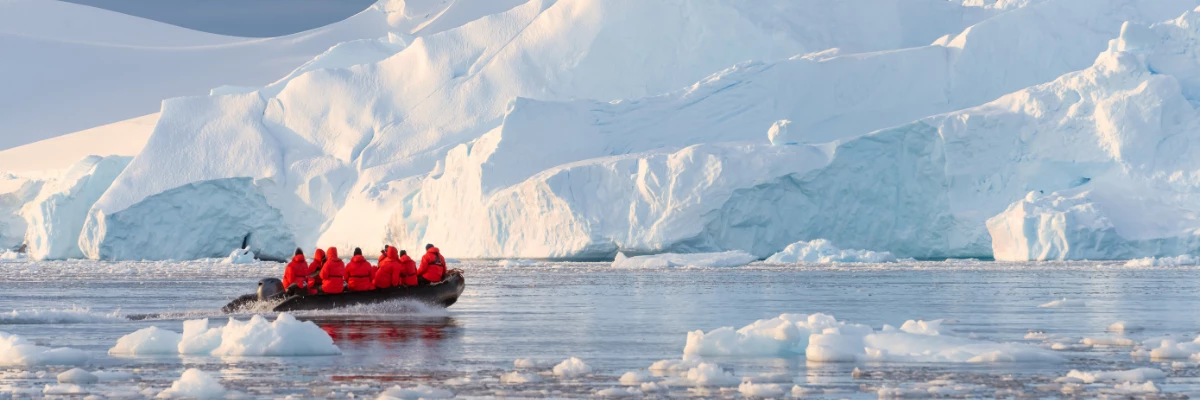
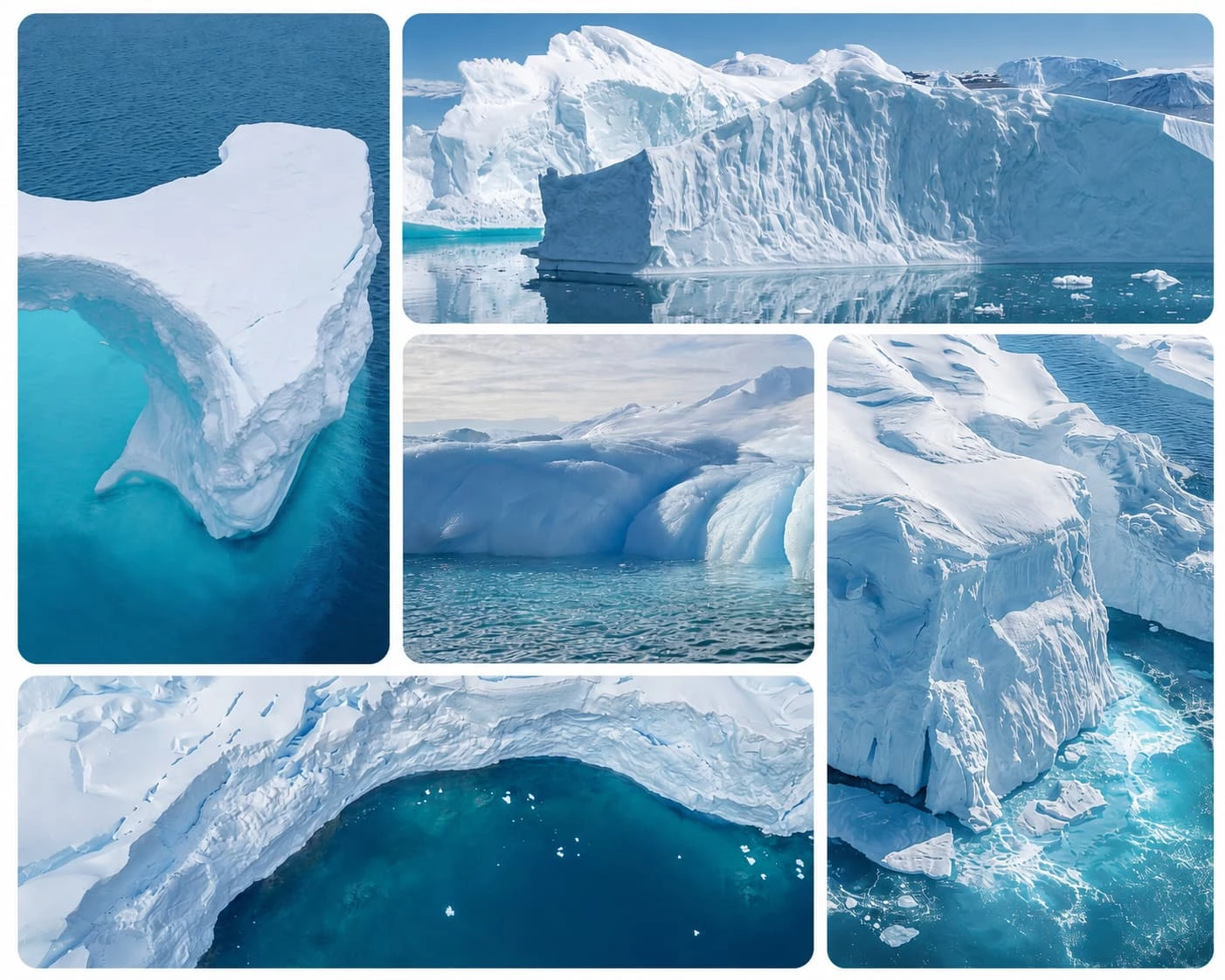
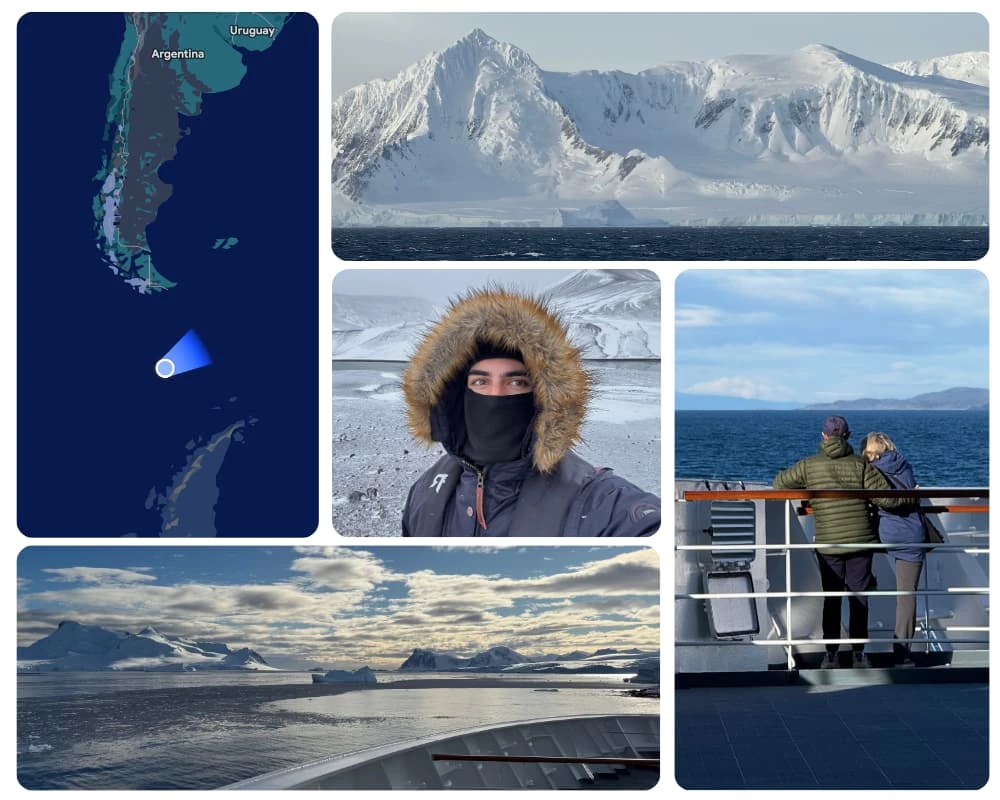
"There's a blue out there that you don't see anywhere else in nature, a blue full of nuances that is characteristic of Antarctic landscapes" mentions Théo, advisor at Filovent, about what he observed during his exploration cruise in the southern polar circle. Indeed, if his trip to Antarctica had to carry one color, it would be this incomparable light blue, born from the reflection of the sun on the water and the icebergs.
In this article, I retrace his journey day by day: six days in Chile as a warm-up, crossing the Drake Passage, the descent below the polar circle to Marguerite Bay, a storm with 90 km/h winds, then the return north to the Falkland Islands and their penguin colonies.
Summary
- 1. An expedition cruise to Antarctica: what to expect
- Life on board
- A cruise designed for travelers seeking adventure
- Temperature, season and equipment
- Discoveries and learning
- 2. 22-day itinerary in Antarctica, from Chile to Argentina
- Days 1 to 5: the pre-tour in Chile
- Day 6: Ushuaia and the Beagle Channel
- Days 7 to 8: Cape Horn and the Drake Passage
- Day 9: Marguerite Bay → Adelaide Island by zodiac
- Day 10: King George VI Sound
- Day 11: Stonington Island
- Days 12 to 14: Thurston Island, the Bismarck Strait and the Melchior Islands
- Day 15: Deception Island
- Days 16 to 17: the storm and the return north
- Day 18: Falkland Islands
- Days 19 to 22: post-tour in Argentina
- 3. Why choose Antarctica?
An expedition cruise to Antarctica: what to expect
Life on board
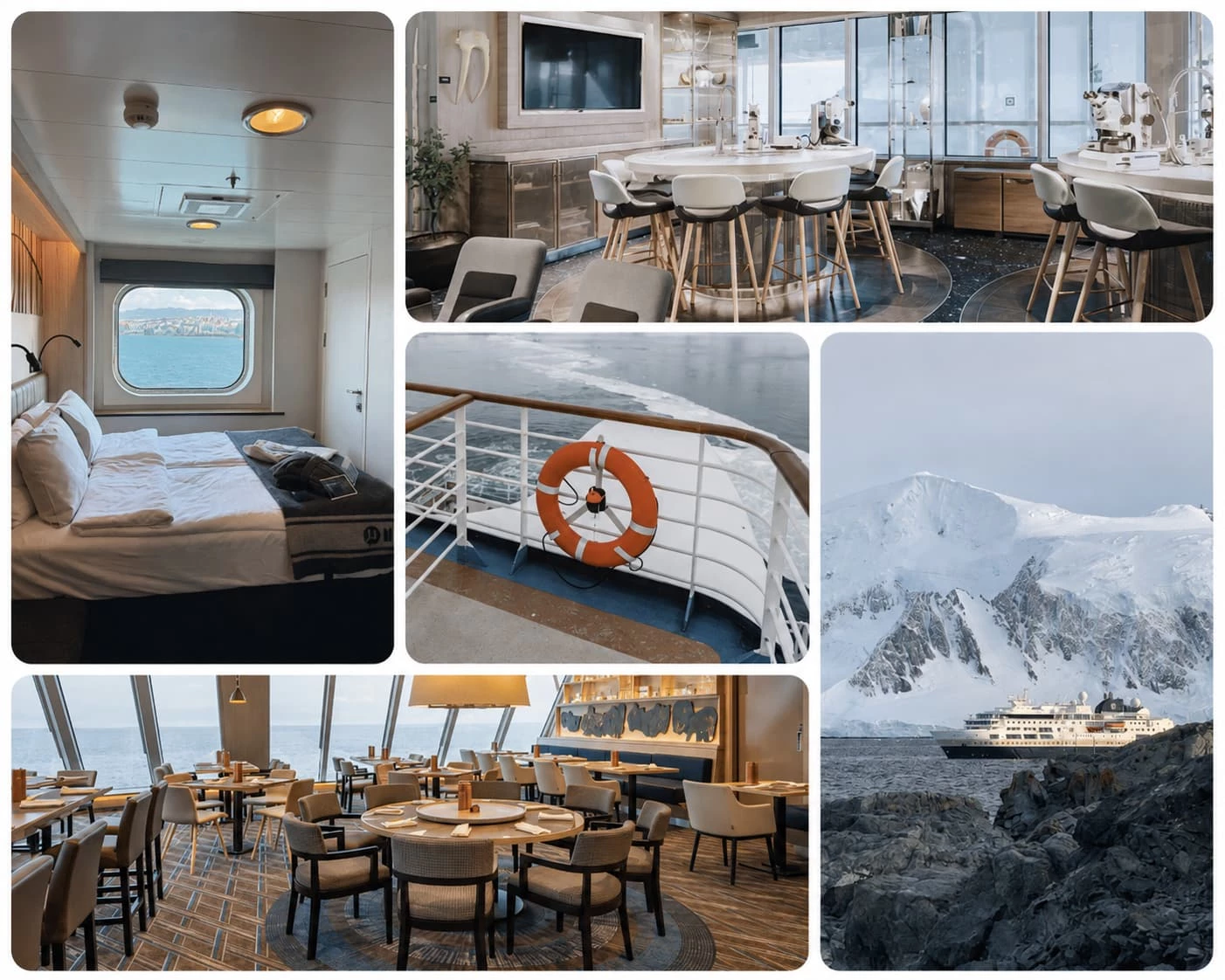
Fully renovated in 2024, the ship has comfortable, bright cabins. But what strikes you first is the attentiveness of the crew, very attuned to everyone's habits: the table you like to sit at, the drink you order when you get back from an outing... The team is deeply multicultural, with seven French speakers on board, but also Portuguese, Mandarin and Spanish, and an expedition team recruited from all corners of the world.
The cuisine follows the same standard of excellence. Nothing frozen: everything is prepared with care on board, and touring the kitchens is part of the program. "Foodies should watch out" notes Théo, underlining the quality of the dishes on offer.
Over the days, a particular rhythm sets in. Between two expeditions, the ship becomes a cocoon: you leave behind the cold, the wind and the salt, and rediscover the warmth, the set table and the collective retelling of what everyone just saw. This constant contrast between the raw outdoors and the cozy interior is one of the hallmarks of a polar cruise.
A cruise designed for travelers seeking adventure
A polar expedition can't be compared to any other kind of sailing. Here, nothing is guaranteed in advance: the weather dictates the program, landings are decided day by day, and the itinerary truly takes shape along the way. Théo, whose route initially covered only the northern tip of the peninsula, was ultimately able to sail its entire length.
The setting imposes its own rules right from the start. The Drake Passage, between Cape Horn and the peninsula, is considered the roughest stretch of sea on the globe. Further south, the expedition weathered a storm: winds of 90 km/h, 10-meter swells. "If something serious happens, the only possible rescue is by helicopter. You quickly realize where you are."
It's precisely this spirit of adventure that gives the trip its value. You sail as close as possible to the elements, in an isolation few destinations still offer, with the constant awareness of moving through an environment that tolerates no room for error.
Temperature, season and equipment
The sailing season runs from November to March, as the austral winter is impassable. Théo left in March, at the very end of the season. The thermometer dropped to -9 °C, with a wind chill close to -24 °C. Yet he was never cold, without investing in expensive gear: waterproof pants, a second-hand down jacket and thermal clothing from a budget brand were all he needed.
| Marker | Recorded data |
| Total trip duration | 22 days, including the Chilean pre-tour and Argentine post-tour. Beyond the cruise, Théo's trip extended to nearly a month and a half. |
| Sailing season | From November to March |
| Temperatures observed | -9 °C, wind chill down to -24 °C |
| Time to cross the Drake Passage | 2 and a half days from Cape Horn |
| Southernmost point reached | Beyond the Antarctic polar circle, 66°33' S |
| Extreme conditions encountered | Winds of 90 km/h, 10-meter waves |
Discoveries and learning
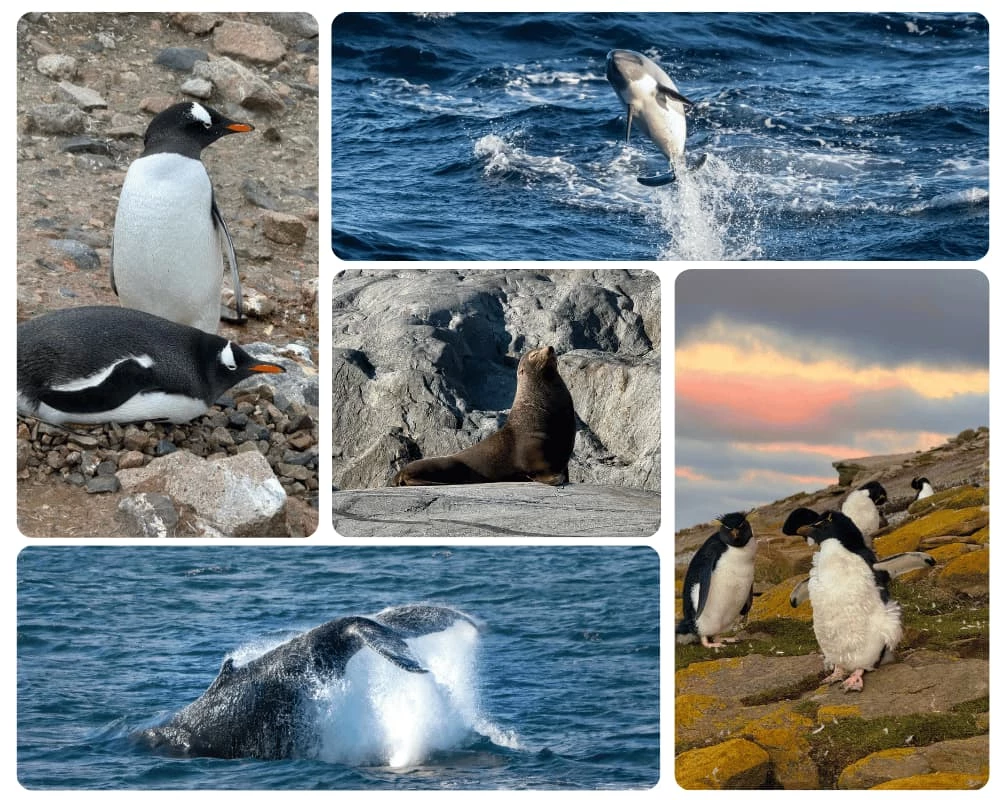
Each day is built around excursions. These outings, almost daily, offer the most direct contact with the environment: gliding just above the water, between ice floes, just meters from colonies and resting seals. They are prime moments to observe up close the animals of the South Pole found on the pack ice. No landing is ever quite like the last, and the ship deliberately moves slowly to limit its impact on wildlife.
The other side of the discovery unfolds on board with a series of lectures on subjects related to the cruise: glaciology, iceberg formation and drift, seabirds, polar mammals, wind patterns. Some passengers actually board for this very reason. The group included several scientists and naturalists, alongside travelers of all ages from Australia, Britain and Germany. You don't just look at the landscape: you learn to read it.
22-day itinerary in Antarctica, from Chile to Argentina
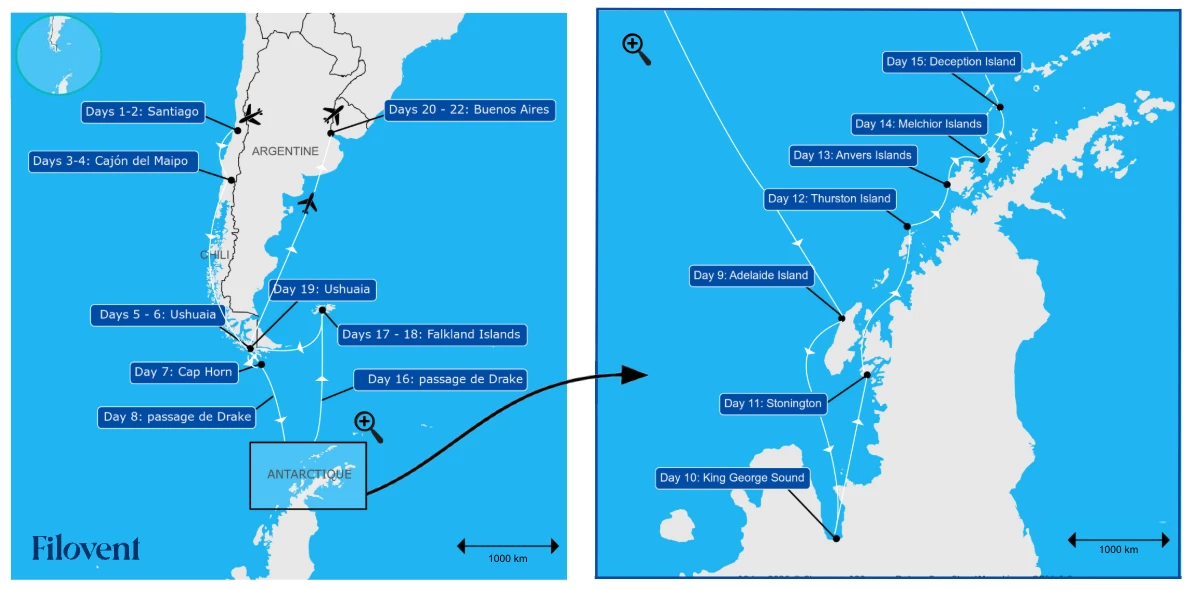
The itinerary of a polar expedition is never fixed. The original plan covered only the northern tip of the peninsula; conditions ultimately allowed for sailing its entire length, well beyond the polar circle. Here is the route Théo followed, having departed on March 15, 2026.
Departure from Santiago, Chile
Days 1 to 5: the pre-tour in Chile
Day 6: Ushuaia → Beagle Channel (embarkation)
Days 7 and 8: Cape Horn and the Drake Passage
Day 9: Marguerite Bay → Adelaide Island by zodiac
Day 10: King George VI Sound
Day 11: Stonington Island
Days 12 to 14: Thurston Island, the Bismarck Strait and the Melchior Islands
Day 15: Deception Island
Days 16 and 17: Storm and return north
Day 18: Falkland Islands
Days 19 to 22: post-tour in Argentina
Return from Buenos Aires
Days 1 to 5: the pre-tour in Chile
The trip begins in Chile, six days before embarkation. The standout stop of this opening stretch is Cajón del Maipo, an Andean valley carved out southeast of Santiago, which Théo visited on March 19. The steep walls and glacial waters evoke the Scandinavian fjords, though with a much milder climate. This acclimatization stage also allows time to recover from jet lag before the physical demands of the days ahead.
Day 6: Ushuaia and the Beagle Channel
Embarkation in Ushuaia, at the tip of Argentine Tierra del Fuego. The ship enters the Beagle Channel, the strait separating the main island of Tierra del Fuego from the southern islands. Hanging glaciers, austere forests, colonies of birds and pinnipeds: the scenery already sets the tone, without hinting at what will unfold further south.
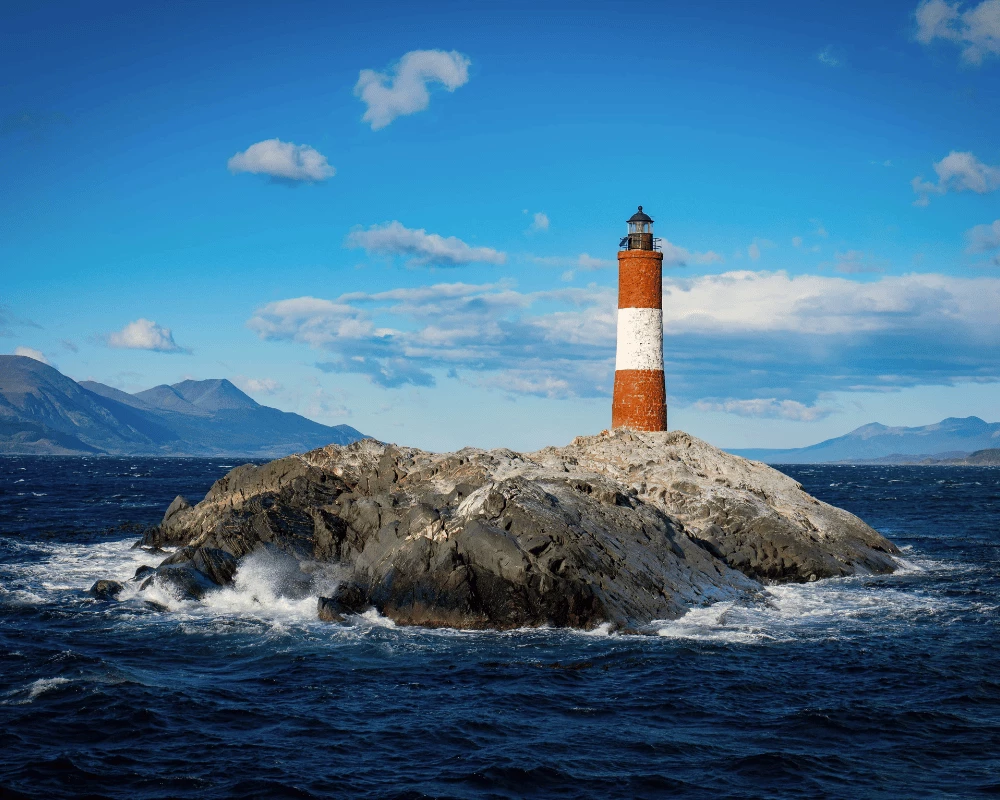
Days 7 to 8: Cape Horn and the Drake Passage
The ship rounds Cape Horn, then enters the 800 kilometers of the Drake Passage. Two and a half days separate the cape from the peninsula. This stretch at sea, often dreaded, turns here into full immersion: back-to-back lectures, watch on the outer decks, first albatrosses and first whales. Something else sets in too: the light changes, the horizon empties, and familiar reference points disappear one by one.
Day 9: Marguerite Bay → Adelaide Island by zodiac
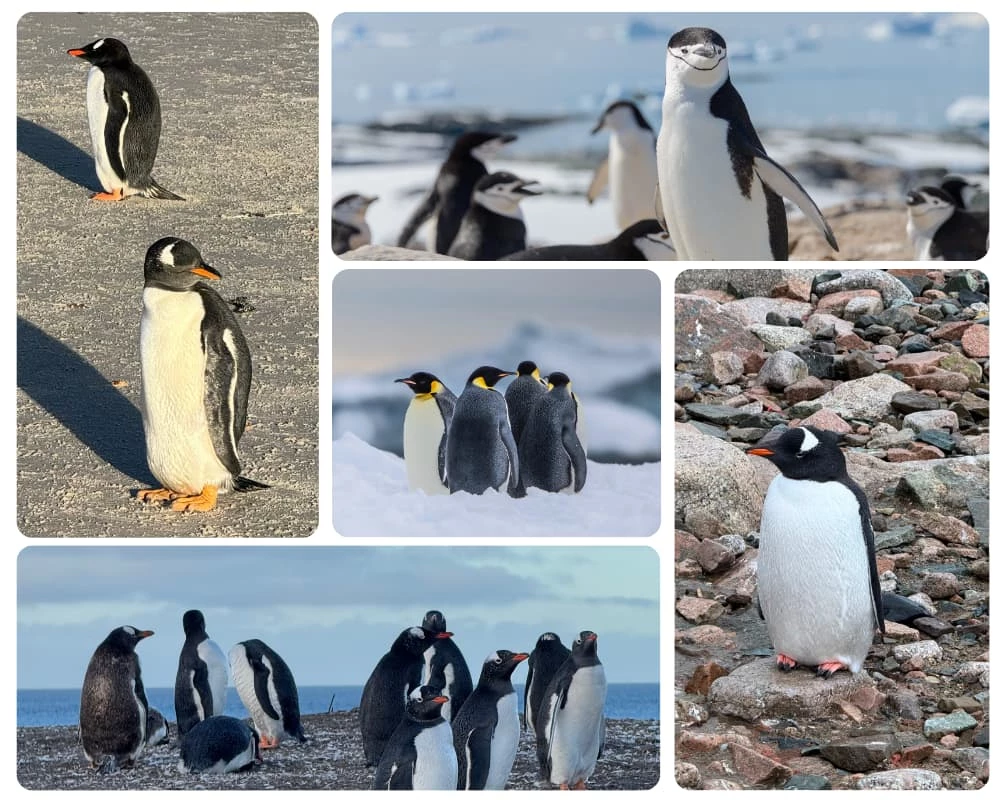
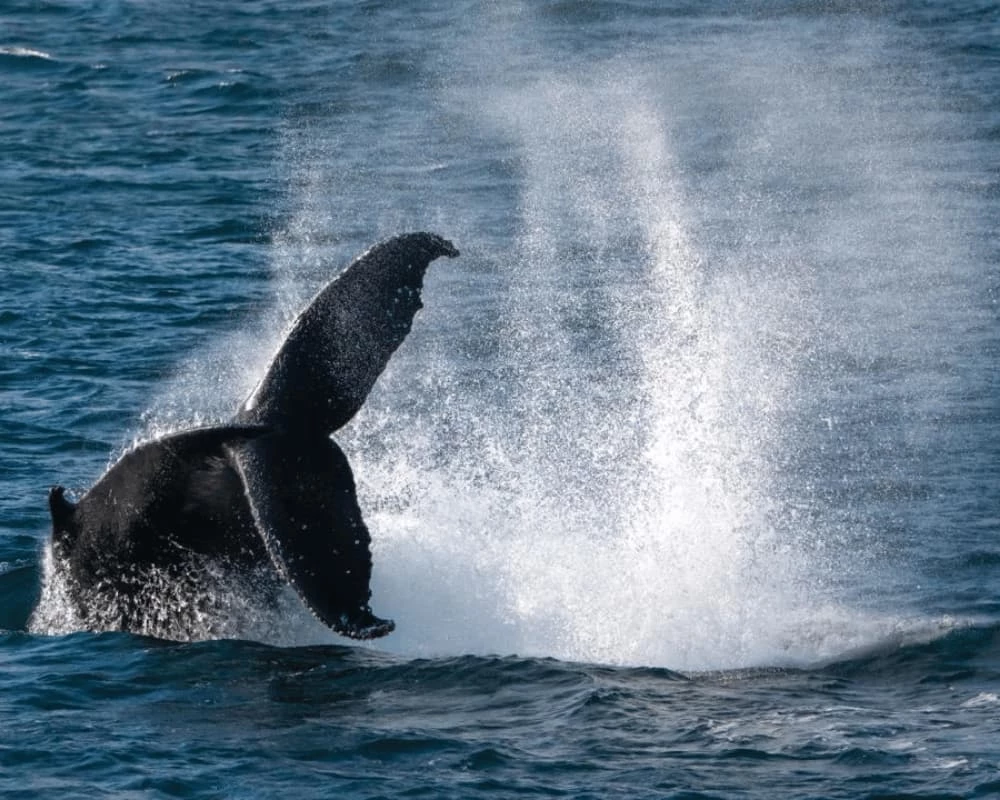
First landing south of the polar circle: Tutton Point. This rocky headland, set at the southwestern tip of Liard Island (off Adelaide Island), marks the entrance to a natural passage that pushes into the icy interior of the island, like a door carved into rock, opening onto a world of ice. Here, Théo makes his first zodiac outings and enjoys total immersion in nature, observing up close the animals present on the pack ice. From the very first steps on shore, the wildlife reveals itself: humpback whales cut through the water offshore, fur seals occupy the rocks, while crabeater seals and Weddell seals lounge on the ice. A little further on, a colony of chinstrap penguins completes this striking picture of southern biodiversity.
Day 10: King George VI Sound
Course set for King George VI Sound, this long, ice-bound strait separating Alexander Island from Palmer Land. It's the most remote point of the entire crossing, a place where you fully grasp the vastness and silence of the white continent. Here, the network signal remains surprisingly available, but it hardly matters: Théo is firm about the sense of disconnection this trip brought, even with Internet access working. Far from everything, facing this icy expanse stretching as far as the eye can see, you don't just cut yourself off from the world: you rediscover yourself, in a kind of silent communion with nature.
The King George VI Sound area delivers two remarkable encounters: humpback whales at the surface, and above all a group of adult emperor penguins. A rare sighting that some naturalists wait an entire decade to witness. "Several passengers were crying. They were enthusiasts who hadn't seen this in 10 years."
Day 11: Stonington Island
Stonington Island carries a singular history. It was here, during the 1947-1948 overwintering, that Americans Edith Ronne and Jennie Darlington became the first two women to spend a full winter on the Antarctic continent. The remains of the polar bases (wooden buildings, huts and old equipment frozen in place) are still visible, silent witnesses to that era. A colony of Adélie penguins now occupies the shores of the island.
The afternoon continues at Red Rock Ridge, a red rock crest that stands out against the surrounding whiteness and towers over the pack ice. The site offers a spectacular view over the strait, and allows for close approach to resting Weddell seals, peacefully stretched out on the ice.
Days 12 to 14: Thurston Island, the Bismarck Strait and the Melchior Islands
The Bismarck Strait is one of the major passageways of the peninsula, used by both scientific vessels and expedition ships. People come here for the density of icebergs and for the polar wildlife, in a narrow corridor between the islands where light reflects off the icy walls. The crossing passes through "the Gullet," a narrow and spectacular channel wedged between Adelaide Island and Palmer Land, where the icy walls close in so tightly that it feels like sailing through the very heart of the pack ice. At this point in the cruise, Théo takes advantage of the guides' expertise to learn more about the geography of the part of Antarctica he is crossing.
Further on, passengers land at the Melchior Islands, which offer a sheltered anchorage, surrounded by grounded icebergs and steep rocky walls. Here, gentoo penguins and chinstrap penguins can be observed, bringing life to these narrow passages between ice and sea.
Day 15: Deception Island
Deception Island, in the South Shetlands, is a volcanic caldera whose one side collapsed, letting the sea flood into the crater. The result is a lunar landscape, almost surreal in this polar setting: black ash beaches, still-visible fumaroles in places, remnants of an old whaling station worn down by time. The landing takes place on these black-earth coves, rather than on pack ice, making it a place apart, almost foreign, in a journey otherwise dominated by polar white.
Théo remembers, above all, a demanding hike, deep into a snow-covered mountain: steep slope, strong wind, continuous effort all the way to the summit. One of the most physically demanding shore excursions of the trip, but also one of the most rewarding, with a sweeping view over the caldera and the ocean surrounding it.
Days 16 to 17: the storm and the return north
The ship heads back north along the peninsula in rough conditions: 90 km/h winds, 10-meter swells. The ship pitches, the sea slams hard against the hull, but at no point does the situation feel frightening: the crew, well accustomed to this type of condition, handles the crossing with calm and skill. A day without landings, then, devoted to lectures and watching from the sheltered decks, where you can follow the swell and the sea spray in complete safety.
This kind of episode illustrates well the basic rule of polar navigation: the weather decides, and the itinerary follows. A reminder that Antarctic adventure is never entirely written in advance, and that you have to work with the whims of the far south.
Day 18: Falkland Islands
Two days of sailing northeast lead to the Falkland Islands, an isolated archipelago whose population lives very far removed from the rest of the world. This is where the most powerful moment of the trip takes place: on an island covered in macaroni penguins, Théo witnesses a migration in progress, from three meters away, without any contact, in accordance with wildlife approach rules. King, Magellanic, chinstrap and gentoo penguins complete the picture.
Days 19 to 22: post-tour in Argentina
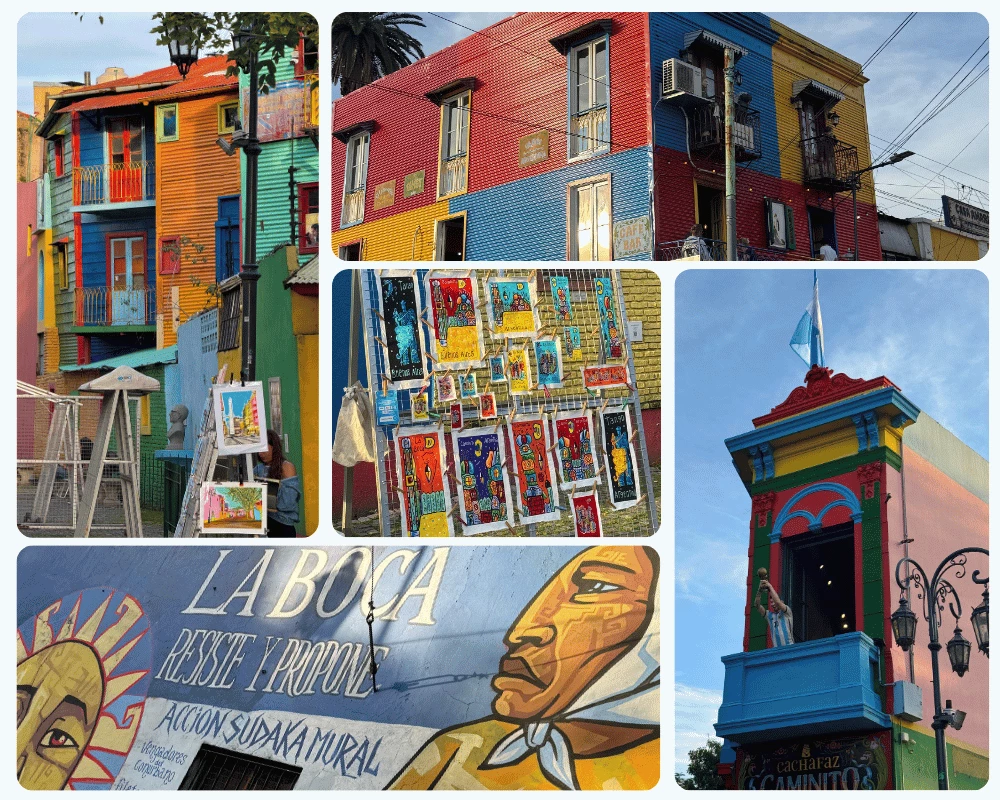
The end of the expedition and a return to continental life, with five days in Buenos Aires as a post-tour. The contrast is stark after three weeks of silence, wind and ice. Théo comes away with a clear conviction: Antarctica is unlike any of his previous voyages, in Egypt, Norway or on the rivers of Europe.
Why choose Antarctica?
The choice of destination was no accident. Théo settled on it for five reasons, which he sums up as follows:
- Unrivaled landscapes: scenery found on no other continent, and a palette of blues unique to polar ice.
- An original destination: few travelers reach it, making it a genuinely rare experience.
- A narrow window: the season is limited to five months, from November to March, and most travelers only go once in a lifetime.
- Total isolation: the feeling of being at the end of the earth, with no one else around, that few destinations still offer.
- A possibly time-limited opportunity: nothing guarantees this type of trip will remain possible under the same conditions in the future.
A few unforgettable memories
- The adult emperor penguins: a sighting some specialists wait ten years for, and one that brought several passengers to tears.
- The macaroni penguin migration: witnessing an entire colony on the move, from three meters away, without ever interfering.
- The blue of the icebergs: "Dozens of shades, and not a single one that exists anywhere else in nature."
- The zodiac outings: the best way to get close to the ice and wildlife, with a different landing every day.
- The Deception Island hike: a demanding climb through the snow, at the heart of a volcanic caldera flooded by the sea.
- The calm of the Drake Passage: crossing the roughest stretch of sea on the globe in peaceful conditions, before encountering the storm much further south.
Want to experience the same adventure?
Thinking about setting off on an Antarctica cruise, between emperor penguins, icebergs and zodiac landings? Our advisors, who have themselves sailed these waters, work with you to fine-tune the duration, the season and the level of intensity of the route.
Acknowledgments
A big thank you to Théo for the time he devoted to this interview, and for the images and memories he agreed to share to help tell this story!