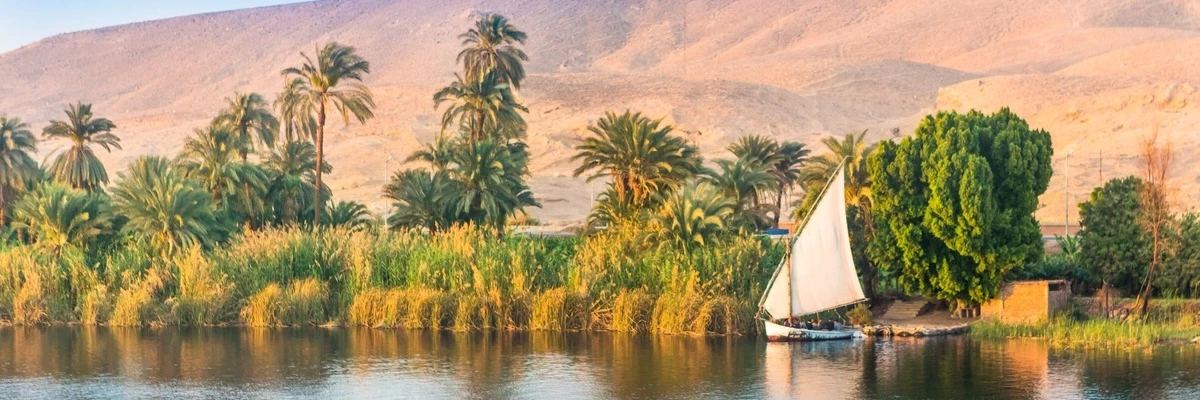
“Discovering the Nile aboard a dahabiya full of Egyptian charm, almost privatised for our family, with a crew at our every beck and call, is without doubt one of my finest journeys.” This is how Marie, a former Filovent adviser, sums up her twelve days in Egypt with her family. Four of them took place aboard the Amoura, a dahabiya that links Aswan to Esna at the mercy of the wind. Setting course for April 2026: while Europe still wavers between spring and winter, Marie takes her loved ones on a programme that brings together everything Egypt does best. April is, moreover, one of the best times to set off for Egypt: mild temperatures before the summer heat, sites that are still uncrowded, and golden light ideal for photos. On the agenda for these twelve days: the pyramids the moment you step off the plane, Abu Simbel at dawn, then a leisurely journey up the Nile under lateen sails. The trip ends with Karnak and the Valley of the Kings, before a few beachside days near the Red Sea to unwind. If you were wondering what a Nile cruise aboard a small boat might be like, here is an account that should shed some light.
In this article, I take you in the footsteps of Marie and her family, from the bustle of Cairo all the way to the reefs of the Red Sea, by way of the Nile's peaceful branches and the major sites of Upper Egypt. Before setting off, it's worth checking the latest Egypt travel advice to prepare your trip with peace of mind.
A cruise aboard the Amoura
A dahabiya in the tradition of 19th-century sailing boats
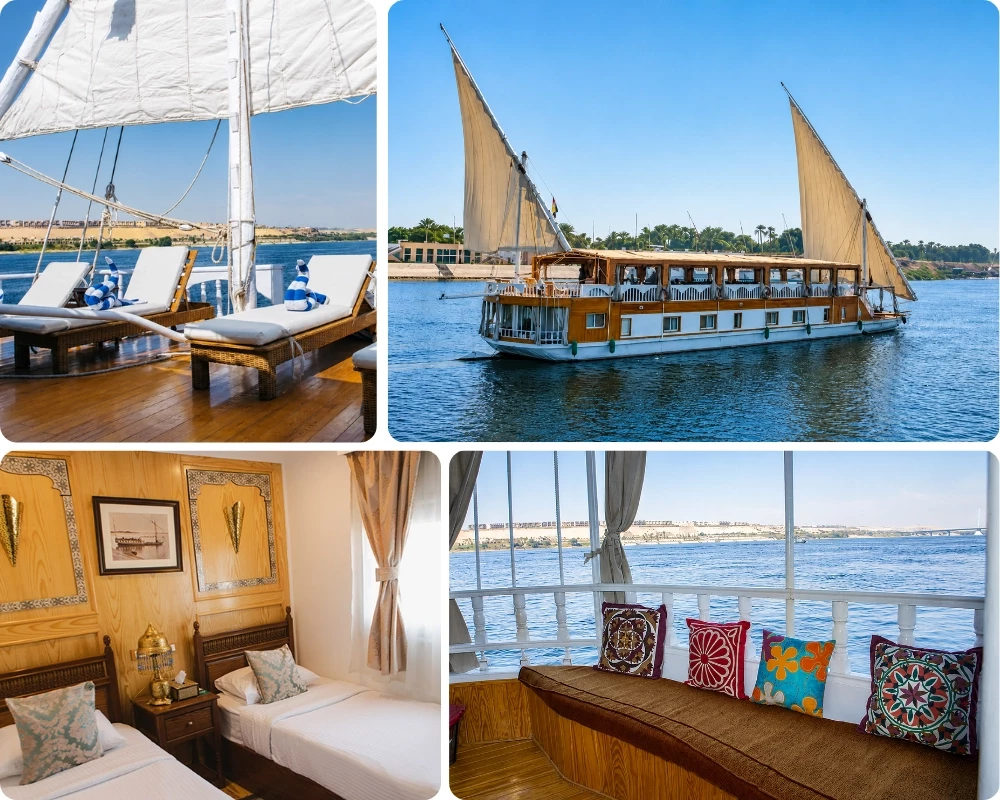
The Amoura is no ordinary boat. This two-masted dahabiya with lateen sails descends in a direct line from the vessels that already carried pashas and Western travellers in the 19th century, in the days when Flaubert and Champollion sailed up the river. It offers 9 cabins for a maximum of 18 passengers, with 9 crew members on board, a near one-to-one ratio between travellers and staff, and a capacity that remains five to ten times smaller than that of a classic river cruiser.
This difference in scale changes everything: no imposed group entertainment, no standardised buffets, no assembly-line boarding. The dahabiya sails at its own pace, stops wherever it likes, and moors on banks that no large boat could ever approach. For Marie, who wanted to give her family a genuine immersion rather than a packaged tourist product, the choice came almost naturally.
“I already believed in the dahabiya as an adviser, but after experiencing it I no longer have any doubt. At this scale, with such an attentive crew and an approachable guide, you truly live the Nile, you don't just cross it”, she explains.
On board: cabins and fittings
On board, the fittings draw on Egyptian tradition without giving up modern comfort. The 13 m² air-conditioned double cabins are dressed in Egyptian cotton and all look out onto the river thanks to a large panoramic window, a precious asset for watching life on the banks from your bed. The aft suite, more spacious with its 21 m², features a genuine lounge area and a private terrace overlooking the boat's wake.
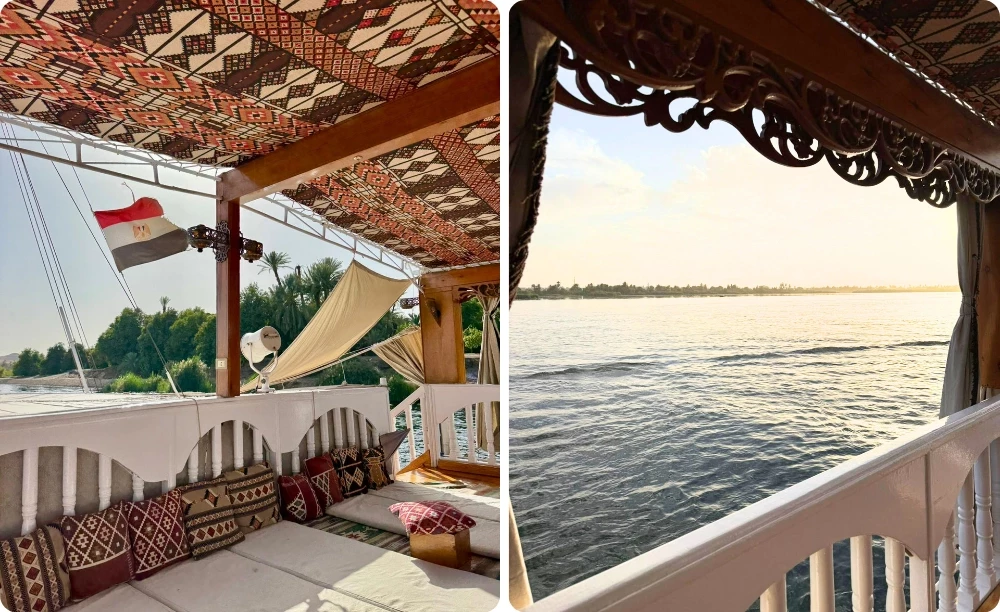
Each cabin has its own private bathroom with shower, toilet, washbasin and hairdryer. The upper deck, for its part, plays the role of an open-air lounge: sun loungers, low benches dressed with colourful cushions, a ceremonial table set three times a day, and an oriental corner where one happily lingers after dinner over a mint tea. “The boat is even more beautiful in real life than in the photos. It truly has the Egyptian style, plenty of charm. The cabins are comfortable, the beds perfect, the bathrooms very good, and the suite with its terrace at the back of the boat is simply immense.”
A crew of nine
But what really makes the difference on a sailing boat of this kind is the crew. Nine people to look after a maximum of eighteen passengers: a Nubian captain who knows every sandbank of the river, a cook who reinvents Egyptian cuisine according to the markets visited during the stopovers, smiling stewards, and above all a French-speaking Egyptologist guide who accompanies the family on every cultural visit. The passenger-to-crew ratio is such that everyone feels looked after without being watched over, a balance that large boats struggle to achieve.
“The crew is adorable, attentive at all times. What I appreciated most is that they are always smiling; you can tell it gives them almost as much pleasure as it gives us. Imad, our guide throughout the cruise, truly made the difference.”
A family cruise
For a Nile cruise with children, the dahabiya format offers another, more discreet but essential, advantage: serenity. No endless corridors in which to get lost, no hundreds of anonymous faces to bump into again at breakfast. The children move freely between the deck, their cabin and the lounge, the crew recognises them from the very first day, and the few other passengers soon become travelling companions. It's a bubble, and that is precisely what you are looking for when you choose this type of boat.
A 12-day travel itinerary in Egypt
Arrival in Cairo — 3 days of cultural extension before the cruise
Day 1: Arrival in Cairo
Day 2: Cairo → Pyramids of Giza
Day 3: Cairo → Aswan (domestic flight)
Day 4: Aswan → Abu Simbel → Aswan
Boarding the Amoura in Aswan
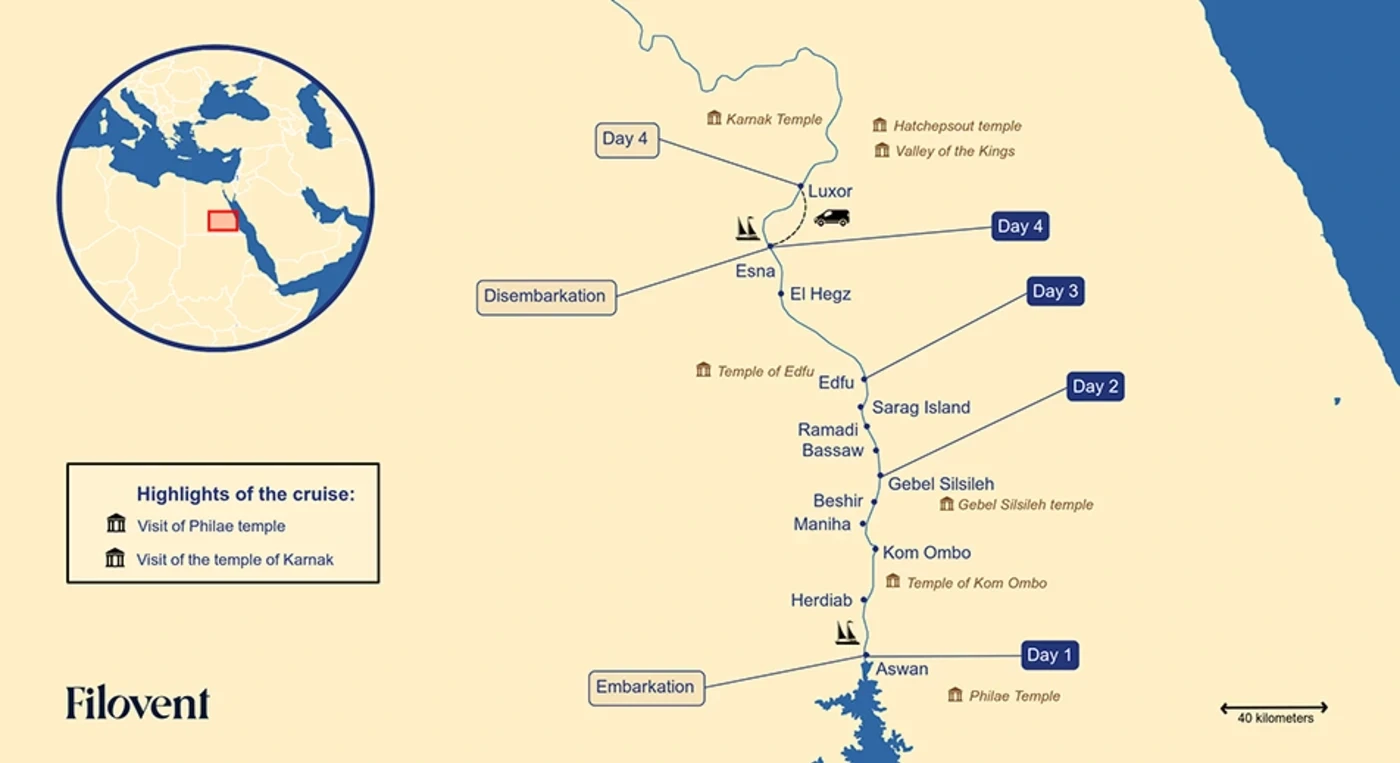
Day 5: Aswan → Kom Ombo
Day 6: Kom Ombo → Gebel Silsila → Edfu
Day 7: Edfu → Esna
Day 8: Disembarkation at Esna → Luxor → Hurghada
Beach extension in Hurghada (Red Sea)
Days 9 to 11: Hurghada
Day 12: Return flight from Hurghada
Day 1: Arrival in Cairo
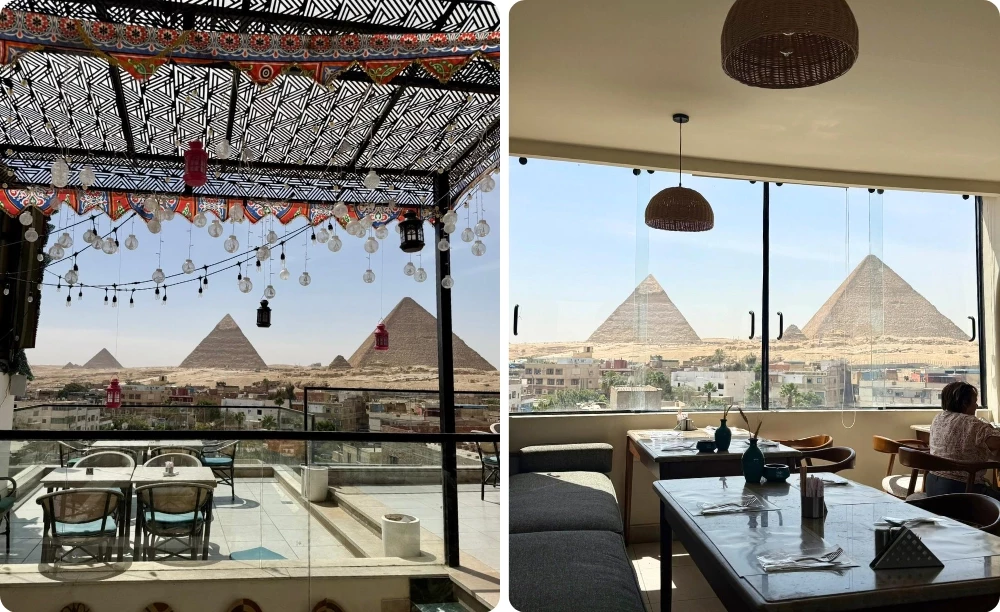
Marie's journey begins with a late landing at Cairo International Airport, around 3 a.m. At such an hour, after several hours of flying, the comfort of a transfer arranged in advance takes on its full meaning: a driver awaits the family at the baggage exit, sign in hand, and takes everyone straight to the hotel, without having to haggle over a taxi in the confusion. With the formalities sorted in advance, including the Egypt visa arranged before departure, the arrival goes smoothly despite the late hour. The bonus of the stay is saved for the waking-up: the hotel, chosen with care, offers a direct view of the Pyramids of Giza from its terrace. A striking first contact with Egypt, right from waking, and a tailor-made gift for the father of the family, a history enthusiast. The following day promises to be intense, but this first morning facing the pyramids from the room is already enough to set the tone for the trip.
Day 2: Cairo → Pyramids of Giza
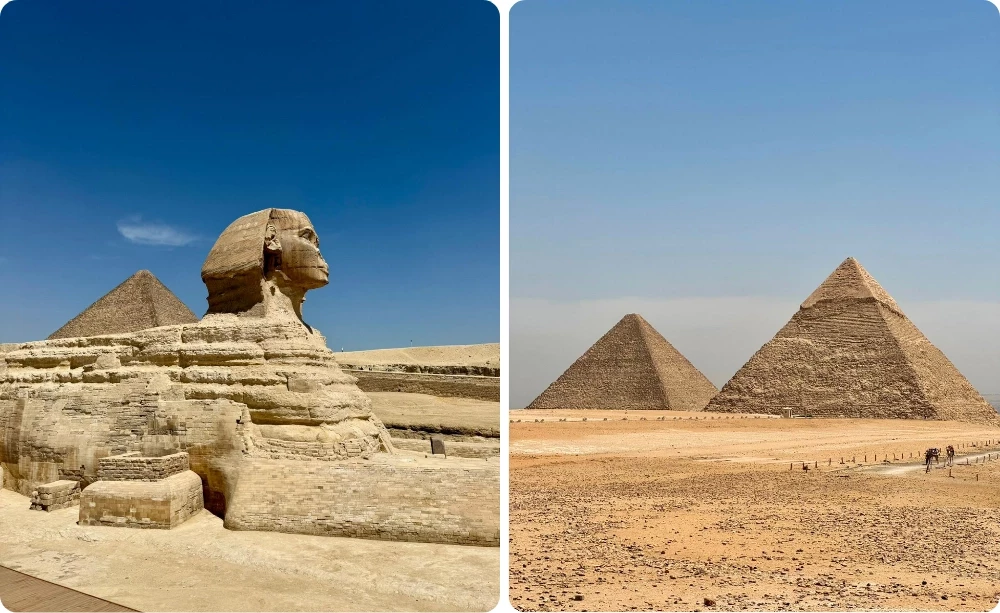
First major cultural day with the visit of the Giza plateau. The three pyramids, Cheops, Chephren and Mykerinos, rise at the edge of the city, far more accessible than one imagines when looking at photos. The family spends the morning approaching them, measuring their size up close, trying to picture the work needed to build them more than 4,500 years ago. The Sphinx completes the visit, with its face worn by time and its riddles still intact.
At midday, a welcome break in a typical Cairo restaurant, around a lunch of oriental flavours: mezze to share, grilled meats, fresh salads and warm breads. A chance for the family to catch their breath before the afternoon, and to taste for the first time this generous cuisine that punctuates every meal of the trip.
Return to the hotel at the end of a day already well filled, with in mind the images long awaited.
Day 3: Cairo → Aswan
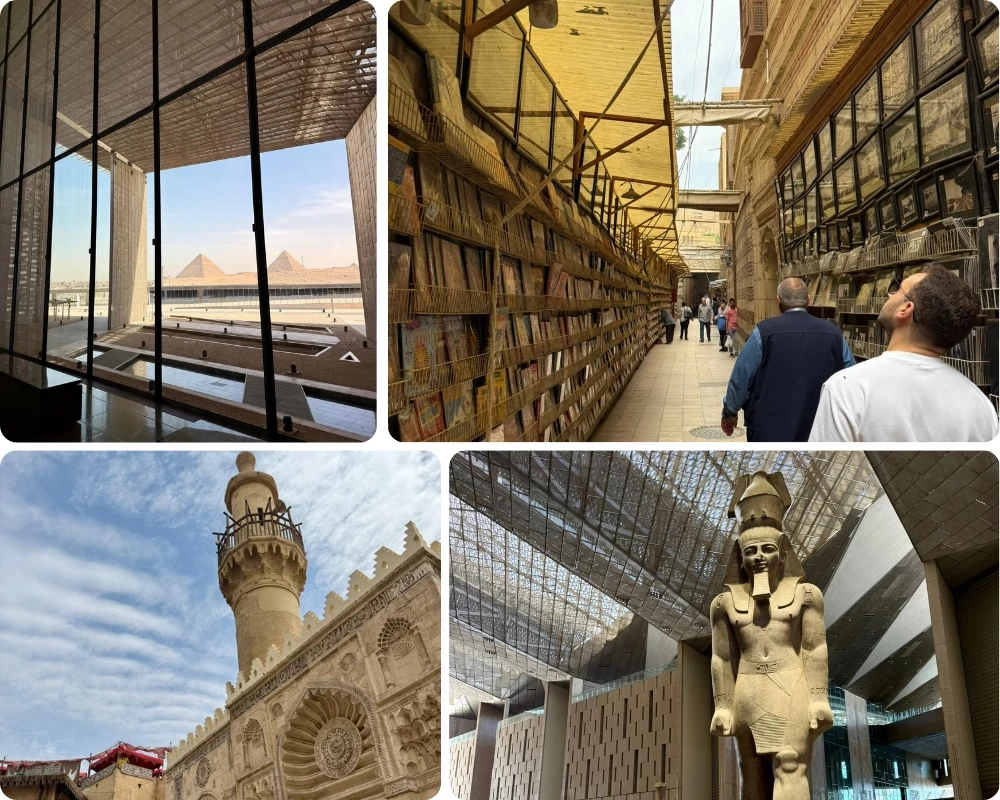
Before heading south, the family devotes its morning to the Grand Egyptian Museum, recently opened at the foot of the Giza plateau and presented as the largest archaeological museum in the world dedicated to a single civilisation. The Tutankhamun collection is gathered there in its entirety for the first time: solid gold funerary mask, nested sarcophagi, parade chariots, bedroom furniture, more than 5,000 pieces found intact in the young pharaoh's tomb in 1922. The visit continues to the Citadel of Saladin for a panoramic view of the city, then through the alleys of the Coptic quarter with its thousand-year-old churches, and ends in the bustle of the Khan el-Khalili bazaar. There, the merchants call out in French, English, Italian, sometimes Russian, and the art of haggling becomes a sport.
Domestic flight at the end of the day: Cairo–Aswan, around 1h30 of flight. Landing at nightfall in this border city, the last major stop before Nubia. The air is drier, hotter, the light more golden. The night is spent at the hotel, on the banks of the Nile, to recover before the big challenge of the next day.
Day 4: Aswan → Abu Simbel → Aswan
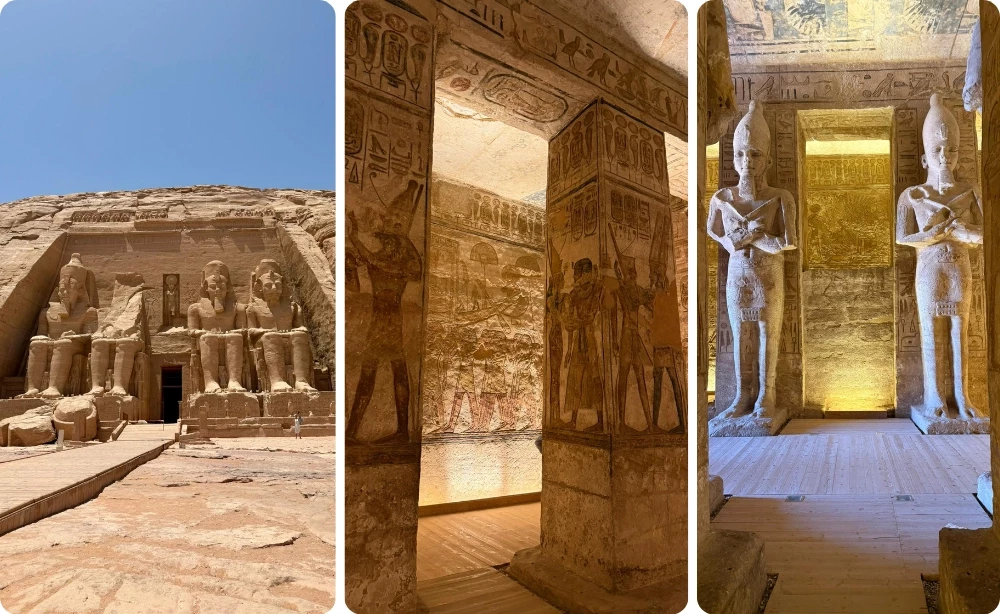
Heading to Abu Simbel, but against the flow. While most groups leave Aswan as early as 6 a.m. to reach the site in the cool of the morning, the family deliberately takes the opposite approach: a later departure, to preserve a well-deserved lie-in after three intense days in Cairo. Three hours of road across the Nubian desert to reach the banks of Lake Nasser, and the appearance of the four colossi of Ramses II, 20 metres high each, carved straight into the rock more than 3,200 years ago. The site, moved stone by stone in the 1960s to escape the rising waters of the Aswan High Dam, impresses as much by its size as by the story of its rescue.
The choice of the staggered timing pays off once on site: “Instead of leaving at 6 like most groups, we let ourselves sleep in. We arrived in full heat, but there were about twenty of us on the site, where there are usually two hundred people. We really felt as if we had the place to ourselves”, Marie tells us. Return to Aswan in the early afternoon, where the family makes the most of the end of the day to rest at the hotel before the big day: boarding the Amoura the following morning.
Day 5: Aswan → Kom Ombo (boarding and first hours of sailing)
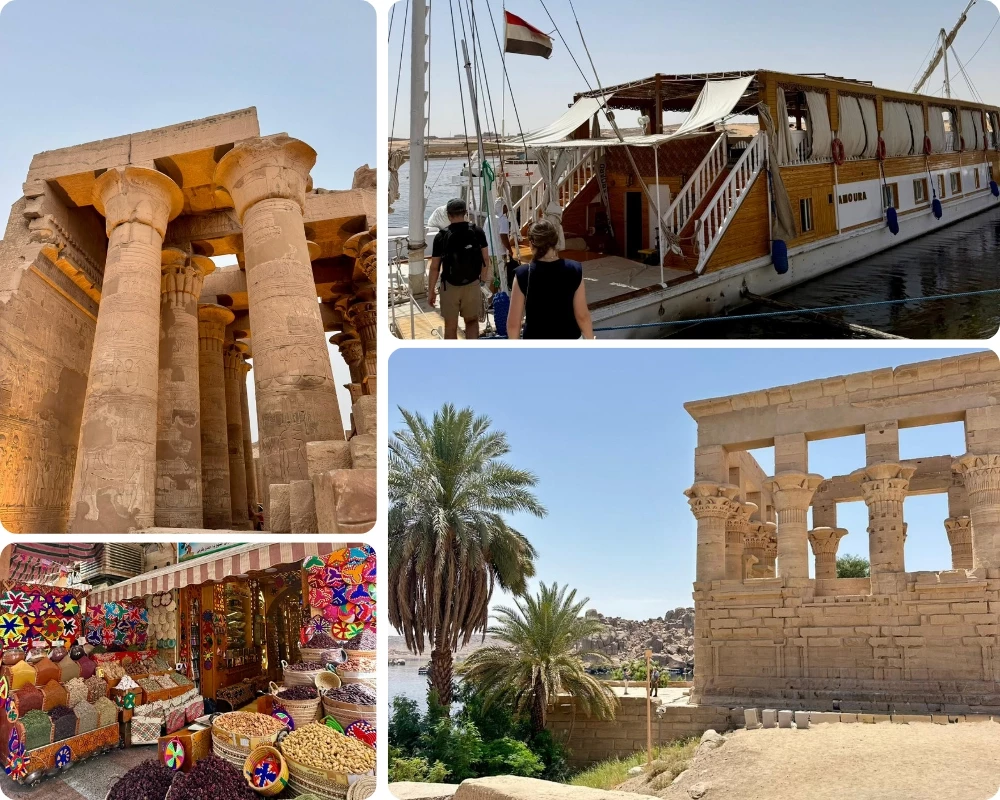
The big day has arrived. The local partner comes to collect the family at the hotel, and the visit begins straightaway with the Temple of Philae, dedicated to the goddess Isis. The sanctuary met the same fate as Abu Simbel: moved stone by stone from its original location to the island of Agilkia to escape the rising waters of Lake Nasser after the construction of the High Dam. On the way back, a stop at the Aswan souk, a chance for the family to test their negotiating skills, to wander through the spice market and to taste the famous fresh sugarcane juice, a local must.
Transfer to the port and boarding the Amoura in the early afternoon. The crew serves the first lunch on board, and the sailing boat heads out southward. The pace changes immediately: on the upper deck, you watch the water buffaloes wallow near the banks, the donkeys go about their business, the river birds bring the shores to life. It is also at this moment that you understand why the dahabiya is often among the best Nile cruises: no aggressive engine, no groups overflowing the deck, just the wind and the river. A first real contact with this everyday, living Nile that the family will get to know over the next four days.
“We strung together three intense days, between Cairo and Abu Simbel. Once on board, we settled into a real cruising pace, more relaxed. It was exactly what we needed at that point”, Marie confides.
In the middle of the afternoon, a stop at the temple of Kom Ombo, one of the most singular sites in Egypt: it is dedicated to two deities simultaneously, Sobek the crocodile-god on the right, Horus the falcon-god on the left. Everything is doubled in the building: two entrances, two hypostyle halls, two sanctuaries, in a rigorous symmetry that no other Egyptian temple reproduces. The small adjoining museum houses several mummified crocodiles, vestiges of the cult devoted to Sobek. The night is spent at anchor near the island of Basheir, in the calm of the river.
Day 6: Kom Ombo → Gebel Silsila → Edfu
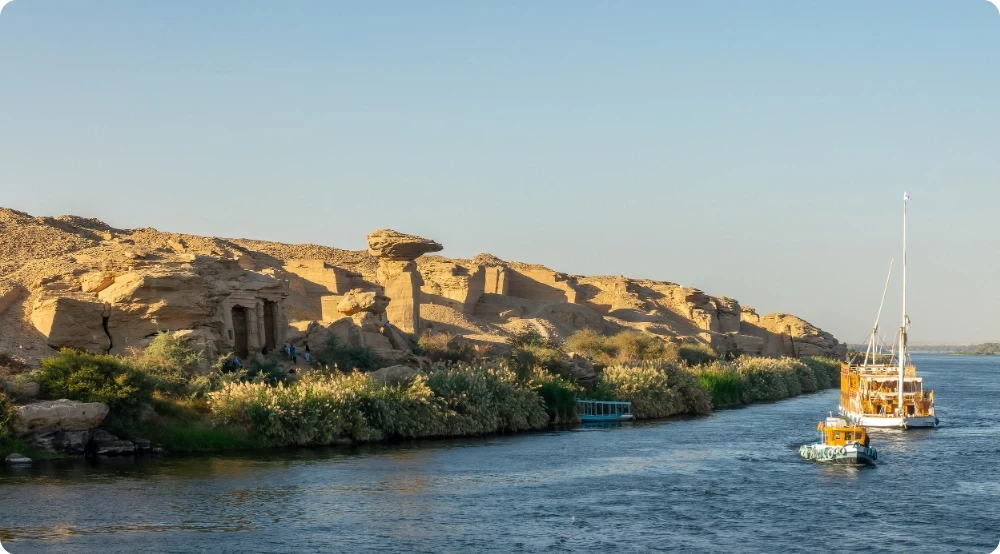
Breakfast on board, and the Amoura sets course for Gebel Silsila, one of the least frequented stops of the cruise. The site is an ancient sandstone quarry where the pharaohs had the blocks extracted for the great temples of the region.
The crew serves lunch on board while the Amoura continues sailing towards the village of Bassaw, on a small island of the Nile. Five hundred inhabitants live there in near self-sufficiency: they grow mangoes, bananas and dates, fish in the river, and seem to move in another time. On arriving on the island, the family is welcomed into the home of a farmer, who opens his house to visitors. It's a chance to talk freely about daily life, in particular about the education of girls.
Sailing then resumes towards the island of Sarag or Fawza, where the family spends the evening. The crew organises a dinner on the island, accompanied by music and Egyptian folk dances.
Day 7: Edfu → Esna
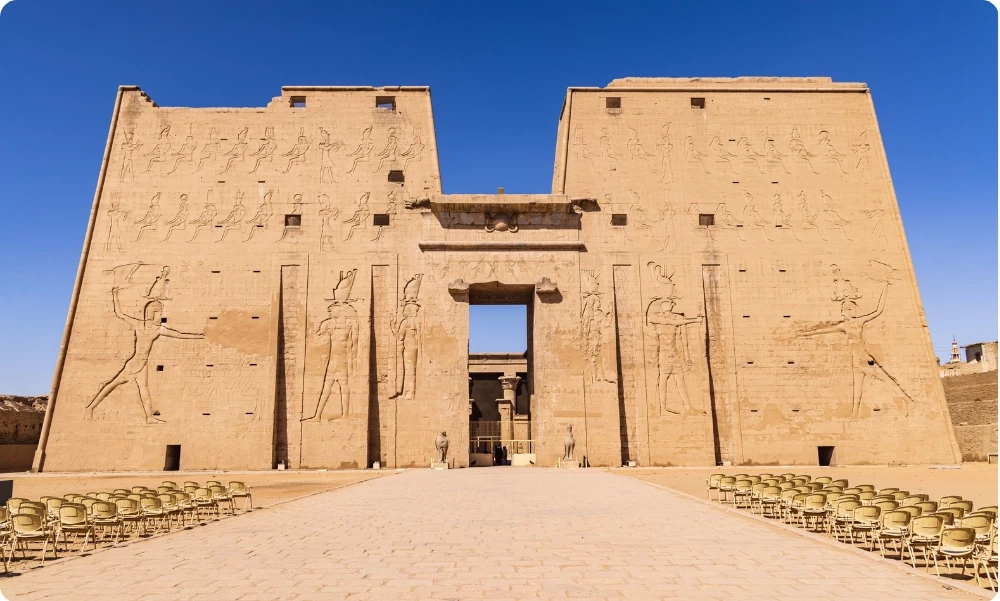
Breakfast on board, and the Amoura sets course for Edfu for the day's visit. On site, the guide leads the family in discovering the temple of Horus, considered the best-preserved temple in Egypt. Buried under the desert sands for nearly 2,000 years before being rediscovered in the 19th century, it owes its exceptional state of preservation to this singular history: intact pylons, sharp bas-reliefs, sanctuary still in place.
Course then set for Esna, whose lock is an obligatory stage of all Nile cruises. The passage is always a small spectacle: dahabiyas, barges and cruise boats cross paths there in a codified ballet. The last night on board is spent moored at Esna, the cruise draws to a close, but the journey continues.
Day 8: Disembarkation at Esna → Luxor → Hurghada
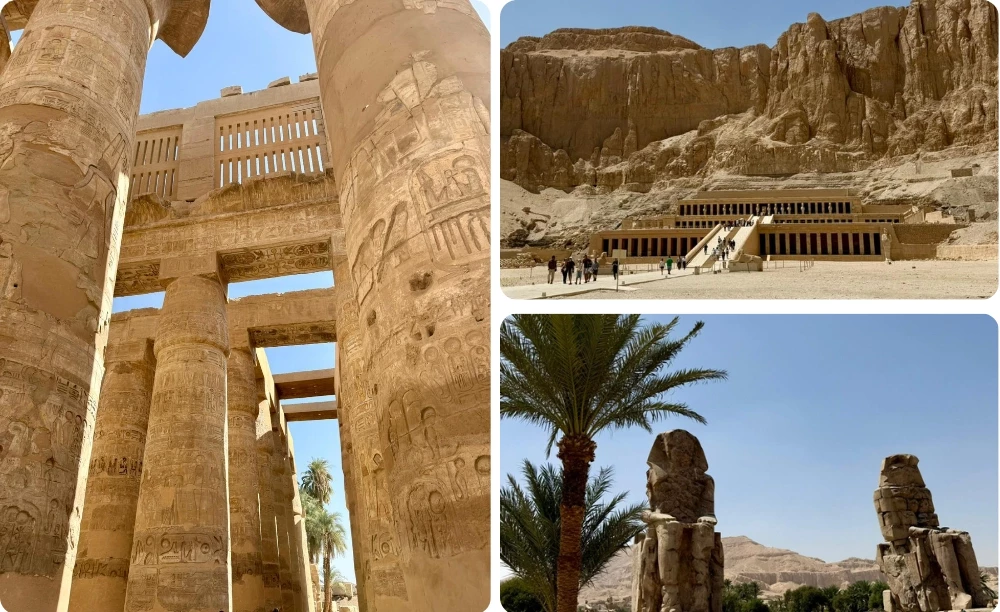
Early morning disembarkation and transfer to Luxor, ancient Thebes, capital of the New Kingdom and probably the greatest concentration of pharaonic remains in the world. The day strings together the major sites at a deliberately brisk pace: there is so much to see that you have to be selective. The temple of Karnak opens the proceedings: 30 hectares, two kilometres of processional avenues, and above all that hypostyle hall with its 134 columns whose papyriform capitals rise to 23 metres. Walking among the giant shafts remains one of the strongest sensations that ancient Egypt can offer.
Then heading to the west bank, the side of the dead in pharaonic cosmology, where the temple of Hatshepsut follows one another, the queen-pharaoh who reigned some twenty years having herself depicted with a false beard, and the Valley of the Kings with its dozens of hypogea dug into the rock, including that of Tutankhamun, the most famous. The Colossi of Memnon close the sequence: two 18-metre statues seated side by side, the lonely remains of a vanished temple.
Four hours of road in the late afternoon across the eastern desert, and the family sets down their bags in Hurghada, on the Red Sea coast. The contrast with the Nile is striking: palm trees, swimming pools, turquoise seafront. You change worlds without changing countries.
Days 9 to 11: Hurghada, relaxing on the Red Sea
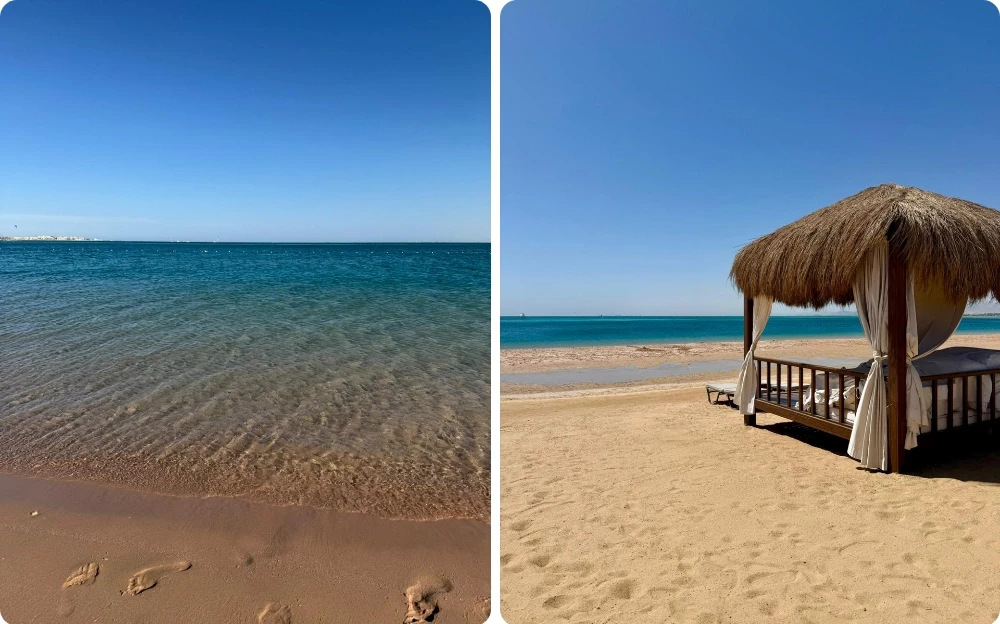
After the cultural marathon of the past days, time for three days of breathing space by the Red Sea, after the intensity of Cairo, Abu Simbel and Luxor. Hurghada holidays lend themselves perfectly: long sandy beaches, seafront hotels, a dry and sunny climate almost all year round, and direct access to one of the most renowned diving spots in the world.
The Red Sea is indeed famous for the richness of its depths: coral reefs, warm water all year round, excellent visibility and a biodiversity that makes it one of the world's paradises for diving and snorkelling. The Giftun Islands, off Hurghada, are one of the classic destinations for day boat trips. But the coast also offers its share of more land-based activities: quad bike or 4x4 excursions in the desert, evenings in the Bedouin villages of the hinterland, or simply enjoying the town's beach facilities.
For the family, the on-shore programme is free. Beach, swimming pool, sea outings or pure rest: everyone chooses their own pace. After twelve days punctuated by cultural visits and sailing, these last days on the Red Sea offer a peaceful interlude before the return, with the memories of the pyramids, the temples and the Nile still fresh in mind.
Day 12: Return flight from Hurghada
A final morning in Hurghada, then transfer to the international airport for the return flight. And so this Egyptian interlude comes to a close, after twelve days that will have combined the country's cultural must-sees: the pyramids, Abu Simbel, Karnak, the Valley of the Kings, and the slowness of a dahabiya cruise on the Nile, extended by a few days of relaxation by the Red Sea. A family trip of rare scope, and a programme that will have kept its promises from start to finish.
A few unforgettable memories
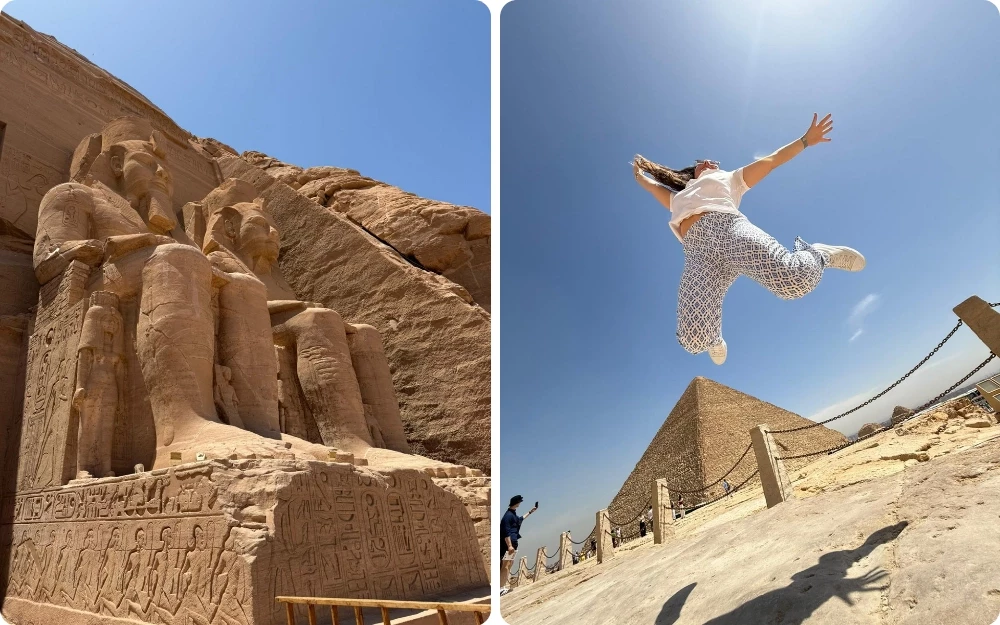
- Abu Simbel almost privatised: the trick of the trip, arriving against the flow of organised groups. While the majority of visitors leave Aswan as early as 6 a.m., the later arrival on site offers a completely different picture. About twenty people in total, where there are usually two hundred visitors. The heat rises quickly, but the impression of having the colossi of Ramses II almost to yourself is well worth the timing detour.
- Cairo with a view of the pyramids: a day in Cairo would not be the same without this image upon waking. From the hotel room, the Pyramids of Giza stand out directly on the horizon, a welcome gift that sets the tone for the trip from the very first morning.
- A swim in the Nile: on the first day of sailing, the Amoura stops in a small Nile cove to let the passengers swim. On the bank, Egyptians have come to picnic with their families, parasols planted in the sand, music in the background. You swim in the middle of this perfectly spontaneous scene of local life, a moment you won't find in any tourist guide.
Fancy living the same adventure?
Do you dream of a dahabiya cruise on the Nile, from Abu Simbel to the temples of Upper Egypt? Our advisers build with you a tailor-made itinerary, cruise and extensions included. Request your quote for a Nile cruise and put together the trip to Egypt that suits you.
Acknowledgements
A big thank you to Marie for the time she agreed to devote to this exchange, and for the superb photos she sent us to illustrate this account!