Learning to sail is often associated with a sense of total freedom, the open sea holding the promise of endless possibilities. Yet that freedom still calls for a certain level of knowledge and experience, and people learn to sail above all where conditions allow: a successful first voyage depends not on the number of training hours you have clocked up, but on where you set sail. The wind, the distance between two safe havens, the presence of tides and the number of available harbours determine what you will learn, and how calmly you will learn it. A well-chosen sailing area forgives beginners' mistakes. A poorly chosen one punishes them.
Here are the five sailing areas that offer the best conditions for a first charter, each with its wind pattern, a realistic one-week itinerary, the documents required, since the different boat licences are not recognised in the same way from one country to another, and the drawback to be aware of before booking. Then come the areas best saved for later.
Summary
- 1. What makes a good sailing area for learning
- Moderate, predictable wind
- Short passages of under 20 miles
- Anchorages and marinas every mile
- No tides, no currents
- An accessible base and fast assistance
- 2. The 5 ideal destinations for beginners
- British Virgin Islands: sailing by sight, no licence required
- Turkey, Göcek Bay: the best value for learning
- Greece, Ionian Sea (Lefkas): the ultimate sailing school
- France, Côte d'Azur: the Mediterranean on your doorstep
- Croatia, Central Dalmatia: Europe's densest marina network
- 3. Areas to avoid as a beginner
- The meltemi: the Cyclades
- Tides and currents: Brittany, Gulf of Morbihan, English Channel
- Exposed crossings: western Corsica and the Strait of Bonifacio
- Heavy traffic and tricky harbours: Bay of Naples, Amalfi Coast
- Reefs and eyeball navigation: Red Sea, Bahamas
- These areas become your goals for a second season
- 4. If you don't feel ready to go it alone
What makes a good place to learn to sail
Moderate, predictable wind
The right wind for learning is between 8 and 15 knots: enough for the boat to make headway and for sail trim to make a noticeable difference, but not so strong that the slightest mistake becomes costly. Its consistency matters even more than its strength. Thermal breezes, which pick up in late morning and die down at sunset, are the easiest to get to grips with because they turn up reliably day after day. You soon know what time to set off and what time you need to have arrived.
Short passages of under 20 miles
A 15-mile passage usually means three to four hours of sailing. That is enough to hold a course, experiment with trim, carry out a clean tack and stay relaxed about your arrival time. Beyond 25 or 30 miles, the day turns into a delivery trip: you cover distance without learning anything and arrive tired for the trickiest moment of all, the harbour manoeuvre.
Anchorages and marinas every mile
An area packed with shelter gives you something irreplaceable, the right to change your mind. If the wind picks up, a crew member feels unwell or a storm is brewing, you simply head for the next bay. This constant option to turn back without consequence is what sets a learning area apart from an adventure area.
No tides, no currents
In the Mediterranean and the Caribbean, there is virtually no tide. In practice, this means you can anchor wherever you like without checking whether you will still be afloat in six hours, enter harbour whenever suits you, and never have to correct your course for tidal streams. On tidal coasts, every one of these decisions depends on working things out beforehand. Nothing insurmountable, but it is one more skill to master, at the very moment you already have plenty to take in.
An accessible base and fast assistance
Two logistical details carry a lot of weight: how long it takes to reach the boat, and how far you are from the base if a technical problem arises. In an area where the base manager can send out a technician within half a day, a breakdown changes character entirely: it remains a minor setback rather than a ruined holiday.
Where to learn to sail: the 5 best areas for beginners
British Virgin Islands: sailing by sight, no licence required
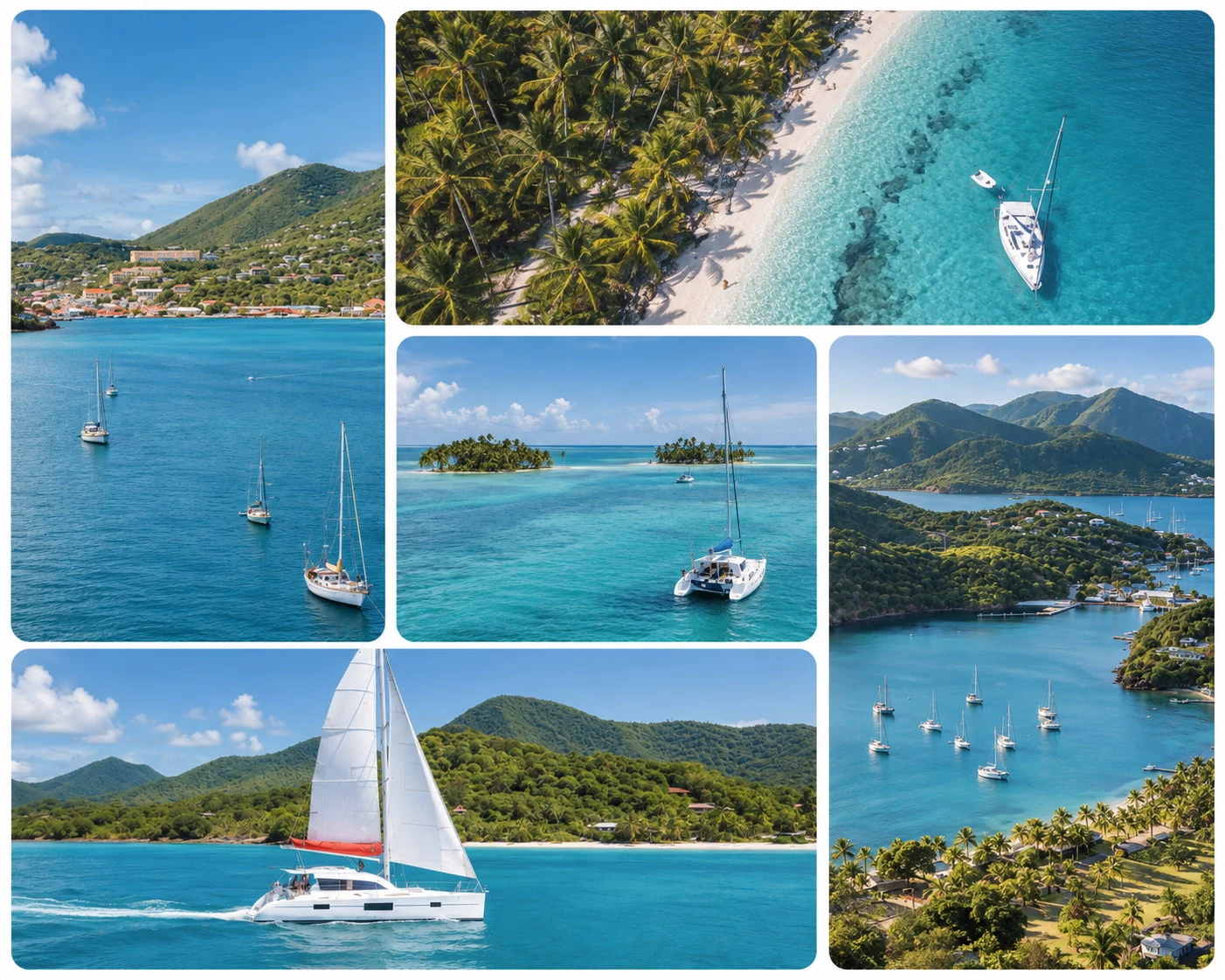
Why it's easy. Sailing boat hire in the British Virgin Islands is ideal because the archipelago forms a horseshoe around a sheltered inner stretch of water, the Sir Francis Drake Channel. Every island is visible from the others: you navigate by pointing at your destination, without ever losing sight of land. The trade winds blow from the east to north-east with remarkable consistency, and almost every anchorage is equipped with mooring buoys, so you don't need to master anchoring from day one.
Wind and weather. This is trade wind territory: a steady easterly of 15 to 20 knots in the high season from December to April, slightly lighter in May and June. It never really drops, which explains the short, choppy sea found in the passages between the islands. In the lee of a coastline, however, the water is flat.
What you really learn here. The steady trade winds give beginners a rare luxury, the time to feel the effect of each trim adjustment and to hold a close-hauled course without the wind constantly shifting. And since almost every anchorage uses buoys, picking up a mooring with the boathook quickly becomes second nature.
| Prevailing winds | East / north-east trade winds, 15 to 20 knots |
| Average passage | 8 to 12 miles |
| Licence required | No official qualification required; a written declaration of your sailing experience is enough |
| Best time to go | December to May |
| The drawback to know about | The transatlantic flight and the hurricane season from June to November |
Turkey, Göcek Bay: the best value for learning
A gulf made for beginners. Göcek is an enclosed gulf, carved into a dozen or so deep coves fringed with pine forests. The meltemi, which sweeps across the Aegean in summer, arrives here heavily softened by the surrounding hills: all that remains is a manageable afternoon breeze. You can spend an entire week inside the gulf without ever sailing more than 8 miles in one go, and find a sheltered lee at every mile.
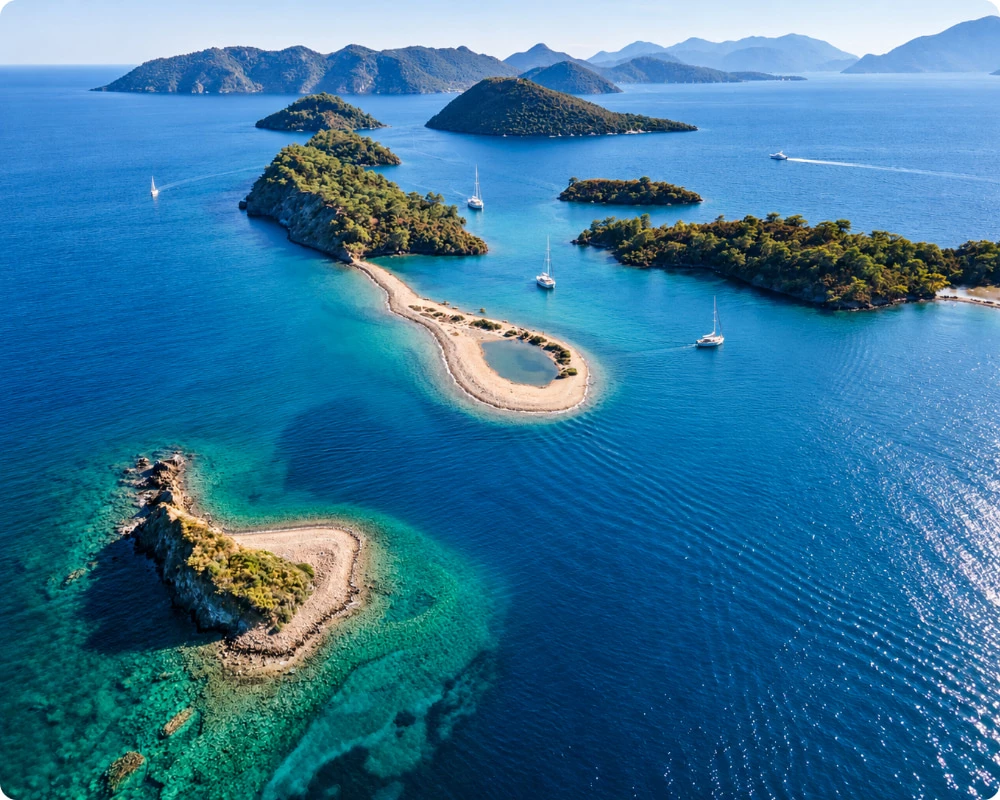
Wind and weather. A thermal breeze of 10 to 15 knots that settles in around midday and dies down in the evening. Mornings are often very calm, ideal for practising manoeuvres under engine.
The manoeuvre you'll master here. Mooring stern-to with a line ashore, the signature manoeuvre of the eastern Mediterranean, in coves where the pontoon restaurants come out to lend a hand. And life at anchor, since that is the default way of doing things here.
| Prevailing winds | Westerly thermal breeze, 10 to 15 knots in the afternoon |
| Average passage | 5 to 10 miles |
| Licence required | A recognised skipper qualification, with the ICC (issued in the UK by the RYA) being the benchmark accepted everywhere |
| Best time to go | May, June, September and October |
| The drawback to know about | July and August: intense heat and crowded coves |
Greece, Ionian Sea (Lefkas): the ultimate sailing school
Why it's easy. It is no coincidence that sailing boat hire in the Ionian Sea attracts so many first-time skippers: it is the busiest learning area in Europe. The islands line up one behind the other in a semi-enclosed stretch of water, the distances are tiny, and the maistro follows an almost unchanging pattern: glassy sea in the morning, a 10 to 15-knot breeze from 1pm, flat calm at sunset. In other words, you choose your window. Tricky manoeuvres are done in the morning, sailing in the afternoon.
Wind and weather. The maistro, a north-westerly thermal wind, blows 10 to 15 knots by mid-afternoon, a little stronger in July and August, but never reaching the levels seen in the Cyclades. The sea stays short and fairly flat.
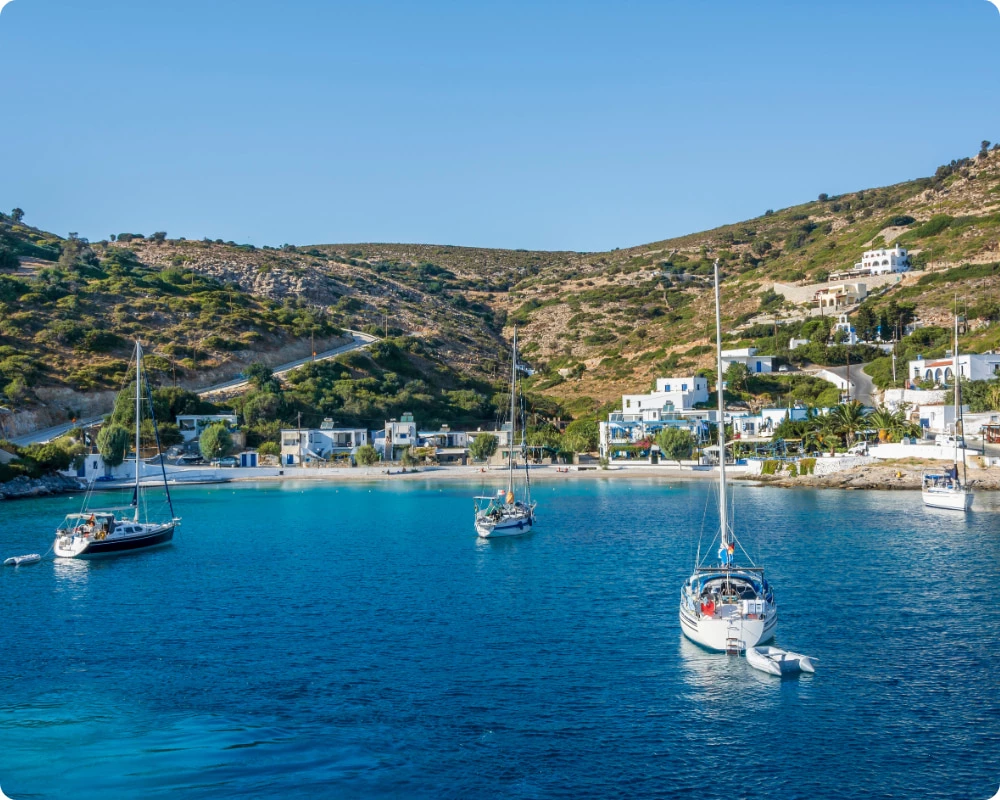
What you really learn here. The rhythm of a cruise: reading the forecast the night before, choosing your departure time, deciding where to stop. It is also the area with the most flotillas and supported cruises, if the idea of setting off on your own still feels daunting.
| Prevailing winds | North-westerly maistro, 10 to 15 knots in the afternoon |
| Average passage | 8 to 15 miles |
| Licence required | A skipper qualification, plus a second crew member declared as co-skipper |
| Best time to go | May to October, ideally June and September |
| The drawback to know about | The swing bridge on the Lefkada canal and its opening times |
France, Côte d'Azur: the Mediterranean on your doorstep
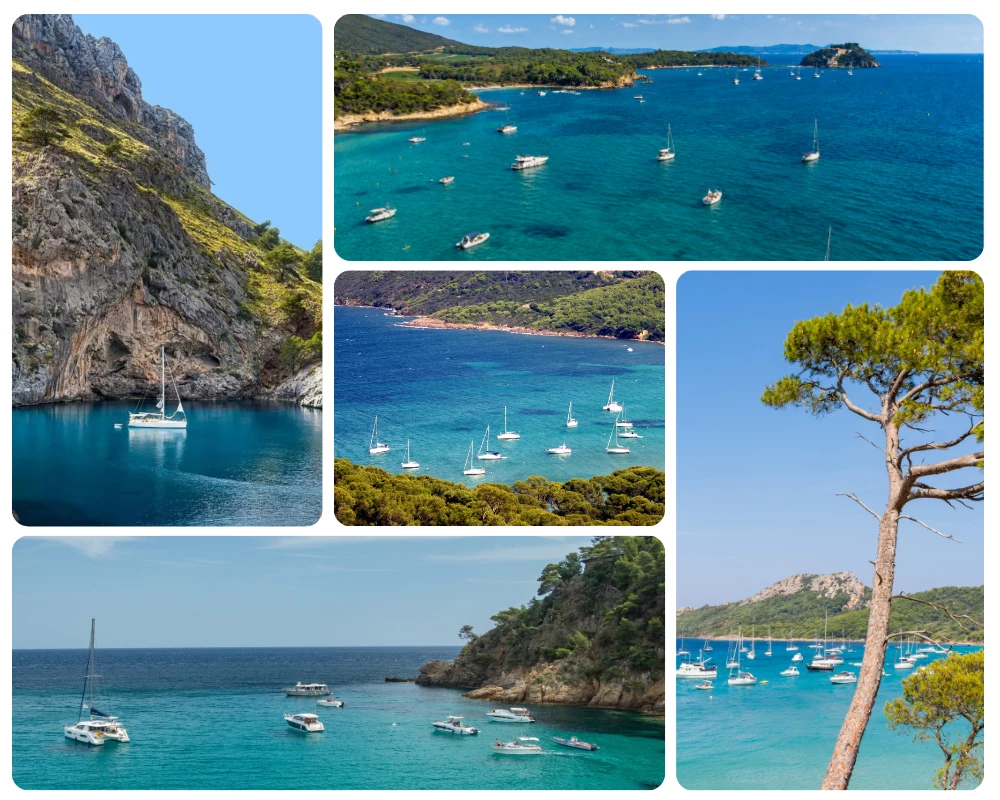
The advantage of proximity. This is the closest destination in this selection for anyone travelling from the UK: a short flight to the south of France or a rail journey via Paris, with no long-haul travel and no jet lag, so you can make the most of every day on the water. For sailors used to British waters, it is also a gentle introduction, with no tidal calculations, very short passages between Hyères and Saint-Tropez, a coastline packed with harbours and easy-to-spot landmarks, and a light thermal breeze in summer.
Typical 7-day itinerary. Bases for boat hire on the French Mediterranean coast are plentiful: set off from Hyères, Les Marines de Cogolin or Mandelieu. Porquerolles, Port-Cros, the Gulf of Saint-Tropez, Cavalaire Bay and, for the more confident, the coves of the Esterel and Cap Camarat. Rarely more than 15 miles a day.
Wind and weather. A south-easterly thermal breeze of 8 to 12 knots in the afternoon in July and August. Then there is the mistral, which can set in for several days at 25 to 35 knots, especially west of Toulon, so you need to see it coming and be prepared to stay in port.
What this coast teaches you. Precise coastal navigation, with bearings on landmarks, traffic to manage and narrow harbour entrances. A demanding school, but one with no surprises, and ideal for a first charter that fits easily into a long weekend or a short holiday.
| Prevailing winds | Thermal breeze of 8 to 12 knots, mistral possible |
| Average passage | 10 to 15 miles |
| Licence required | No licence for a sailing boat, but experience checked by the charter company |
| Best time to go | June and September |
| The drawback to know about | Berth availability and harbour fees in July and August |
Croatia, Central Dalmatia: Europe's densest marina network
An archipelago that shelters you. Between Trogir, Split and Šibenik, you sail through an archipelago of several hundred islands strung out parallel to the coast. This gives you sheltered channels, a sea that stays flat and, above all, a marina or fishing harbour within two hours of any point in the area. No other destination offers such a safety net.
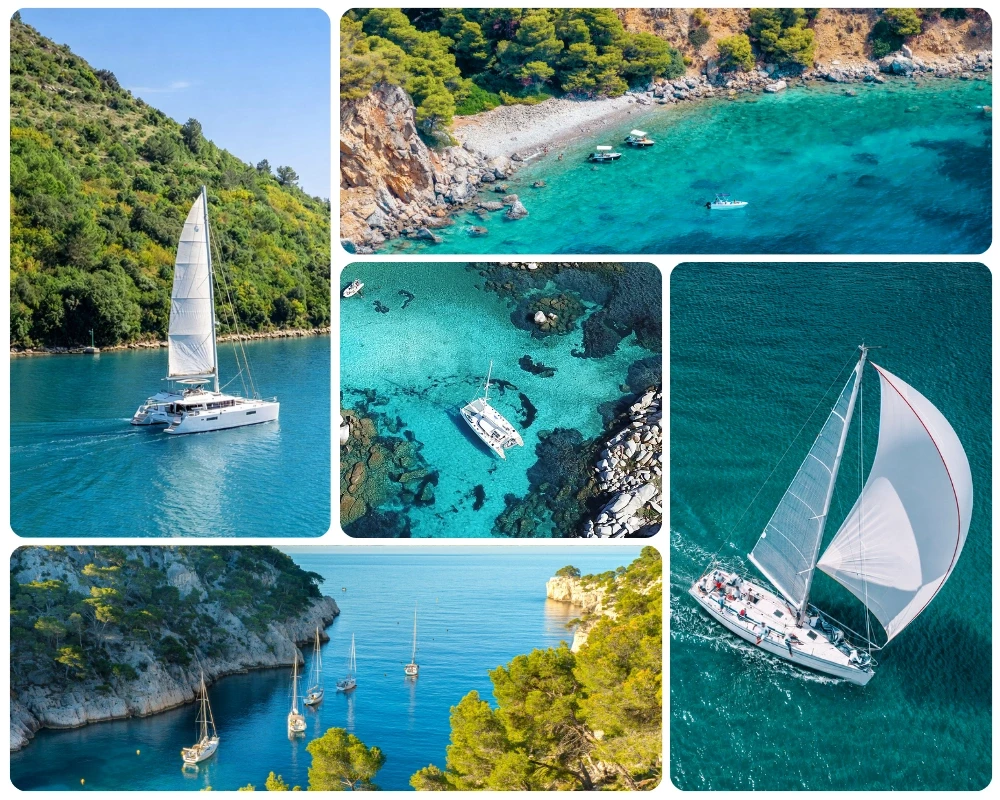
Wind and weather. The maestral, a north-westerly thermal wind, blows 10 to 15 knots in the afternoon from June to September. The jugo, a south-easterly, brings rain and a rougher sea but is always forecast well in advance. The bora, violent and cold, is mainly a winter phenomenon.
The skill you'll take home. Harbour manoeuvres, quite simply, because you do one every day and Croatian marinas have lazy lines and marineros to guide you in. Within a week, any fear of coming alongside has gone.
| Prevailing winds | North-westerly maestral, 10 to 15 knots in the afternoon |
| Average passage | 12 to 20 miles |
| Licence required | A skipper qualification and a VHF radio operator's certificate (SRC), both checked |
| Best time to go | May, June and September |
| The drawback to know about | Entry formalities and tourist taxes to be paid at the start of the cruise |
Areas to avoid as a beginner
The meltemi: the Cyclades
Santorini, Mykonos and Paros are stunning, and yet they are among the worst places in Europe to learn. From June to September, a northerly wind known as the meltemi sets in for three to five days at a time, at 25 to 40 knots, two to three times the wind strength a beginner is comfortable with. It does not ease off at night. Because the bays are open, the swell rolls in and the boat rocks at anchor, making sleep difficult. Add to that crossings of more than 25 miles between islands, meaning five to six hours with nowhere to take shelter, and fast ferries that require you to keep a constant eye on the horizon. This is a cruise to save for when reefing in a rough sea no longer poses a problem.
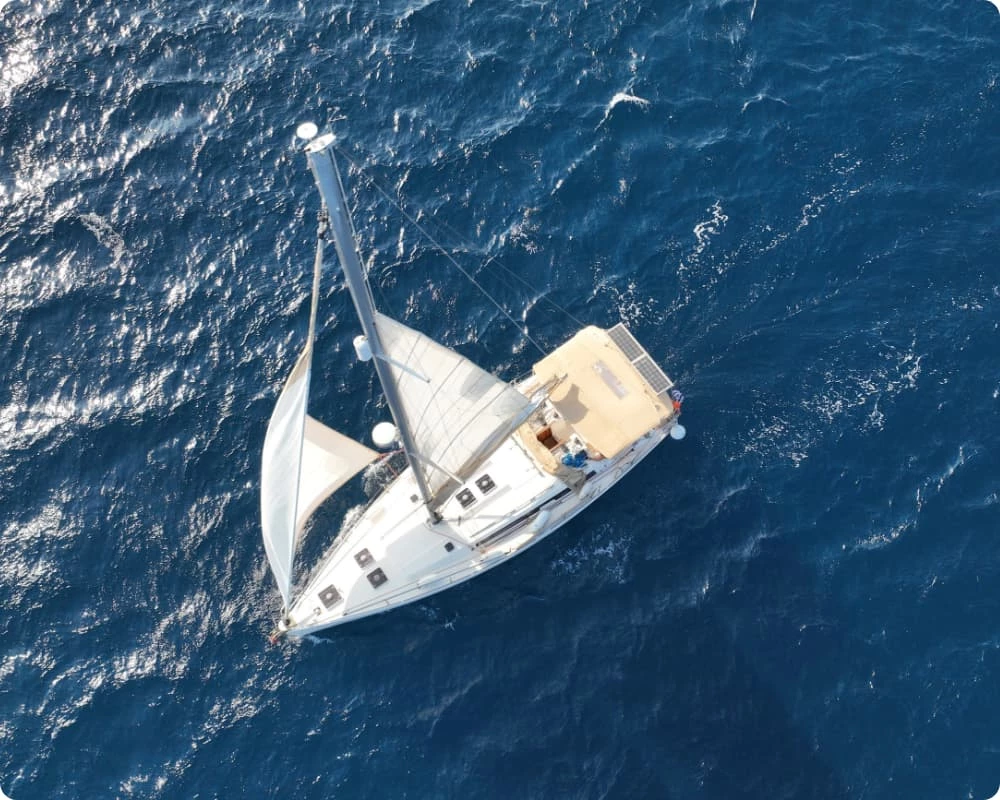
Tides and currents: Brittany, Gulf of Morbihan, English Channel
These are excellent training grounds, and probably the best in Europe for making rapid progress. But learning here has to involve an instructor: tidal coefficients, heights of tide, times of slack water, 4-knot streams in the narrows, fog. Sailing independently without experience leaves too little margin for error. If the area appeals to you, book a sail training cruise rather than a bareboat charter.
Exposed crossings: western Corsica and the Strait of Bonifacio
The west coast of Corsica is magnificent but not very welcoming for a first voyage: long stretches with no shelter between Calvi and Ajaccio, deep gulfs exposed to the west, and a mistral that comes down hard. The Strait of Bonifacio adds a permanent funnel effect and plenty of rocks. Sailing in Corsica is more of a project for your second or third cruise than your first. One exception: skippered charter. Someone who knows the area decides on the weather window and the itinerary, and you learn by watching them, then by manoeuvring under their supervision. It is actually one of the best places to do this, as you will experience real wind and real sailing.
Heavy traffic and tricky harbours: Bay of Naples, Amalfi Coast
Extremely dense commercial and leisure traffic, tiny harbours that are full to bursting in summer, regulated anchorages, and manoeuvres under the gaze of the entire marina. On top of that, the harbour system expects you to negotiate your berth over VHF. A superb cruise, but not for a first command.
Reefs and eyeball navigation: Red Sea, Bahamas
In these areas, the chart is not enough: you need to be able to read the colour of the water, because coral heads sometimes rise to less than a metre below the surface and are not all charted. That means a crew member on the bow, the sun behind you and reduced speed so you have time to steer around an obstacle spotted at the last moment. Otherwise, you risk running aground, with keel or rudder damage that is never covered by the deposit.
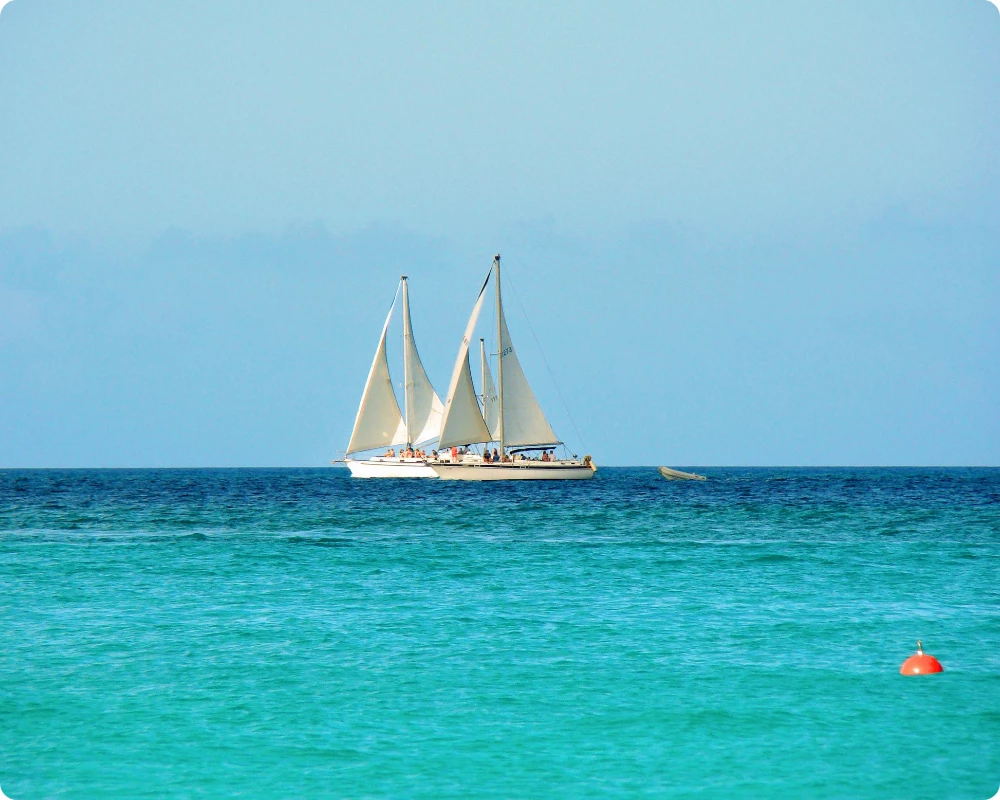
These areas become your goals for a second season
None of these destinations should be crossed off the list; quite the opposite: they are the most beautiful, and they make excellent goals. A first week in the Ionian or Göcek, a second in northern Dalmatia or on the east coast of Corsica, a third in the Cyclades or Brittany: in three cruises, you will have built up solid experience, and each one will have been a pleasure rather than an ordeal.
If you don't feel ready to go it alone
There is a halfway house between a sailing course and a bareboat charter, designed precisely for this stage: the flotilla. Six to twelve boats sail together on a shared itinerary, led by a lead boat with a professional skipper on board. Every morning there is a briefing on the weather and the day's route. You helm your own boat, carry out your own manoeuvres and make your own decisions, but you are never alone: if in doubt, a quick VHF call is all it takes, and someone is waiting on the pontoon to take your line.
Its limitations come from the very way it works: the pace and itinerary are set, the dates are fixed and group life is part of the experience. But for a first time, it is the most reassuring way in, and many flotillas depart from the very areas described above, in the Ionian and Dalmatia.
As for choosing your destination, it comes down to a few simple points: Turkey if budget is the priority, the Ionian for a first time with no experience at all, the Côte d'Azur if you want a short journey and no jet lag, and the Virgin Islands if you are after a change of scene and steady trade winds. In all four cases, book your week in June or September, and plan for one day fewer than you think you can manage.
Sources
- Interviews with Filovent charter advisers on departure bases, the experience levels required by charter companies and feedback from beginner clients.
- Imray pilot books and sailing guides: Greek Waters Pilot and Turkish Waters & Cyprus Pilot (Rod Heikell), Adriatic Pilot (Trevor and Dinah Thompson), Cruising Guide to the Virgin Islands (Nancy and Simon Scott).
- SHOM nautical instructions and charts for the French Mediterranean, Corsica and the Channel and Atlantic coasts.
- Bulletins and wind statistics from national meteorological services: Météo-France, the Hellenic National Meteorological Service (EMY), the Croatian Meteorological and Hydrological Service (DHMZ) and the Turkish State Meteorological Service (MGM).