





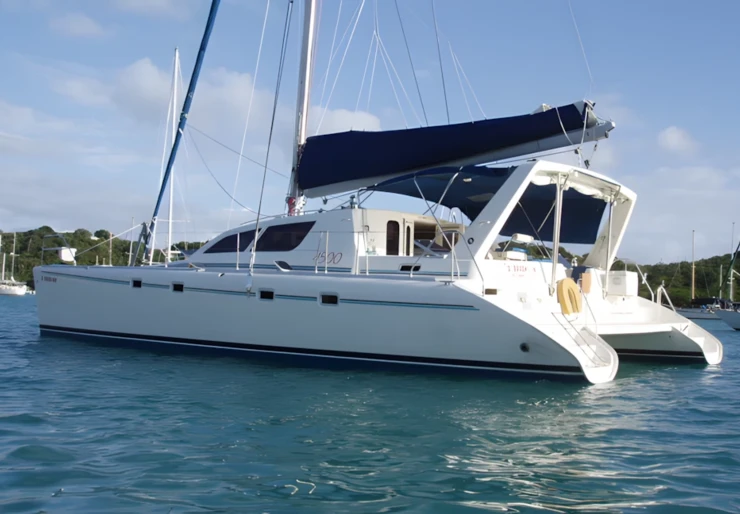
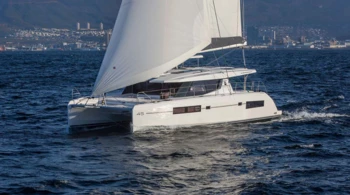
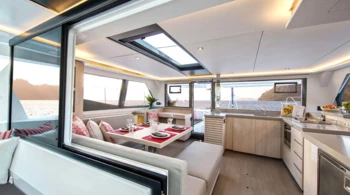
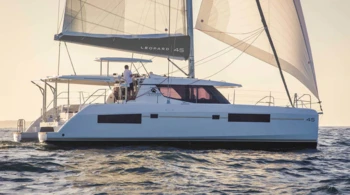
2019 14.25 m
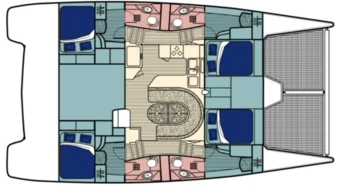
9 berth(s) 4 cabin(s)
Main equipments
Solar panels Fully battened mainsail Fins-masks-snorkels Stability Spaciousness Trampoline
with Filovent experts
You can rent this boat with or without skipper more+
Rental conditions
Damage waiver is mandatory if you take a professional skipper Offshore license required or equivalent Boating licence Nautical CV mandatory Valid national identity card or passport compulsory

Technical features - Leopard 45

Model:
Leopard 45
Boatbuilder:
Leopard
Year of construction:
2019
Mainsail:
Fully battened mainsail
Overall length:
14.25 m
Width (beam):
7.92 m
Draught:
1 m

Boat layout - Leopard 45

Certified berths:
9
Cabins with 1 double bed:
4
Berth in the saloon:
1
Note: comfort may vary according from one cabin to another
For charters with a skipper, a cabin must be allocated for him, and access to a bathroom must be ensured.

Equipments - Leopard 45

See the complete list of 7 equipments

You need a skipper or an hostess?

Extras

Extras Status Price
Skipper see+
  • We inform you that you must allocate a cabin for the crew member to sleep in
On request 1 200 € / week
Cleaning Mandatory 250 € / booking
Sheets + hand towels Mandatory 25 € / person / week
Ecotax see+
  • Partner information
  • Environmental levy (tax)
Mandatory 7 € / person / day
See the complete list of 14 extras

Conditions

Important information
Extras Status Price
Deposit Mandatory 3 000 €
Mandatory Seychelles travel authorization (to be completed online on the dedicated website)
It is strongly recommended that you have a VHF certificate, as the local authorities may require you to produce it during a check.

Formalities - mandatory documents and others

  • Offshore license required or equivalent
  • Boating licence
  • Nautical CV mandatory
  • Valid national identity card or passport compulsory

Insurance

  • Damage waiver is mandatory if you take a professional skipper
  • Insurances: all offered boats are fully insured
  • However we advise you to take our cancellation insurance and / or damage waiver more+
  • The photos and information on this boat page are not contractual

Customer reviews

The boat

This boat was not rated by one of our clients yet

The partner

This yachtcharter company was not rated by one of our clients yet

Frequently asked questions

What experience do you need to hire a boat without a skipper?

The essentials

Setting off without a skipper calls for sailing skills that vary from one destination and one boat to another. One rule applies everywhere: you must be able to read a nautical chart and fix your position. The rest depends on where you are going. A licence is compulsory in every country except France, where a yacht can be hired without one, whatever its size. A sailing CV, on the other hand, is always requested: at Filovent, you complete it in your customer account after booking. Some areas also require a restricted radio operator's certificate (VHF), Croatia among them. If you have the slightest doubt, a Filovent adviser will review your file with you before you book.

The two non-negotiable skills

Chart and position: those are the two skills mentioned above, and every bareboat charter starts there. In practice, that means being able to plot a course, pick out a beacon or a shoal before you get close to it, and know where your boat is at any moment, even if the GPS stops working. This is the bare minimum, even before the question of a licence arises. A skipper must also know how to handle the boat in harbour, drop anchor and plan the day around the weather.

Licences: what the law says

The rule depends entirely on the country and the type of boat. In France, a yacht can be hired without any licence at all, regardless of its length; for a motorboat of more than 6 hp, the French coastal licence (permis plaisance option côtière) is compulsory. In the rest of the world, a licence is almost always required: a coastal licence is enough in the vast majority of cases, while an offshore licence is only needed for the most demanding destinations (open-sea crossings, offshore passages).

Good to know: your entitlements travel with you. A coastal licence limits you to 6 nautical miles from a safe haven, in France as well as abroad. A charter company may therefore refuse to hand over a boat for an offshore trip if your licence does not cover the distance. Internationally, the International Certificate of Competence (ICC) is the most widely accepted document: it is the official equivalent of your national licence and is recognised in many countries.

The sailing CV: the document that really decides

Beyond the legal paperwork, your sailing CV is always requested, in France as everywhere else. It sets out: the types of boats you have skippered, their size, the areas you have sailed, your role on board (skipper or crew) and how often you sail.

At Filovent, you fill it in directly in your customer account, after booking. It is based on good faith: nobody will ask you for proof, but it is in your own interest to be honest. Finding yourself at the helm of a boat you cannot handle is a sure way to ruin your holiday.

What the charter company actually looks at

The charter company compares the experience you have declared with the boat you want to hire and checks that the two are consistent. In practice, you will not be handed a large catamaran if your only experience is on a 20-foot monohull. As a rule, you are expected to have already skippered a boat of a comparable size, including harbour manoeuvres and anchoring. There is no official number of hours, but having led several cruises as skipper will reassure the charter company.

The VHF (radio) certificate

In certain areas, a restricted radio operator's certificate (VHF) is required in addition to the licence. Croatia asks for it as standard, and more and more Mediterranean areas are following suit. It certifies that you can operate the onboard radio, in particular to send a distress call. If your destination requires it, make sure you obtain it well before departure.

Every destination has its own level of demand

Destination-by-destination requirements

Not all destinations are equal. Here are the benchmarks by area to give you an idea of what will be asked of you (to be confirmed with the charter company and for the boat concerned):

DestinationLicenceVHF certificateRecommended level
France (yacht)None (engine > 6 hp: coastal licence)No (when sailing close to shore)Beginner-friendly, line-of-sight sailing
CroatiaCoastal licence or ICCYes, compulsoryBeginner to intermediate
GreeceICC + qualified co-skipper often requiredOften requestedIntermediate (Cyclades: meltemi)
ItalyCoastal licence or ICCVaries by areaIntermediate
Spain / BalearicsCoastal licence or ICCVaries by areaIntermediate
TurkeyCoastal licence or ICCOften requestedBeginner to intermediate
SeychellesOffshore licenceOften requestedExperienced, offshore
British Virgin Islands (BVI)No licence required, but sailing CV requestedNoBeginner to intermediate (sheltered waters, line-of-sight sailing)
Grenadines (St Vincent to Grenada)No licence required, but sailing CV requestedNoExperienced (open-sea crossings, steady trade winds)
French PolynesiaNot required (French territory), but offshore experience essentialRecommendedExperienced, offshore

These benchmarks change over time and every charter company applies its own conditions: always check the exact requirements for your booking before you commit.

The check-in on embarkation day: the final verification

On the day of embarkation, a technical briefing is held with the charter company or its representative. They will show you around the boat and may assess your first manoeuvres. If they feel you are not confident enough, they can require you to take a skipper for the first few days, until you find your feet.

Are you a beginner or short on experience?

Not experienced enough? Your options

A bareboat charter is not the place to learn to sail. If your experience is limited, you have several options:

  1. Hire with a skipper: you enjoy the cruise and learn from them along the way, with no stress and no licence formalities.
  2. Train at a sailing school: this is the real way to acquire the basics, then your licence and your independence as a skipper.
  3. Choose a beginner-friendly destination: moderate winds, line-of-sight sailing and short legs, for a confident first charter.

Unsure about your file? Talk to Filovent

Every charter company sets its own requirements, and these can change. Not sure you have the right licence, the right certificate or the experience expected? Do not book blind. A Filovent adviser will review your profile and point you towards the right level of boat and destination. For any questions, contact your Filovent adviser or our concierge team on +44 20 4576 3186.


Mahé or Praslin: where should you start your sailing holiday in the Seychelles?

There are two bases for setting sail in the Seychelles: Mahé, the main island, and Praslin, around 45 km (25 nautical miles) to the north-east. In short:

  • Set sail from Mahé if you want the widest choice of boats, an embarkation point just minutes from the international airport and an itinerary of 10 days or more.
  • Set sail from Praslin if you are going for a week and want to spend as much time at anchor as possible, close to La Digue, Curieuse and St Pierre islet.

Mahé or Praslin: how they compare

From either base, you can explore the islands of the Seychelles in the inner archipelago, but the travel logistics and the pace of sailing are different.

CriterionMahéPraslin
Departure portEden Island MarinaBaie Sainte-Anne
Access from the international airportA few minutes by taxiDomestic flight or ferry
Available fleetThe largest in the archipelagoSmaller
Boat typesCatamarans, monohulls, yachtsCatamarans, monohulls
Cabin cruisesMost departuresLess common
Nearby islandsSainte-Anne, SilhouetteLa Digue, Curieuse, St Pierre
Ideal length10 days or more7 days

Why set sail from Mahé?

Mahé is home to most of what the archipelago has to offer. It is the natural starting point if you arrive on an international flight.

  • The widest choice of boats: catamarans of all sizes, monohulls, power catamarans and crewed yachts, which you can compare in our range for catamaran hire on Mahé.
  • Simpler logistics: Eden Island Marina is very close to the international airport, with no domestic flight or ferry to arrange.
  • Services on site: supermarkets for provisioning, restaurants and shops at the marina, and the capital, Victoria, close by.
  • The embarkation point for most cabin cruises, ideal if you are travelling as a couple.
  • Stops unique to Mahé: Sainte-Anne Marine Park, Anse Major, Beau Vallon and the wild island of Silhouette.

Worth knowing: the most beautiful islands (Praslin, La Digue, Curieuse) lie about 25 nautical miles (45 km) from Mahé. Allow half a day for the crossing each way, which eats into a one-week trip.

Why set sail from Praslin?

Praslin sits at the heart of the archipelago’s most popular islands. From Baie Sainte-Anne, each stop is only a short sail from the last.

  • More time at anchor: La Digue, Curieuse and St Pierre islet are less than two hours’ sailing away.
  • No long crossings: a plus for crews prone to seasickness or families with children.
  • Beaches within reach from day one: Anse Lazio and Anse Georgette, in the north-west of Praslin.
  • A fleet of recent catamarans and monohulls, which you can browse in our range for catamaran hire on Praslin.

Worth knowing: you will need to get from Mahé to Praslin, either on a domestic flight of around 15 minutes or by fast ferry (a crossing of around 1 hr 15 min, depending on the operators’ timetables). Leave enough time between your international arrival and embarkation.

Which base for the length of your cruise?

LengthRecommended baseWhy
Under 7 daysPraslinNo long crossings
7 daysPraslin or MahéMahé works with a tighter schedule
10 to 14 daysMahéFull tour, Silhouette included

On a short trip, many travellers wonder whether they can sail Mahé, Praslin and Silhouette in 4 days. For a longer trip, our sailing itinerary in the Seychelles from Mahé shows how to spread 11 days across Sainte-Anne, La Digue, Praslin, Curieuse and Silhouette.

Which base for the season?

The season mainly affects how comfortable the crossing between Mahé and Praslin will be. Sailing conditions in the Seychelles follow two wind patterns:

  • May to October (south-east trade wind, 15 to 25 knots): great sailing, but the sea can build between Mahé and Praslin. Setting off from Praslin cuts down the hours spent in the channel.
  • November to April (lighter north-west winds): calm seas and an easy crossing. Setting off from Mahé is then very comfortable, even for a week.

The shoulder seasons, April to May and October to November, often offer the best balance of wind, weather and crowds. Our guide on when to go to the Seychelles covers temperatures and rainfall month by month.

Catamaran or sailing yacht hire: which base to choose?

  • Catamaran with or without a skipper: available at both bases, with more choice on Mahé.
  • Monohull sailing yacht: available from both Mahé and Praslin.
  • Crewed yacht or large catamaran: almost exclusively from Mahé.
  • Cabin cruise: embarkation mainly at Eden Island, on Mahé.

Frequently asked questions

Can you set sail from Mahé and finish on Praslin (one way)?

Some charter companies accept one-way trips between their Mahé and Praslin bases, usually for a surcharge. This option is confirmed case by case with our advisers, depending on the boat and dates.

How do you get to Praslin from Mahé airport?

  • By plane: frequent domestic flights, around 15 minutes in the air.
  • By fast ferry: around 1 hr 15 min from Victoria harbour.

Can you visit La Digue if you set sail from Mahé?

Yes. La Digue features on almost every itinerary, whichever base you choose. From Mahé, allow half a day’s sailing to get there, compared with under an hour from Praslin.

Which base for a family cruise?

Praslin is often the most comfortable choice with children: short sails, sheltered anchorages and different activities every day. Family highlights: hiking in the Vallée de Mai, cycling on La Digue and the giant tortoises of Curieuse.

Can I opt for an all-inclusive package for my boat rental?

Yes, the all-inclusive package is part of our offering with certain partners! It is available for boat rentals that include at least a skipper and a hostess. It generally includes:

  • Full board (meals and non-alcoholic beverages)
  • Customs and mooring fees
  • Consumables (diesel, gasoline, gas)

It does not include:

  • Flights (can be booked through our advisors, 20% above the public price, with free replacement in case of cancellation)

Please note:

  • This is a premium option with significant additional costs
  • In certain destinations (e.g., Polynesia), the skipper and hostess must stay in a cabin, which requires a larger boat

“Semi-inclusive” alternative:

  • Anonline provisioning service (groceries prepared and delivered on board on the day of embarkation)
  • You choose your provisions while saving time
  • More economical than all-inclusive, but does not cover fuel or other consumables
What are the sailing conditions on a cruise in the Seychelles?

Sailing conditions in the Seychelles are very favorable. However, wind speeds vary depending on the time of year, and it is important to distinguish between the two seasons in the Seychelles:

  • the dry season, from May to September, during which southeasterly winds range from 15 to 25 knots—ideal if you want to sail.
  • the wet season from November to March, during which northwesterly winds range from 8 to 12 knots, best for a relaxing, windless cruise

In the archipelago, the prevailing winds are dry, low-altitude winds known as trade winds, which are typical of the tropics.

Another point to note: the archipelago lies outside the hurricane zone of this part of the tropics.

For a trip to the Seychelles, you can depart from two bases: Mahé, home to the capital Victoria, where 100 boats are available, or Praslin, further to the northeast, where we offer 21 boats.

What is the horsepower of the motor on a dinghy when renting a sailboat?

The engine power of a dinghy generally ranges from 2.5 to 5 horsepower, depending on several factors, such as the size of the main boat. The larger the sailboat or catamaran, the more powerful and spacious the dinghy is likely to be.

As a general rule, most tenders are equipped with an engine under 6 horsepower, as anything above that requires a boat license.

Exception: In the Bahamas or the Caribbean, trips between the anchorage and the shore can be longer due to coral reefs. It is therefore recommended to have a more powerful dinghy, between 10 and 15 horsepower, for greater comfort.

On some large sailboats, you’ll even find tenders with 40-horsepower engines, allowing for activities like water skiing.

Need specific information? Contact our advisors to learn about the features of the tender included with your boat.

How much does a skipper cost?

Estimated rates:

  • Mediterranean: approx. €350/day
  • Caribbean: approximately €290 per day

These rates apply only to the skipper’s services. They do not include his provisions, i.e., his meals during the cruise.

Please note:

You are responsible for providing meals for your skipper. You have two options:

  • Invite him to join you for a meal (on board or at a restaurant)
  • Pay him a meal allowance (approximately €20 per meal) if he eats on his own

It depends on your itinerary and your preferences: just remember to include the skipper in the logistical planning of your trip.

Information about the partner

  • Filovent partner since 2024
  • Last booking with this partner in August 2025
  • 3 bookings with this partner

With Filovent, book your sea holidays with complete peace of mind

OUR COMMITMENTS
  • 30 years of expertise An expert dedicated to your cruise project
    • This longevity is a guarantee of quality and reliability.
  • Total transparency A comprehensive view of the boats from all the rental companies present at each destination
    • Our goal is to tell EVERYTHING to our clients about the quality of the boats, the partners, and the risks associated with the cruise.
  • A unique concierge service A human and responsive service by phone or email until your return from the cruise
    • Everything is done to make the preparation of your cruise smooth. A team of 6 people is dedicated to the Experience: Support, Contract modifications, Advice, Customer service.
  • Strong commitments Values that matter to us
    • Filovent defends and promotes Freedom and Respect for everyone and the client, for diversity, for the environment, for laws and regulations.

Excellent

trustpilot-stars
TrustScore 4.3 / 5
All our reviews

Location

Rates

See the price list