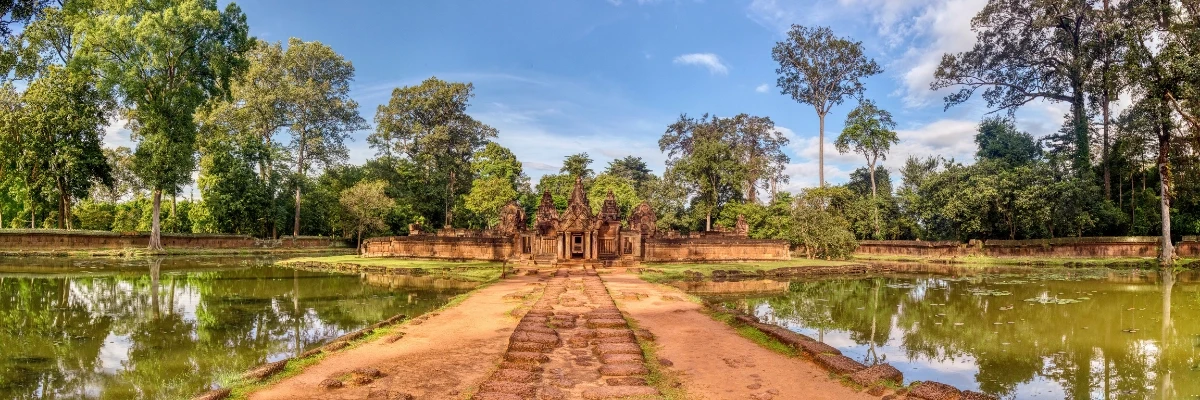
Torn between Cambodia and Laos for your next trip to Southeast Asia? The choice mostly comes down to the pace you're after. Cambodia wins people over with the temples of Angkor, its lively cities and its tropical islands. Laos appeals to those who want to slow down along the Mekong, among mountains, waterfalls and unspoilt villages.
To help you decide, the team at Filovent, a sailing and cruise travel agency founded in 1995, has compared the two destinations on the criteria that really matter: atmosphere, highlights, landscapes, food, budget, season and type of traveller.
Cambodia or Laos: the key differences
Atmosphere and pace of travel
Travelling in Cambodia has a real energy to it. Phnom Penh buzzes with markets, cafés and riverside promenades, Siem Reap teems with travellers who have come to explore Angkor, and the coast has a livelier, more party-friendly side. It's a country that keeps you on the move, from one discovery to the next.
Laos, on the other hand, invites you to take your foot off the pedal. Even its capital, Vientiane, feels like a sleepy provincial town. Days revolve around sunrise, morning markets and long hours on the banks of the Mekong or aboard a cruise in Laos. Here, slowness is part of the experience.
Top sights
Cambodia is home to one of the most spectacular archaeological sites in the world: Angkor, with Angkor Wat, the Bayon and root-covered Ta Prohm. Yet the country is far more than its temples, and there's no shortage of ideas for what to do in Cambodia beyond Angkor:
- Phnom Penh, for the Royal Palace and the country's recent history;
- Battambang, for the countryside, the rice paddies and the famous bamboo train;
- Tonlé Sap Lake and its floating villages;
- Kampot and Kep, for the pepper plantations and the green pepper crab.
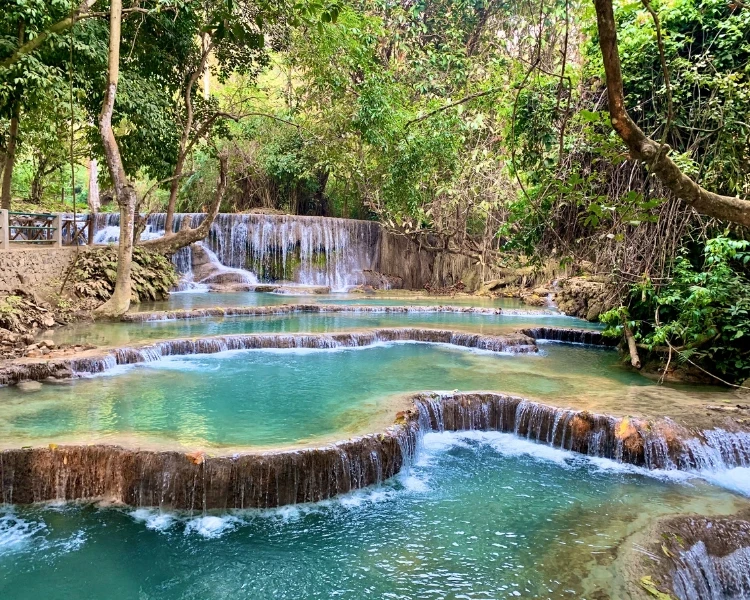 Kuang Si Falls, Laos (Source: Adobe Stock)
In Laos, the one stop you can't miss is Luang Prabang, a former royal city and UNESCO World Heritage Site, with its golden temples, colonial houses and the procession of monks at dawn. Beyond Luang Prabang, these stops are well worth the detour:
- Kuang Si Falls and their turquoise pools;
- Vang Vieng and its karst peaks;
- Nong Khiaw, set on the riverbank at the foot of the cliffs;
- the Plain of Jars, a mysterious UNESCO World Heritage Site;
- the 4,000 Islands (Si Phan Don) in the south, where the Mekong widens into a mosaic of islets.
Nature and landscapes
This is often the deciding factor. Laos is landlocked: if you dream of ending your trip with your toes in the sand, Cambodia is the obvious choice. Its islands, such as Koh Rong and Koh Rong Samloem, offer clear water and white sandy beaches, in a setting reminiscent of the neighbouring archipelagos you can explore on a cruise in Thailand.
Laos, however, comes out on top for mountain scenery, caves, waterfalls and village treks. The two countries share the same common thread: the Mekong, which you can discover by slow boat in Laos and between Phnom Penh and the Tonlé Sap in Cambodia.
Budget
Both destinations are good value by British standards. Accommodation, food and local transport cost considerably less than in the UK. In Cambodia, entry to Angkor is an expense to plan for: in 2026, the pass costs US$37 for one day, US$62 for three days (to be used within a week) and US$72 for seven days (to be used within a month), according to Angkor Enterprise, the official body that manages the site. In Laos, journeys can be longer and sometimes slightly more expensive, due to the mountainous terrain and a less developed road network.
In short, here's how the two destinations compare:
| Criterion | Cambodia | Laos |
| Atmosphere | Lively, urban | Peaceful, contemplative |
| Top highlight | Temples of Angkor | Luang Prabang |
| Beaches | Yes (Gulf of Thailand) | No (landlocked country) |
| Nature | Lakes, islands, forests | Mountains, waterfalls, caves |
| Visitor numbers | More touristy | More off the beaten track |
| Budget | Affordable | Affordable |
| Ideal length | 10 to 15 days | 10 to 15 days |
| Best time to go | November to February | November to February |
Food: Khmer or Lao cuisine?
Food is an excellent reason to choose one over the other. Both cuisines share rice, fresh herbs and a love of market produce, but their flavours are quite distinct.
Cambodian cuisine: mild and fragrant
Khmer cuisine is all about balancing sweet, salty and sour, with milder spices than its neighbours. Coconut milk, lemongrass, galangal and turmeric are everywhere. Dishes you simply must try:
- amok, a fish curry with coconut milk steamed in a banana leaf, the country's signature dish;
- lok lak, stir-fried beef served with a lime and pepper sauce;
- num banh chok, rice noodles with green curry, often eaten for breakfast;
- Kampot green pepper crab, the great speciality of the Kep crab market.
Lao cuisine: fresh and spicy
Lao cuisine is more herbal, more sour and often spicier. It's traditionally eaten with your fingers, rolling small balls of sticky rice to dip into the dishes. Dishes not to miss:
- laap, a salad of minced meat or fish with fresh herbs and lime, regarded as the national dish;
- khao niao, the sticky rice served in small bamboo baskets at every meal;
- tam mak hoong, a fiery green papaya salad;
- or lam, a thick stew of vegetables and herbs, a Luang Prabang speciality;
- khao piak sen, a comforting noodle soup.
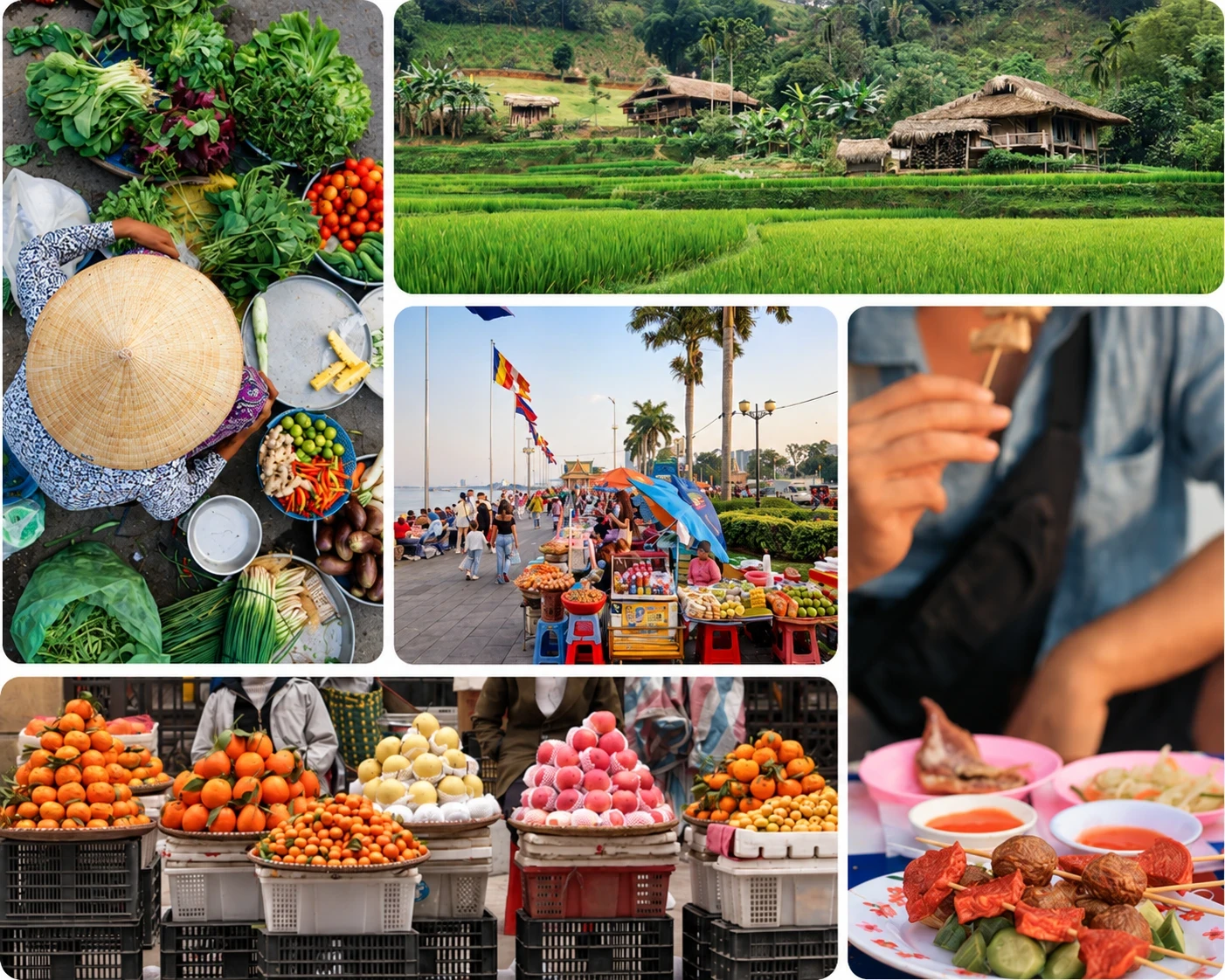 Typical Southeast Asian food (Sources: Adobe Stock, Shutterstock)
Which one for foodies?
If you prefer mild flavours and coconut milk curries, Cambodia will delight you, with the added bonus of seafood from the coast. If you love bold tastes, fresh herbs and chilli, Laos will surprise you more. In both countries, night markets and street stalls remain the best way to try everything on a budget.
When is the best time to visit Cambodia and Laos?
Both countries have a tropical monsoon climate, with fairly similar seasons. On the river itself, the best time to go on a cruise in Southeast Asia along the Mekong runs from November to March.
- November to February: the ideal season. It's dry, temperatures are pleasant and skies are clear. It's also the busiest period.
- March to May: the heat becomes intense, especially in April. In Laos, the end of the dry season can bring haze from agricultural burning.
- June to October: the rainy season. Showers are often short, the landscapes lush and green and the sites less crowded, but some roads become difficult.
Worth knowing: the Mekong's water level changes dramatically from one season to the next. High water, at the end of the rainy season, is the best time to discover the Tonlé Sap and its floating villages.
Which one suits your travel style?
For a first trip to Asia
Cambodia is often the easier place to start: tourist infrastructure is more developed, distances are shorter and Angkor provides an instant highlight. Laos is also very well suited to first-timers, as long as you're happy with longer journeys.
As a family
Both countries lend themselves to family holidays. Cambodia mixes temples and beaches, which tends to go down well with children. Laos wins families over with its calm, swimming in waterfalls and boat trips on the Mekong.
As a couple
For a romantic and relaxing trip, Laos is hard to beat: sunsets on a Mekong cruise in Laos, charming guesthouses in Luang Prabang and the tranquillity of the 4,000 Islands. Cambodia can also work well if you end your trip with a few days on an island.
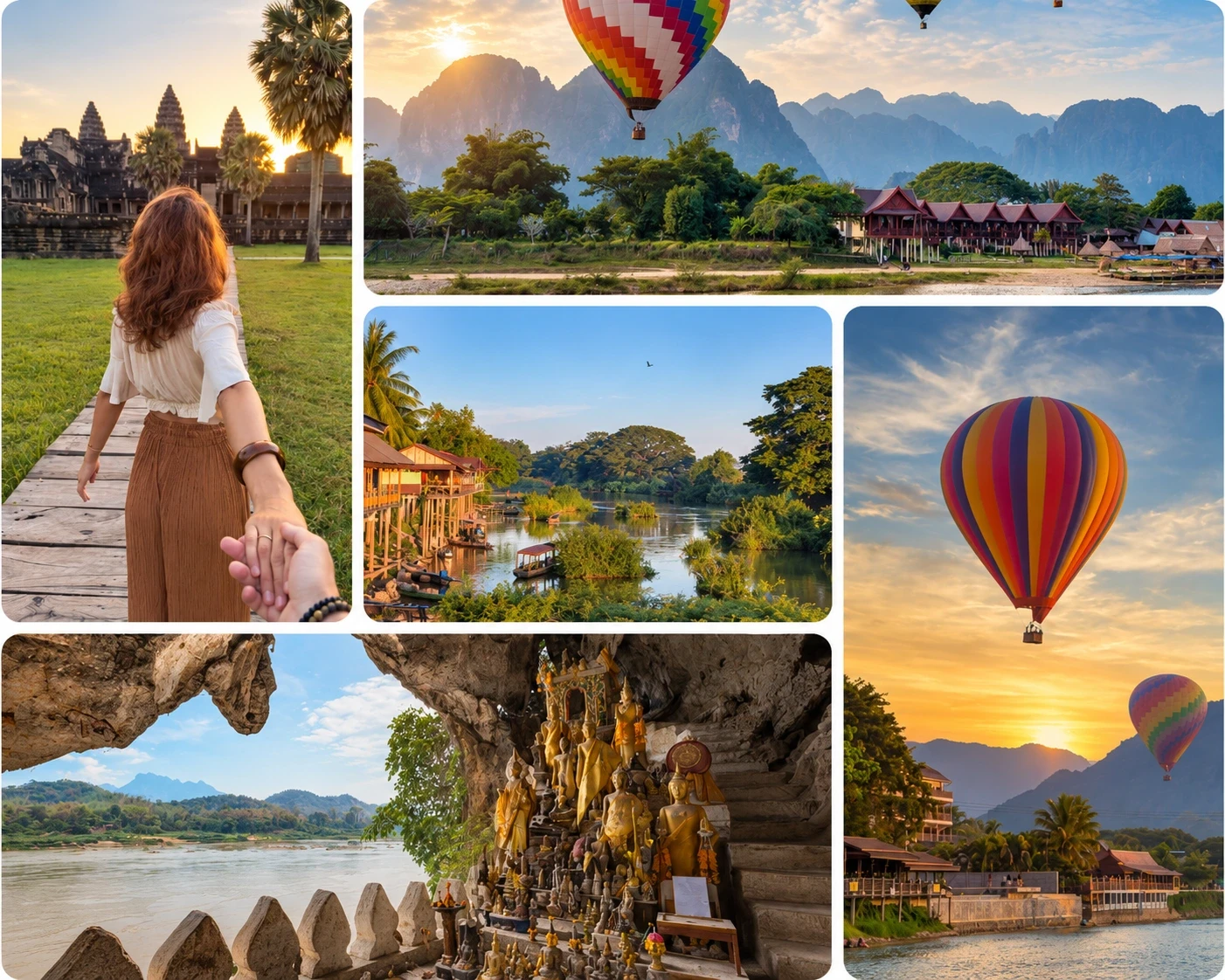 Landscapes of Laos (Sources: Adobe Stock, Shutterstock)
On a tight budget
It's a draw: both countries offer excellent value for money. In Cambodia, remember to factor in the cost of the Angkor pass. In Laos, expect transport to be slightly more expensive over long distances.
Short on time
With barely a week, Cambodia is easier to organise: a few days at Angkor and a stop in Phnom Penh are enough for a first taste, perhaps linked by a short cruise in Cambodia. In Laos, a week is enough to discover Luang Prabang and its surroundings, but not much more: you'll need to know exactly what to do in Laos so you don't miss the essentials.
Why not both?
If you have three weeks, there's no need to choose. Cambodia and Laos combine naturally, following the course of the Mekong.
- Recommended length: 3 weeks for a well-balanced combined trip, 4 weeks to take your time.
- Direction of travel: from northern Laos to southern Cambodia, to end on a beach.
- Crossing the border: the main land crossing links southern Laos, near the 4,000 Islands, with north-eastern Cambodia. You can also fly between the two countries.
The Mekong remains the best common thread for this trip: a slow boat in Laos, then sailing in Cambodia between Phnom Penh and the Tonlé Sap. Further south, a Mekong cruise between Cambodia and Vietnam links several stops without the long road journeys.
Frequently asked questions
Which country is more beautiful, Cambodia or Laos?
It all depends on what you're looking for. Cambodia impresses with its heritage, led by Angkor. Laos captivates with its natural landscapes and peaceful atmosphere.
Which one is more touristy?
Cambodia welcomes more visitors, largely thanks to Angkor, especially in winter, when it's one of the best answers to where to go on a cruise in December. Laos remains more off the beaten track, although Luang Prabang and Vang Vieng attract many travellers.
Are there beaches in Laos?
No, Laos is the only landlocked country in Southeast Asia. For beaches, head to Cambodia or neighbouring Thailand, where boat hire in Thailand lets you explore the islands of the Andaman Sea and the Gulf of Thailand.
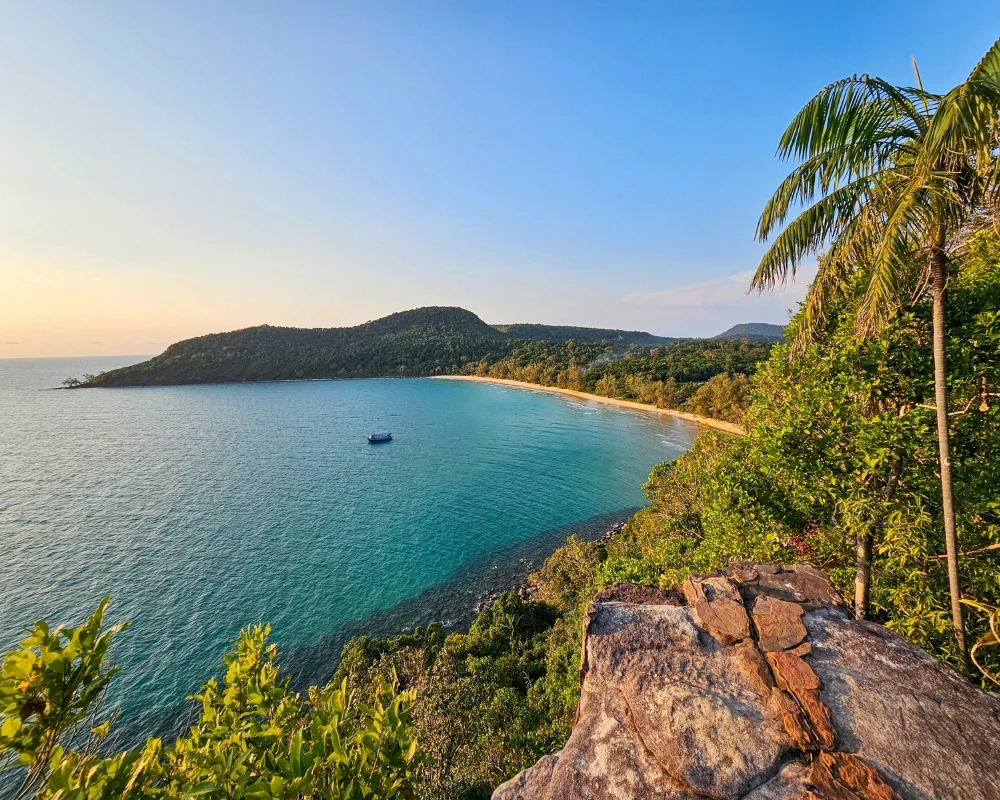 Koh Rong Samloem, Cambodia (Source: Shutterstock)
Do you need a visa for Cambodia and Laos?
Yes, British citizens need a visa for each of the two countries, as well as a passport valid for at least six months. You can get one online before you travel (via the official portals evisa.gov.kh for Cambodia and laoevisa.gov.la for Laos), from the embassy or on arrival, although not all border posts issue visas. According to France Diplomatie (September 2026), the Cambodian visa costs around US$40 in cash at land crossings from Laos. As conditions and fees change regularly, check them before you travel.
Are Cambodia and Laos safe destinations?
Yes, both countries are considered safe destinations for travellers. The usual precautions apply: keep an eye on your belongings in crowded places and stick to marked paths in rural areas. Check the FCDO's foreign travel advice before you go.
How many days do you need to visit Cambodia or Laos?
Allow 10 to 15 days to see the essentials of each country, and around 3 weeks to combine the two. The delta alone takes just four days: that's the length of a classic Mekong cruise itinerary from Ho Chi Minh City to Phnom Penh.
Sources
- Angkor Enterprise. (2026). Available tickets – Angkor Pass. Royal Government of Cambodia. https://www.angkorenterprise.gov.kh/en/available-tickets (accessed 28 September 2026).
- Ministère de l'Europe et des Affaires étrangères. (2026, 21 September). Cambodge – Entrée / Séjour. Conseils aux voyageurs. France Diplomatie. https://www.diplomatie.gouv.fr/fr/information-par-pays/cambodge/conseils-aux-voyageurs-entree-sejour (accessed 28 September 2026).
- Ministère de l'Europe et des Affaires étrangères. (2026, 15 September). Laos – Entrée / Séjour. Conseils aux voyageurs. France Diplomatie. https://www.diplomatie.gouv.fr/fr/information-par-pays/laos/conseils-aux-voyageurs-entree-sejour (accessed 28 September 2026).
- UNESCO World Heritage Centre. (n.d.). Ville de Luang Prabang. https://whc.unesco.org/fr/list/479 (accessed 28 September 2026).
- UNESCO World Heritage Centre. (n.d.). Sites de jarres mégalithiques de Xieng Khouang – plaine des Jarres. https://whc.unesco.org/fr/list/1587 (accessed 28 September 2026).