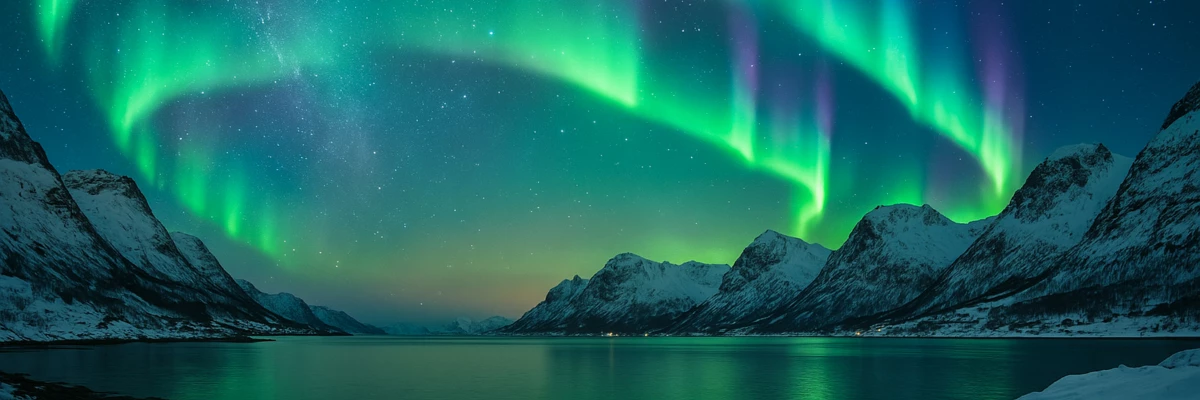
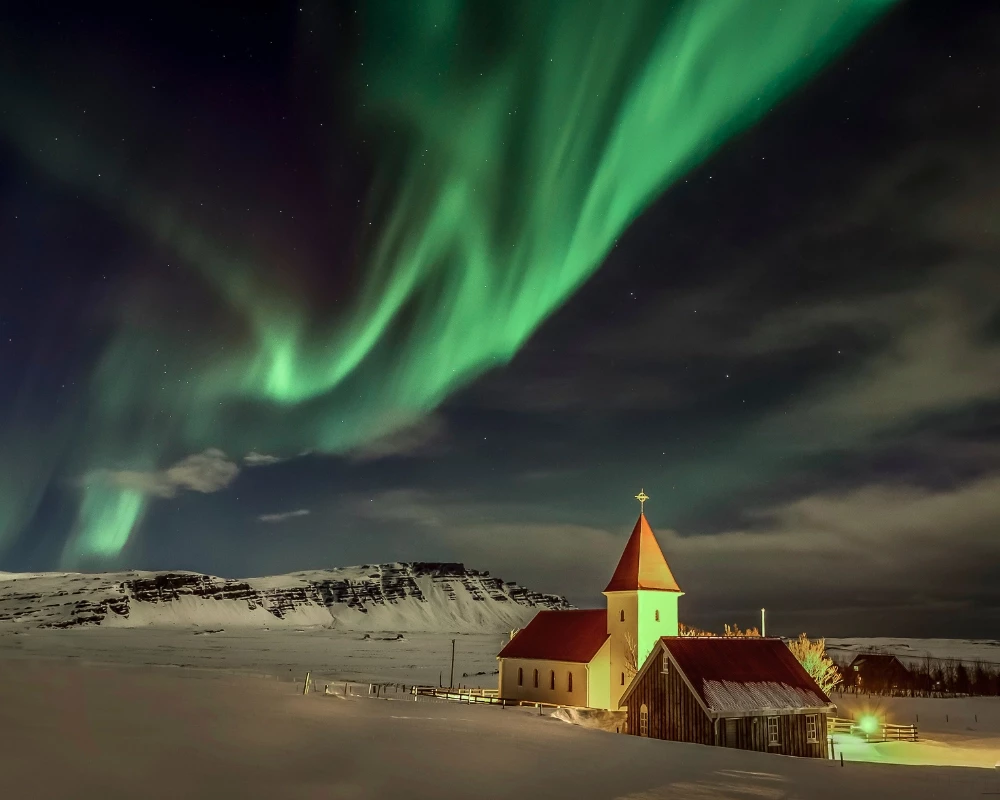
In Iceland, the northern lights are visible from September to April, on nights that are dark enough and skies that are clear enough. The sky can stay quiet for several nights, then suddenly light up with green veils above a lava field, a glacier or a lagoon.
Seeing them owes as much to preparation as to luck. Across that season the country offers many opportunities to witness the phenomenon, provided you deal with the weather, the darkness and solar activity. Choosing the right period, knowing where to go and learning to read the forecasts is what tips the odds in your favour.
Summary
- 1. When can you see the northern lights in Iceland?
- 2. Where can you see the northern lights in Iceland?
- 3. How can you maximize your chances of seeing the northern lights?
- Check the weather before heading out
- Understand northern lights forecasts
- Get away from the lights and stay mobile
- 4. How can you go northern lights hunting in Iceland?
- By car, for more freedom to move around
- On a guided tour
- From the sea, a different way to experience the Icelandic sky
- 5. How should you prepare for a trip to see the northern lights?
- How many days should you plan for in Iceland?
- What should you wear while waiting for the northern lights?
- Photographing the northern lights in Iceland
- 6. Frequently asked questions about the northern lights in Iceland
- What is the best month to see the northern lights in Iceland?
- Can you see the northern lights from Reykjavik?
- Can you see the northern lights in Iceland in summer?
- Are the northern lights visible to the naked eye?
- Are you guaranteed to see the northern lights on a trip to Iceland?
- Do you need a moonless night to see the northern lights?
When can you see the northern lights in Iceland?
The northern lights season, from September to April
The northern lights occur all year round. What changes with the seasons is not the phenomenon itself, but our ability to see it: the sky has to be dark enough. In summer, the brightness of Icelandic nights makes observation impossible, even when solar activity is strong.
The viewing season in Iceland therefore runs broadly from September to April. This is the period when nights become long enough and dark enough for the aurora to appear. The window is similar in other countries at these latitudes, starting with the northern lights in Norway.
In late August and early September, the first sightings become possible again. Nights are still short, but they regain genuine darkness and the landscapes keep their autumn colours. September and October offer a good compromise: there is enough darkness, temperatures remain bearable and most inland roads are still open.
From November to February, the nights are especially long. In late December, in Reykjavik, it is dark from late afternoon until mid-morning, which considerably extends the viewing window. In return, the Icelandic winter imposes its constraints: storms, wind, snow, ice and road closures.
March and early April close the season. Nights remain dark enough to watch the northern lights, while days grow noticeably longer, leaving far more time to explore the island before nightfall.
One point is worth clarifying: no period guarantees more aurora than another. And contrary to a widespread idea, cold is not the cause of the phenomenon. If the northern lights are associated with winter, it is purely because darkness is what makes them visible.
| Period | Available darkness | Conditions on the ground | Key point |
| Late August to early September | Short but genuinely dark nights | Mild temperatures, roads open | Start of the season, autumn landscapes |
| September and October | Nights lengthening quickly | Weather still relatively mild | Good compromise between comfort and darkness |
| November to February | Very long nights | Full winter: wind, snow, ice, roads sometimes closed | Maximum viewing window, trickier travel |
| March to early April | Nights still dark enough | Longer days, milder winter | Plenty of time for daytime sightseeing |
What time can you see the northern lights?
There is no precise time at which an aurora appears. The only genuinely decisive condition is that the night be dark enough.
An aurora can therefore show up early in the evening, just after dinner, or much later, in the middle of the night. In practice, most observers watch the Icelandic sky as soon as darkness sets in and stay available for several hours.
The duration of the phenomenon is just as variable. An aurora may last only a few minutes, disappear completely, then return an hour later with greater intensity. Other episodes stay visible for several hours on end. Patience is part of the experience: giving up after twenty minutes often means missing out.
Where to see the northern lights in Iceland?
There is no single "best spot" in Iceland. Three criteria matter above all: a clear sky, low light pollution and a sufficiently open field of view towards the north. A completely unknown location under a clear sky will always beat an iconic site smothered in cloud.
Reykjavik and its surroundings
It is entirely possible to watch the northern lights from Reykjavik when they are strong enough. During the most active episodes, they can even be made out from certain districts of the capital.
Urban lighting remains a handicap, however. It erases faint aurora, the ones that first appear as a greyish veil on the horizon, and sharply reduces colour contrast.
To stay in the city while moving away from the lights, the Seltjarnarnes peninsula and the Grótta lighthouse, at the western tip of the urban area, are among the most used spots. They offer a clear horizon over the ocean and much more limited lighting.
Leaving Reykjavik nevertheless remains the best option. A few dozen kilometres are enough to find a genuinely dark environment, which radically changes how the phenomenon is perceived.
The Golden Circle
The Golden Circle has the advantage of remaining accessible from Reykjavik in every season, which makes it a convenient fallback area when cloud cover worsens over the capital.
- Thingvellir National Park: wide open spaces, a barely lit environment and broad, unobstructed views over the rift and the lake, with fine foreground possibilities.
- The Gullfoss area: further east, it also allows you to move away from light sources, with the sound of the waterfall in the background.
- The surroundings of Laugarvatn: a stretch of water that reflects the Icelandic sky, with accommodation right nearby.
The appeal of this area lies above all in how it can be organised: you string together the classic Golden Circle sights during the day, then go hunting for the aurora once night has fallen, without having to reach a distant region.
The south coast
The south coast concentrates several of Iceland's most photographed settings, and its interest for aurora watching owes a great deal to what you can place in the foreground.
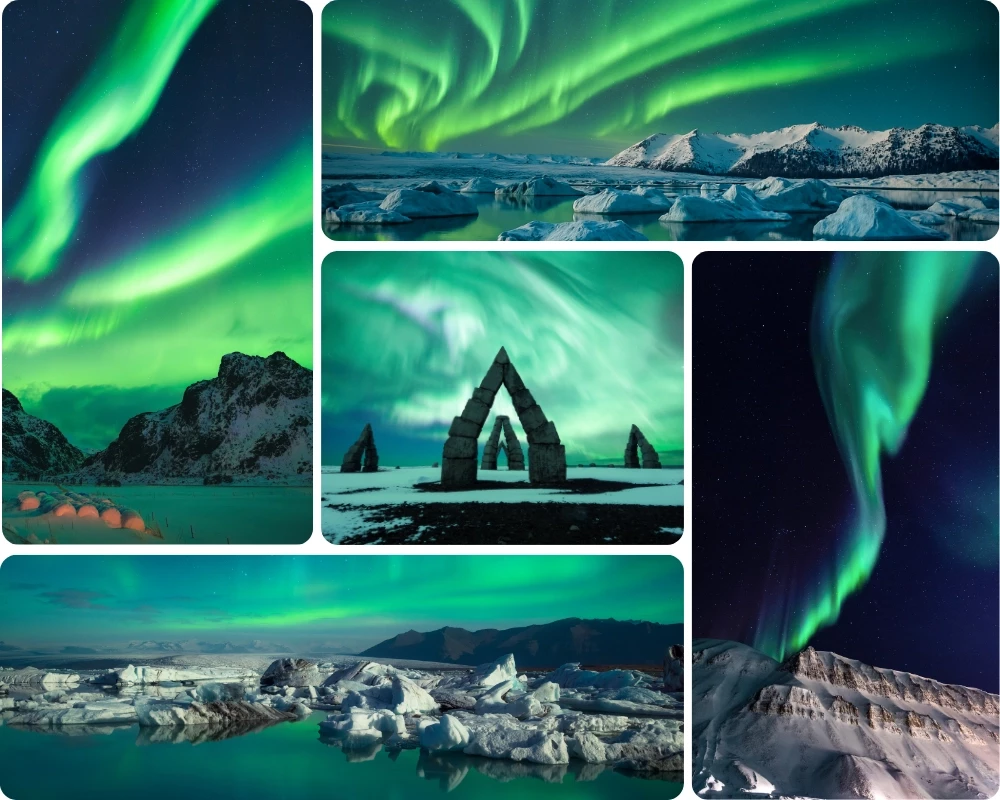
The Jökulsárlón glacier lagoon is probably the most sought-after site on that count. The icebergs calved from the glacier and the surface of the water send back the light of the aurora and multiply the visual effect, producing scenes that are impossible to reproduce anywhere else.
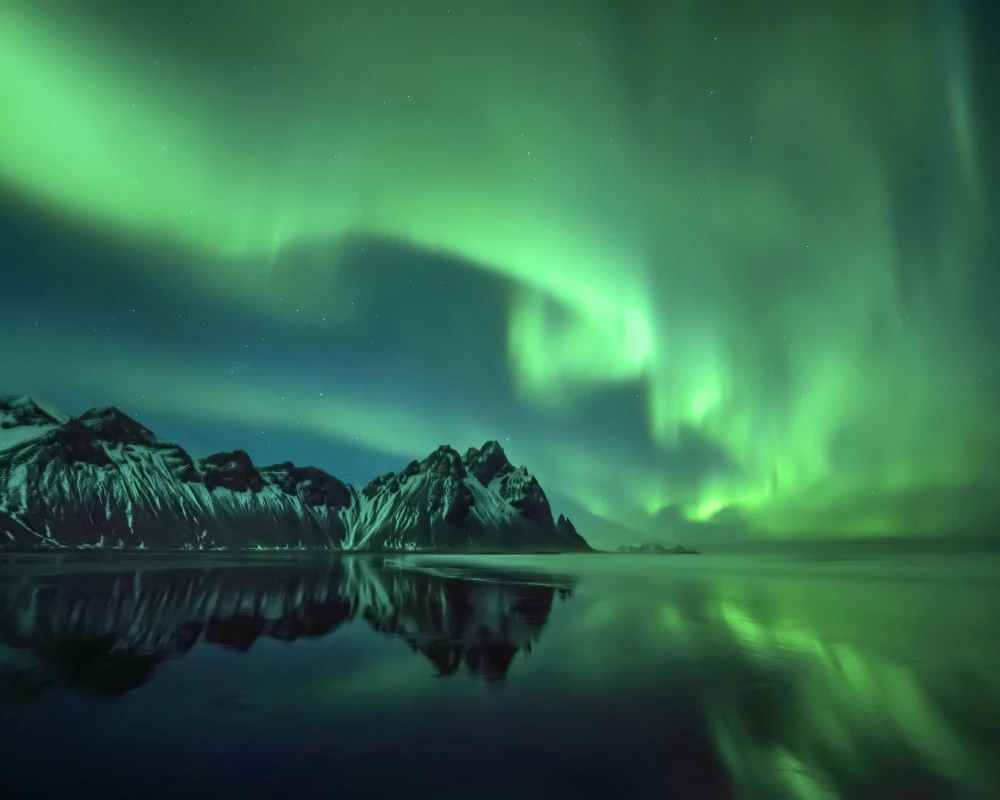
Skógafoss lets you combine a sixty-metre waterfall with the night sky, while the Vestrahorn massif, near Höfn, stands out above the black sand beaches of Stokksnes. Glaciers, coastline and mountains make up a typically Icelandic foreground here, which clearly sets aurora watching on this coast apart from simply watching from open flat ground. These same settings can be found from the water on a cruise through the polar lands and fjords.
Northern and western Iceland
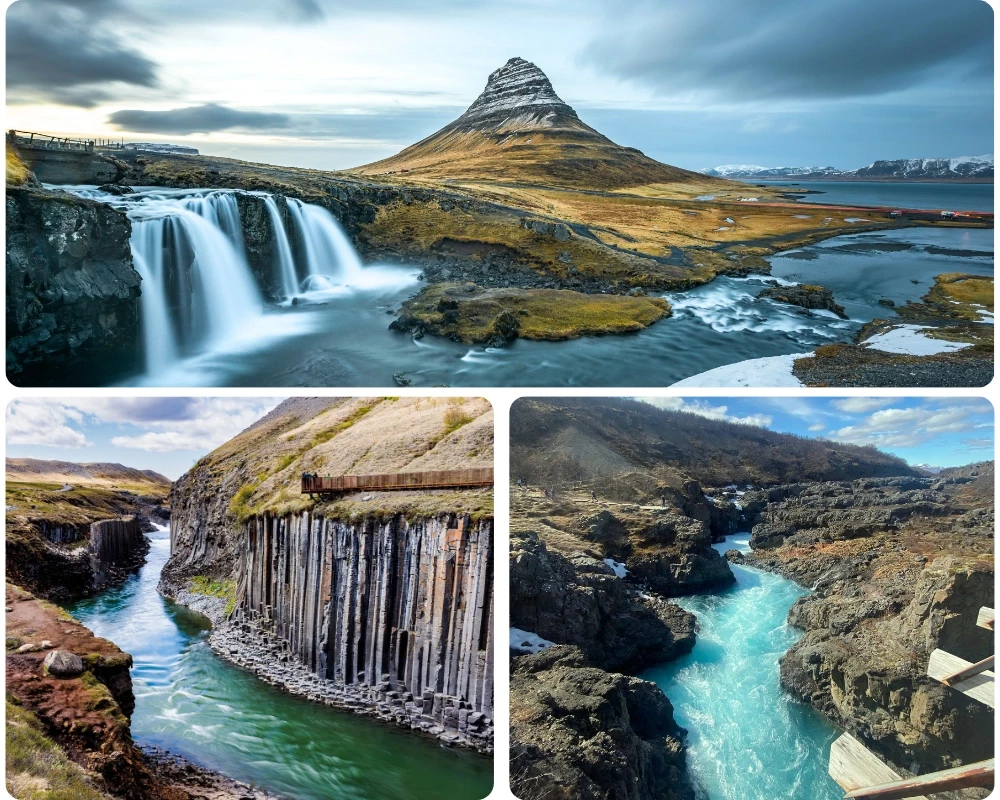
The north of the island is very sparsely built up, which makes it particularly favourable terrain. Lake Mývatn, with its lava fields, craters and stretches of water, is among the most popular areas. The surroundings of Akureyri and Húsavík also offer dark skies a short distance from accommodation, on the shores of Eyjafjörður, the longest fjord in Iceland.
To the west, the Snæfellsnes peninsula packs volcanic relief, an indented coastline and very little artificial light into a few dozen kilometres. Mount Kirkjufell, with its recognisable outline and the Kirkjufellfoss waterfalls in front of it, has become a landmark for photographers.
These regions have another advantage: they remain less busy than the south of the island in winter, which leaves more freedom to choose your spot and wait in peace.
How can you maximise your chances of seeing the northern lights?
The northern lights result from the interaction between charged particles emitted by the Sun and the gases of the upper atmosphere. The Earth's magnetic field channels some of these particles towards the polar regions, where they trigger the emission of light observed from the ground.
This mechanism explains why Iceland is so well placed: the country lies beneath the auroral oval, the ring-shaped zone where aurora are most frequent. That same ring crosses northern Scandinavia, where a cruise in the Norwegian fjords offers comparable viewing conditions. Green dominates by far, but red, pink, blue or purple can appear depending on the gases involved and the altitude at which the reaction occurs.
This background is enough to plan a trip. The rest comes down to four conditions that must be met at the same time:
- A sufficiently dark night, which rules out much of the Icelandic summer.
- A clear sky above the viewing point, the most restrictive condition in Iceland.
- Low light pollution, therefore a location far from urban centres.
- Sufficient auroral activity, the only parameter over which the traveller has no control.
The first three conditions depend on the place and the time you choose, and can therefore be worked on in advance. The last one cannot be controlled, only monitored.
Check the weather before setting off
Of these four conditions, cloud cover is the one that ruins the greatest number of outings. It therefore deserves close attention, and not only on the eve of departure.
In Iceland, cloud cover is the main difficulty. The weather changes extremely fast: an evening can go from a completely overcast sky to a clear break in less than an hour, then close in again just as quickly. A very active aurora remains entirely invisible behind a layer of cloud.
Another useful habit: an overcast sky in Reykjavik tells you nothing about what is happening elsewhere. It is not unusual for a clear zone to sit a few dozen kilometres away, on the Golden Circle, the Reykjanes peninsula or the south coast. Consulting a cloud cover map for the whole island, rather than just the forecast for your own town, changes a great deal.
Understanding northern lights forecasts
Aurora forecasts are based mainly on the Kp index, a scale from 0 to 9 that measures the intensity of geomagnetic activity. The higher the value, the stronger the activity and the further south the aurora is likely to be visible.
Two nuances are worth remembering. First, a high Kp does not guarantee a sighting: without a clear sky, it is of no use. Second, because Iceland is very well placed geographically, an aurora can be perfectly visible there with a relatively low Kp, where other European countries would need far stronger activity.
There is no need to go further into technical parameters such as the Bz component or solar wind density: for a trip, the essential thing is to cross-check two pieces of information, the aurora forecast and the cloud cover. The forecasts of the Icelandic Meteorological Office, the most reliable source for the country's weather conditions, in fact bring both together on a single map. Apps such as My Aurora Forecast, or weather visualisation tools such as Ventusky, usefully complete the picture.
Get away from the lights and stay mobile
Leaving urban centres remains the most rewarding move. Under a genuinely dark sky, a faint aurora becomes perceptible, whereas it would go completely unnoticed from a lit area.
A few simple habits clearly improve viewing conditions:
- Look for a clear horizon towards the north, with no relief or buildings in the way: a lakeside car park, a viewpoint or a beach will do perfectly.
- Switch off every nearby light source, car headlights included, and give your eyes about fifteen minutes to adjust to the darkness.
- Stay mobile: Icelandic weather changes fast, and driving thirty or forty kilometres to reach a break in the clouds is often the difference between a blank evening and a successful sighting.
- Keep a fallback option in another direction, identified before nightfall on the cloud cover map.
Two safety rules do apply, however. Never stop on the verge of an Icelandic road to watch or photograph an aurora: roadside stops are a known cause of accidents on the ring road. And always check road conditions and weather alerts with the Icelandic road services before any winter journey.
How can you go hunting for the northern lights in Iceland?
From the sea, the darkest horizon within reach
Iceland is an island, and the sea fits fairly naturally into the experience. Night sailings leave from Reykjavik's old harbour in particular, and a few nautical miles offshore are enough to change viewing conditions completely: once the vessel clears the harbour lights, the capital's glow drops away astern.
Out at sea, you get an unobstructed horizon and no light pollution to wash out the colours. Colour perception gains a great deal, especially during low-intensity episodes, and watching from the deck, with the aurora reflected on the water, adds a dimension you will not find on land.
It is also the gateway to another way of travelling in the Far North. Human-scale vessels, whether small expedition ships or charter yachts, combine daytime coastal discovery with clear skies once night falls, without having to get back on the road. Anchorages sit far from any village, in fjords where the only lights are those of the ship herself. For anyone wanting to go further north, an Arctic cruise extends the same logic towards Greenland and Svalbard.
The limitation is obvious: a vessel is far less mobile than a car. There is no driving fifty kilometres to get around a mass of cloud. A night at sea should therefore be seen as an experience in its own right, not as the most effective way to chase a clear break.
By car, to stay free to move around
The car remains the most flexible option for an aurora hunt. It lets you switch area according to cloud cover, chase a clear break spotted on a map, and stay as long as you like at one spot without depending on a return time.
That flexibility pairs naturally with a self-drive itinerary in Iceland: you sightsee during the day, choose your viewing point in the late afternoon and adjust according to the evening forecast.
Winter does call for real vigilance, though. Snow, ice, strong wind and temporary road closures are frequent between November and March, including on the main routes. Checking road conditions before every journey is not a formality, it is a safety requirement.
On a guided excursion
Guided excursions, widely available from Reykjavik, are a good alternative for anyone who would rather not drive at night in winter.
Their main strength lies in the experience of the guides. Used to reading aurora forecasts and cloud maps together, they know where to head on a given evening and adapt the route along the way.
Small-group outings offer more flexibility than large coaches, with the option of moving away from the busiest sites. Some operators also offer a free second attempt when no aurora was seen on the first night, which is worth checking when booking.
How should you plan your trip to see the northern lights?
How many days should you plan in Iceland?
Betting on a single night is risky. All it takes is a cloud front or weak solar activity for the window to close, with no chance of a second try.
Simply put, the more nights your stay includes, the greater the chances of having both a clear sky and sufficient auroral activity at the same time. That never amounts to a guarantee: the aurora remains an unpredictable natural phenomenon that no tour operator and no app can promise.
The best approach is to build the stay around discovering Iceland by day and to treat the search for the northern lights as an evening activity. A cruise in Iceland fits that logic well, stringing together coastal stops over several consecutive nights. Glaciers, waterfalls, volcanic areas, hot springs and coastline fill the days more than adequately: if the aurora appears, it adds to the trip; if it keeps you waiting, the stay loses none of its appeal.
What should you wear while waiting for an aurora?
The issue is not just the temperature on the thermometer. In Iceland, it is the combination of wind and standing still that makes waiting hard: an hour on your feet without moving, facing a steady wind, feels far colder than a hike at the same temperature. On deck, the apparent wind adds to it, so plan for one layer more than you think you need.
The three-layer principle remains the benchmark. A thermal layer next to the skin to wick away moisture, an insulating fleece or down layer to hold in warmth, and a waterproof, windproof jacket on the outside to block the wind and showers.
The rest comes down to a few simple items: warm waterproof shoes, gloves, a hat and thick socks. A head torch, ideally with a red mode, lets you move around without ruining your eyes' adaptation to the dark. A power bank offsets how quickly devices drain in the cold, and a flask of hot drink makes the wait considerably more bearable.
Photographing the northern lights in Iceland
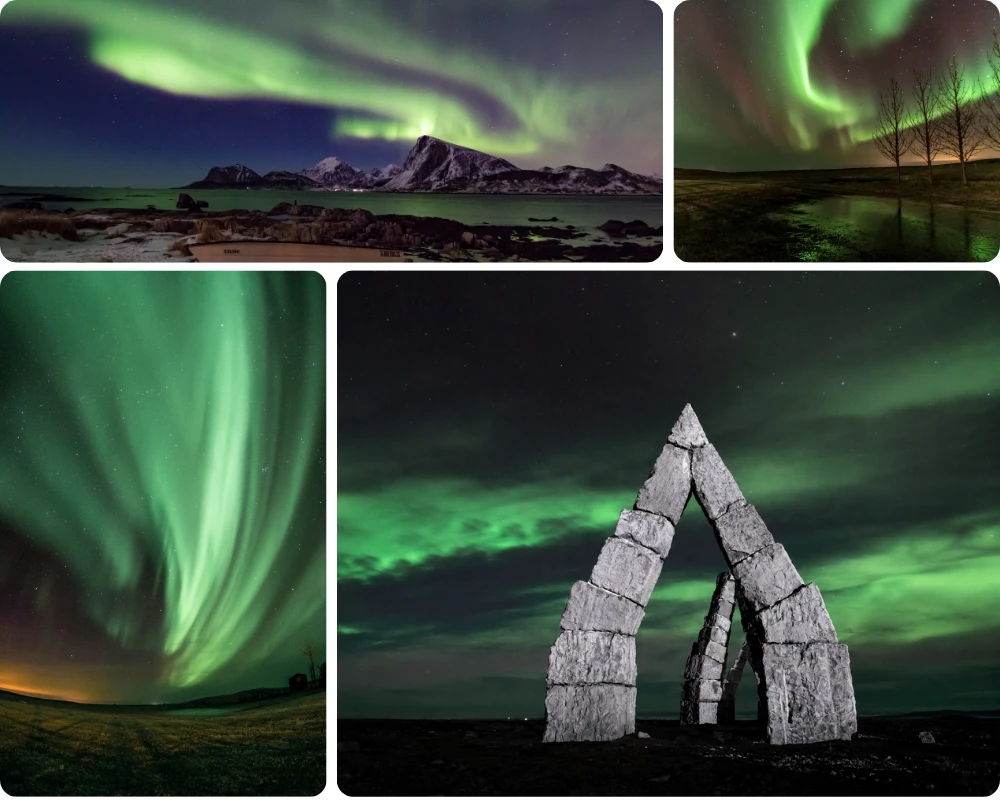
With a camera, everything hinges on three elements: a fast lens, a wide-angle focal length to take in the landscape, and a stable tripod, essential as soon as exposure times lengthen.
Settings can only be given as a guide, since they depend entirely on the intensity of the aurora. In practice you work in manual mode, with a high ISO, maximum aperture and an exposure of a few seconds up to around twenty seconds. A very active aurora calls for a short exposure to preserve the structure of the display; a faint one calls for a longer exposure. On the water, keep exposures shorter still, since the vessel's movement blurs anything much beyond a few seconds.
On a smartphone, the night mode of recent devices gives decent results provided the phone is stabilised, ideally on a small tripod or a fixed surface. The flash, on the other hand, is completely useless: it lights nothing at that distance and degrades the image.
One last point, often a source of disappointment: sensors record more colour than the human eye. A faint aurora can look greyish or pale green to the naked eye and come out a vivid green in the photograph. This is not a flaw in your eyesight, simply a difference in sensitivity between eye and sensor, and it is better to know about it before you go.
Frequently asked questions about the northern lights in Iceland
What is the best month to see the northern lights in Iceland?
The viewing season runs from September to April. No month guarantees a sighting: September and October offer milder conditions, November to February much longer nights, March and April a good balance between darkness and daytime sightseeing. The choice mainly depends on the type of trip you want.
Can you see the northern lights from Reykjavik?
Yes, particularly when activity is strong. Urban lighting does sharply reduce the contrast of faint aurora, though. It is better to head for the least lit parts of the city, such as Seltjarnarnes and the Grótta lighthouse, or to leave the urban area altogether.
Can you see the northern lights in Iceland in summer?
The phenomenon still occurs, but Icelandic nights are too bright for much of the summer to allow any sighting. As Iceland lies almost entirely south of the Arctic Circle, it has no true polar night in winter, but it does have extremely bright summer nights.
Are the northern lights visible to the naked eye?
Yes. Their colours appear less saturated than in photographs, however, especially during low-activity episodes, when the aurora can look greyish or pale green.
Are you certain to see the northern lights on a trip to Iceland?
No. Sightings depend on solar activity, darkness and above all cloud cover. No destination, no season and no excursion can guarantee them. Spending more nights on site simply increases the number of opportunities.
Do you need a moonless night to watch the aurora?
No. A full moon reduces the contrast of the faintest aurora, but it does not prevent you from watching a sufficiently strong episode. It also lights up the landscape, which can even be useful for photography.
Chasing the northern lights ultimately comes down to giving yourself enough nights, and being in the right place when the sky finally clears. Building the trip around several nights afloat, with the days given over to glaciers, fjords and black sand coastlines, remains the surest way to make the most of that window: if the aurora appears, the voyage takes on another dimension, and if it stays hidden, Iceland alone is well worth the crossing. Our cruise teams can help you pick the season and the itinerary that match the trip you have in mind.