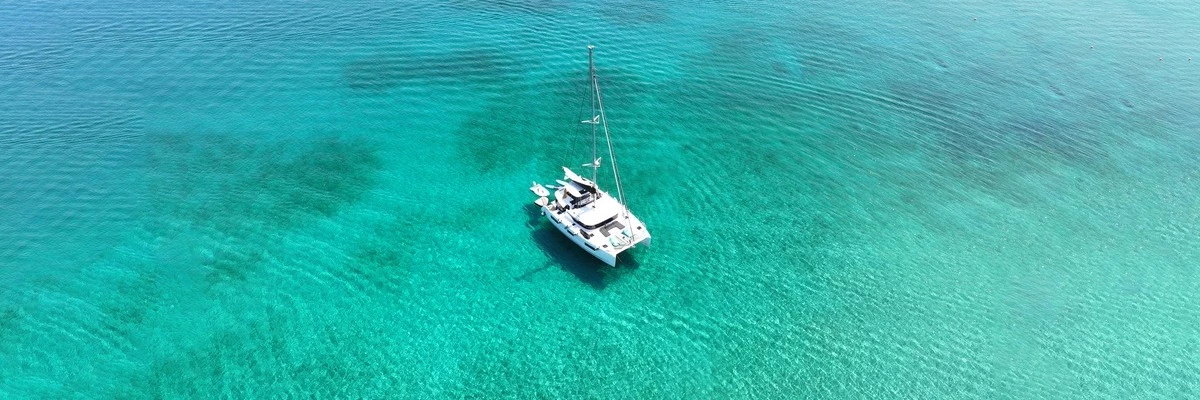
"How much should you really budget for a week at sea?" This is the first question most of our clients ask themselves before casting off.
The answer comes in a broad range, and that's normal: a week's cruise can cost €450 per person or exceed €10,000. Let's be clear from the outset: we're talking here about sailing cruises or private boat charters (sailing yacht, catamaran, dahabiya), not the large cruise ships such as MSC or Costa, which follow a very different pricing logic. It all then comes down to three variables: the package you choose, the type of boat and the season. In this article, we break down the price of a one-week cruise package by package and destination by destination, with concrete figures, so you can place your own budget.
The essentials at a glance:
|
Summary
- 1. How much does a one-week cruise for 2 people cost?
- 2. The 6 factors that make a cruise price vary
- 1. The season, the number-one lever
- 2. The destination
- 3. The type of boat
- 4. The size and number of cabins
- 5. Booking in advance
- 6. What's included
- 3. Cruise prices by destination: cabin or charter
- Mediterranean cruise prices
- Nile cruise prices
- Caribbean and West Indies cruise prices
- Norwegian fjords cruise prices
- All-inclusive Corsica cruise prices
- 4. Chartering a whole boat: how much to budget for a private cruise?
- 5. Beyond the advertised price: the real budget for a one-week cruise
- 6. How to pay less for your cruise: 6 tips to save
- 7. Frequently asked questions
- How much does a one-week cruise in the Mediterranean cost?
- How much does a one-week cruise on the Nile cost?
- What is the cheapest cruise package for a week?
- Is the price of a cabin cruise per person or per cabin?
- Can you pay for a cruise in instalments?
- Does a cruise price drop at the last minute?
- Do you need a boat licence to rent bareboat?
- Is the security deposit included in the cruise price?
- When should you book to pay less?
How much does a one-week cruise for 2 people cost?
The price of a cruise for 2 people over one week depends above all on the package you choose. Three main options exist, from the most affordable to the most upmarket, and each suits a different traveller profile. The table below gives you an overview so you can get your bearings straight away.
| Package | How it works | Who is it for? | Price for 2 people / week |
| Cabin cruise | You rent a cabin, crew and full board included | Couples, tight budget, first experience | €2,500 to €4,500 |
| With skipper or crew | Private boat charter, professional(s) on board | Seeking comfort, no licence | From €4,000 (the boat) |
| Without a skipper (bareboat) | Boat rented bare, you helm it | Qualified, self-sufficient sailors | Monohull ~€4,500 · Catamaran ~€10,500 (the boat) |
A word on the vocabulary: the term bareboat refers to renting a boat "bare", in other words without a skipper or crew. You helm it yourself, provided you hold a licence and are sufficiently self-sufficient at sea.
Then bear in mind the key nuance: for a cabin, the price is per person or per cabin (crew included); for the other two packages, it is the price of the whole boat, to be divided by the number of crew members. This is why a catamaran advertised at €10,500 can become very affordable once shared between eight people. We detail each case in the rest of the article.
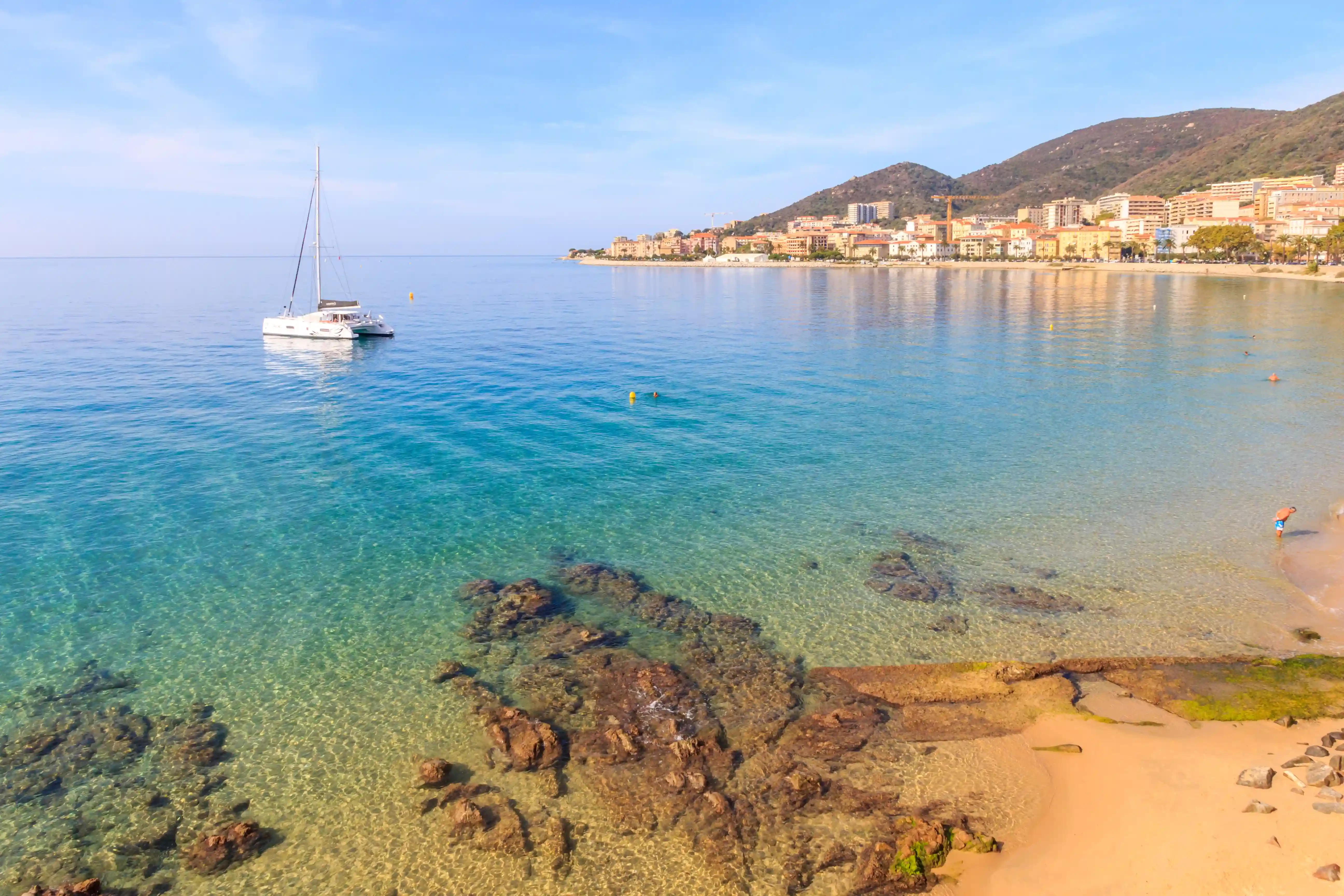
The 6 factors that make a cruise price vary
No two one-week cruises are priced exactly alike, and that is precisely what makes the budget question so hard to settle with a single figure. Six levers explain most of the differences you'll see from one offer to the next. Understanding them means not only decoding why two seemingly similar cruises can vary by several thousand euros, but also knowing exactly which levers to pull to fit the bill to your budget.
1. The season, the number-one lever
It is by far the most powerful factor, the one that can make the price of the same cruise, on the same boat, swing from single to double. The logic is that of the entire travel industry: when demand rises, prices follow. We generally distinguish three periods. High season corresponds to the school holidays and the best weather: in the Mediterranean, that means July and August, when a week negotiated at €2,500 in spring can reach €4,200. Mid-season (June and September in the Mediterranean) offers an excellent compromise, with still-ideal weather and intermediate rates, around €3,300. Low season (April, May, October) shows the gentlest prices, sometimes 30% to 40% below the summer peak.
Be aware that this calendar reverses depending on the destination. In the West Indies, the high season is the European winter (December to April), when Europe is shivering and the Caribbean enjoys its ideal weather, safe from the cyclone season. In Egypt, you avoid the summer heatwave: the best time to set off on a Nile cruise falls between November and May. Understanding this rhythm specific to each sea is the first key to paying less: shifting your departure by two or three weeks, just before or after the peak, is often enough to save several hundred euros for almost identical weather.
2. The destination
Not all seas are equal in budget terms, and the gap can be considerable. A week in the Mediterranean remains far more affordable than a cruise in the Seychelles, in Polynesia or in the Norwegian fjords, where several factors combine: the remoteness, the cost of bringing in and maintaining boats in far-flung areas, a sometimes very short operating season, and a limited supply that keeps prices high.
On top of this cruise price comes the cost of getting there, which should never be overlooked in the overall budget. A flight to Greece or Croatia weighs far less than a long-haul flight to Tahiti or the Seychelles, the latter alone potentially doubling the cost of the trip. As a rule, destinations close to France (the western Mediterranean, the Adriatic, Corsica, the Balearics) offer the best price-to-accessibility ratio and are perfectly suited to a first cruise. Far-flung seas, for their part, are best kept for a once-in-a-lifetime trip. This is also why certain destinations such as Egypt stand out: despite the distance, entry-level prices from €450 and relatively short flights make it a surprisingly competitive option.
3. The type of boat
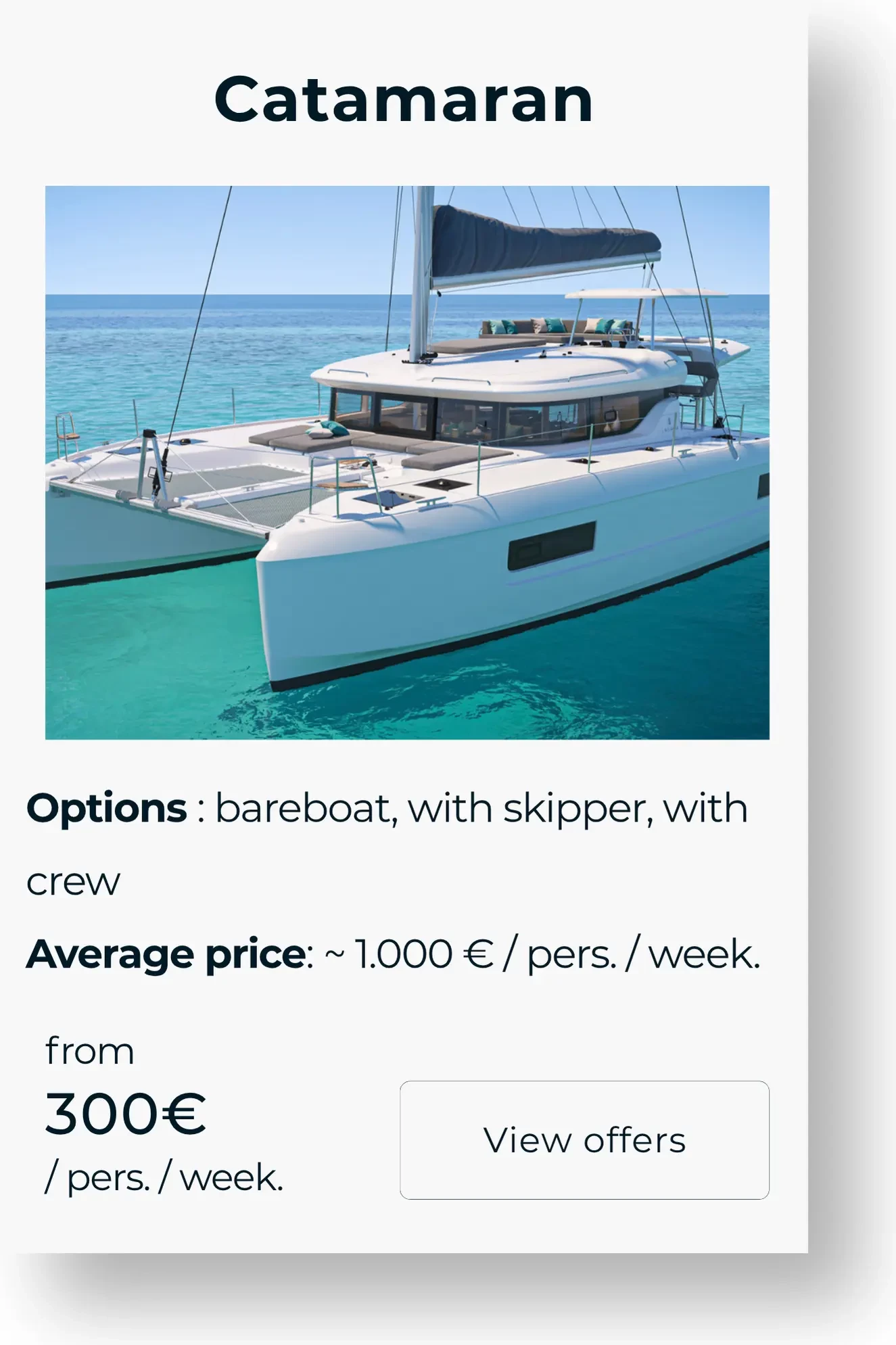
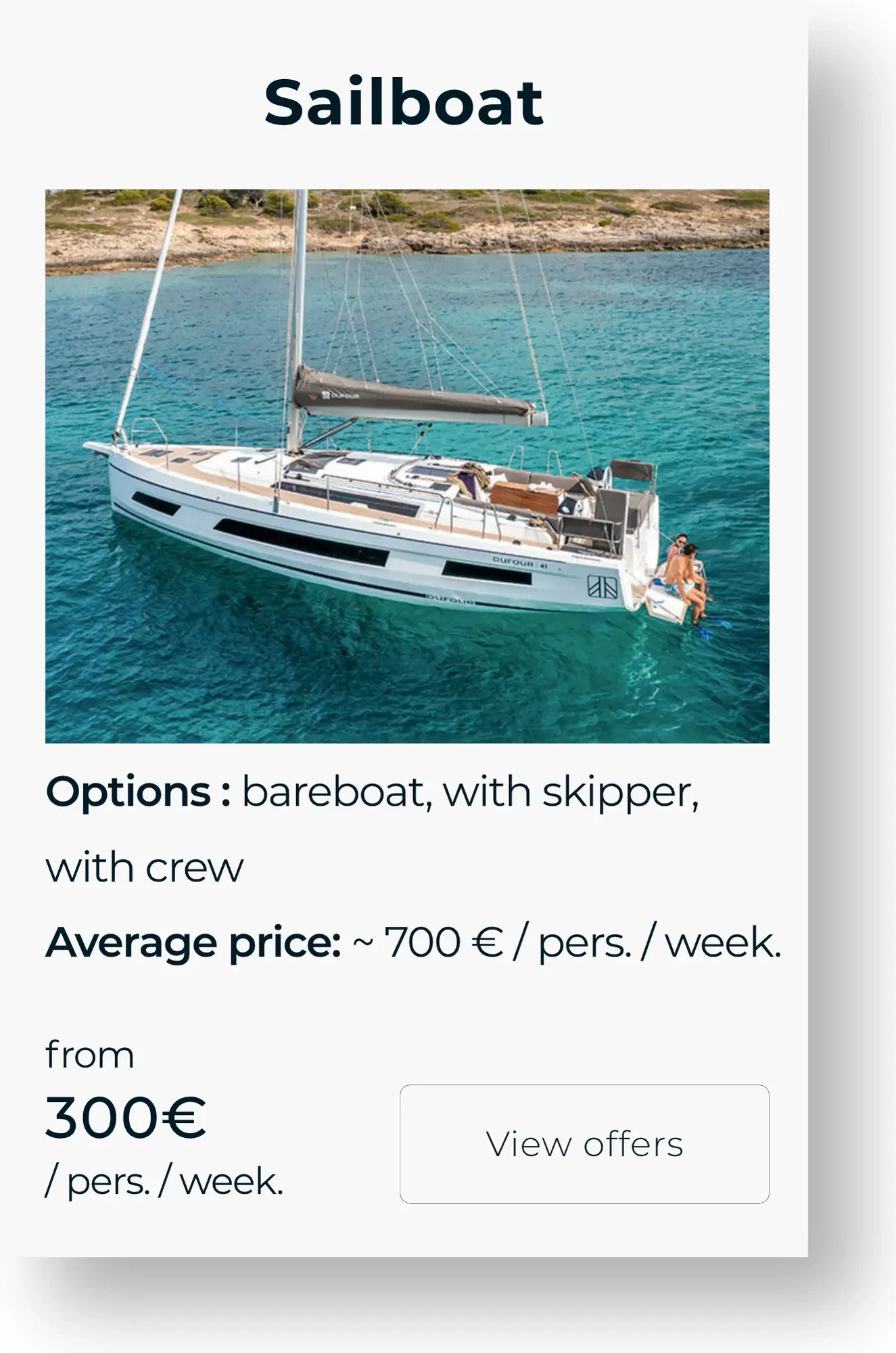
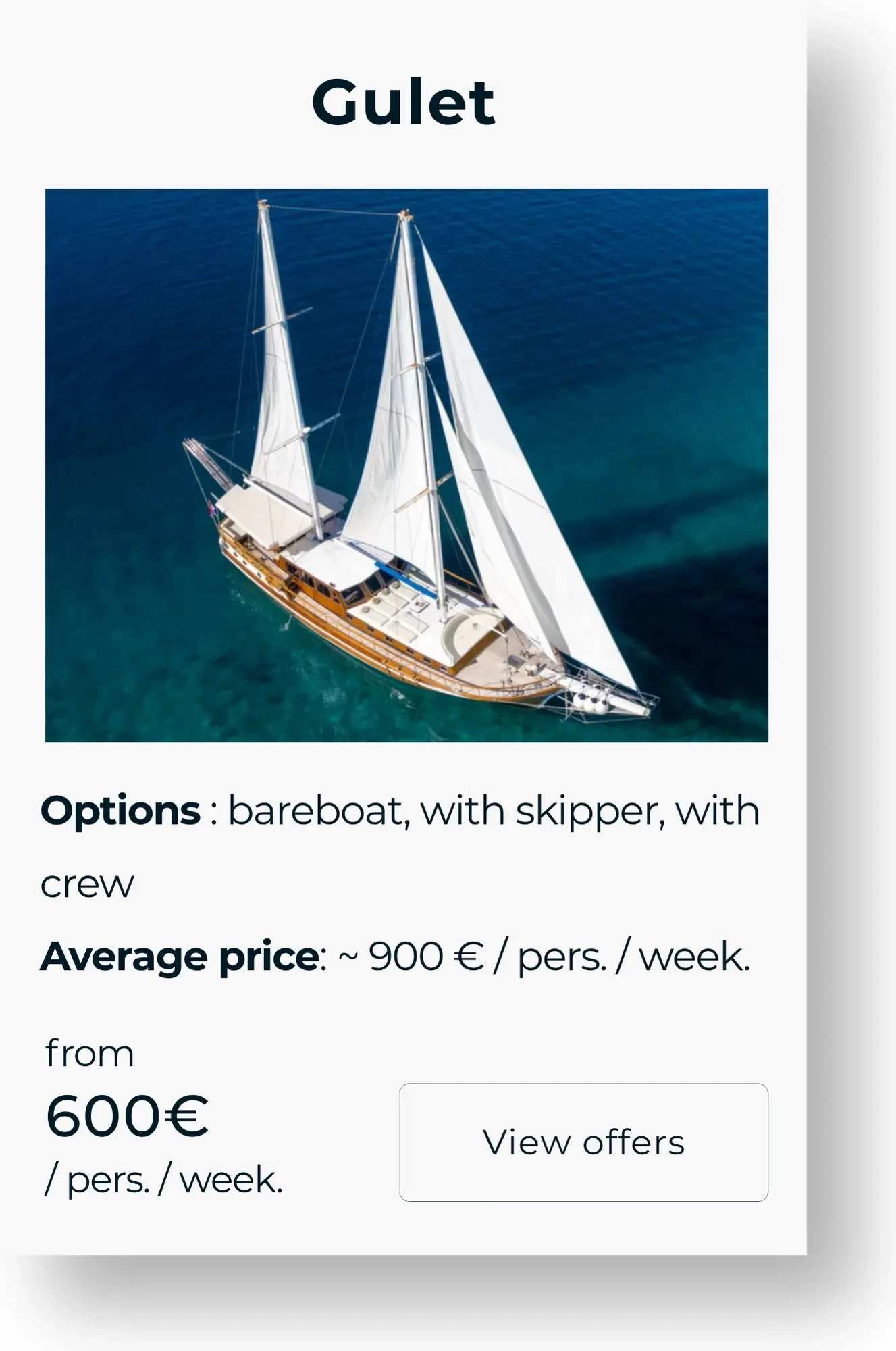
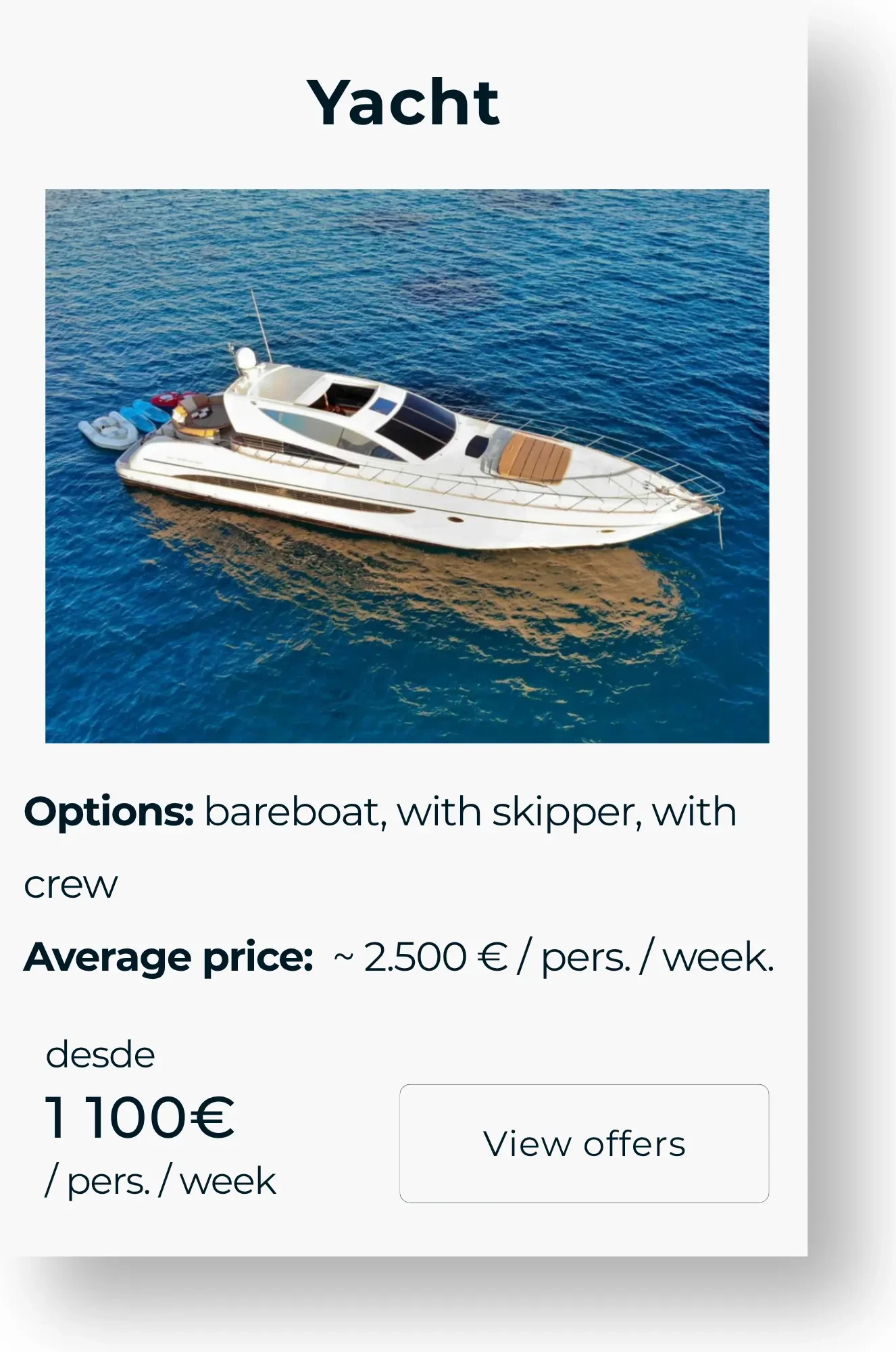
The choice of hull weighs heavily on the budget. The boat rental price varies greatly between a caïque, a monohull, a catamaran and a yacht. The catamaran price is on average twice that of a monohull of comparable capacity: count on around €10,500 per week for the former against €4,500 for the latter. This gap is explained by far higher purchase and maintenance costs, but also by very strong demand. In return, the catamaran offers unrivalled comfort: a far larger living space, vast decks and trampolines, separate cabins in each hull for more privacy, and above all remarkable stability; it heels very little, a decisive argument for families with children and anyone prone to seasickness. The monohull, for its part, appeals to lovers of authentic sailing, those who like to feel the boat heel under the wind, and to tighter budgets.
On the Nile, it is a third type of vessel that defines the experience: the dahabiya, a traditional Egyptian sailing boat with lateen sails, whose historic charm and high-end comfort set a price level all of their own. Beyond the type of hull, the model and year of construction also matter: a recent boat, better equipped (air conditioning, navigation electronics, a watermaker, a desalinator that produces fresh water on board), rents for noticeably more than a vessel a few years old, which remains perfectly reliable for a reduced budget. This is an often-overlooked way to save: accepting a boat from the previous generation can bring the bill down by 15% to 20%.
 |  |
 |  |
4. The size and number of cabins
There is an apparent contradiction worth understanding: the bigger a boat and the more cabins it has, the higher its absolute rental price, but the lower the cost per person once the boat is full. That is the whole secret of group cruises: the boat's fixed cost is spread across the number of crew members. A telling example: a large four-cabin catamaran rented at €10,500 works out at €1,312 per person for eight, whereas a small monohull at €4,500 rented by a single couple costs €2,250 a head. The large boat, more expensive on paper, is in reality almost twice as economical per person.
The calculation to make is therefore never "how much does this boat cost?" but rather "how much does it cost me, once the bill is shared?". A 12-metre sailing yacht for six people can thus drop below €800 per person per week, transport and extras not included. The limit, of course, is comfort: filling each cabin to the maximum optimises the price but reduces everyone's space. The right balance is often two people per double cabin, which lets you split the costs without getting in each other's way. Bear in mind too that not all cabins are equal: forward cabins, more exposed to the boat's motion, are sometimes less sought-after and may come at a reduced rate.
5. Booking in advance
When you book directly influences the price, sometimes as much as the season itself. Booking early, what's known as early booking (generally six months to a year before departure), gives you access to the best choice of boats and the best rates, with operators rewarding early bookings with discounts of up to 10% to 20%, or even more in certain periods. This is the strategy to favour if you're aiming for a popular destination, specific dates (school holidays) or a particular boat model.
Conversely, last minute can hold pleasant surprises: rather than leave a boat empty at the quay, operators are happy to slash prices on units still available as departure approaches, with sometimes spectacular reductions. The trade-off is a very limited choice: model, dates and destination dictated by what's left, and arrangements to finalise in a hurry (flights, transfers). Between the two lurks the worst pricing scenario: booking a peak-season destination at the last minute, when only the most expensive boats remain. Our concrete advice: for a July-August departure or a flagship destination, book as far ahead as possible; for a flexible getaway, with no constraints on dates or location, last minute out of season can really pay off.
6. What's included
This is the most insidious factor, because it isn't visible in the advertised price. An "all-inclusive" rate (full board, crew, drinks, water sports, sometimes even airport transfers) has nothing to do with a "base" rate to which a long list of extras is added once on site. Two cruises advertised at the same price can thus conceal very different real budgets: the one that looks cheapest at the outset sometimes turns out to be the most expensive once all the extras are added up.
That is precisely why you should always compare offers on what they contain, and not on the shop-window figure alone. In practice, always check what the price covers. A cabin cruise generally includes accommodation, most meals prepared by a chef, and the crew, but rarely all drinks, shore excursions or tips. A bareboat charter covers only the boat: fuel, the final clean, the onboard kitty and harbour fees remain at your expense. Always ask the right questions before booking: are all meals included? Is fuel included or charged by consumption? Are harbour and mooring fees in the price? We detail all these items in the section on the real budget, a little further down.
Cruise prices by destination: cabin or charter
A cruise price depends greatly on the destination, but also on the package you choose. For each area, we therefore distinguish two budgets: the cabin cruise (you book a berth on a shared boat, crew and often full board included, ideal for a first experience or a trip for two) and boat charter (you rent the whole boat and share it with your group, without a skipper if you're self-sufficient and qualified, or with a skipper or even a full crew if you'd rather be accompanied). Cabin prices are given for two people per week; charter prices for the whole boat, to be divided by the number of crew members. All these rates vary according to the season, availability, the model and the age of the boat; they give a reliable order of magnitude, which your advisor will refine when drawing up your quote.
Mediterranean cruise prices
By cabin, for a Mediterranean cruise (Greece, Italy, Croatia, Spain, Corsica) count on €3,000 in low season (April, October) to €5,200 in high season (July, August) for two people in a standard double cabin, and around €4,500 in a superior cabin. The best time remains May-June and September: the sea is warm, the days are long, prices are contained and the anchorages far less crowded than at the height of summer.
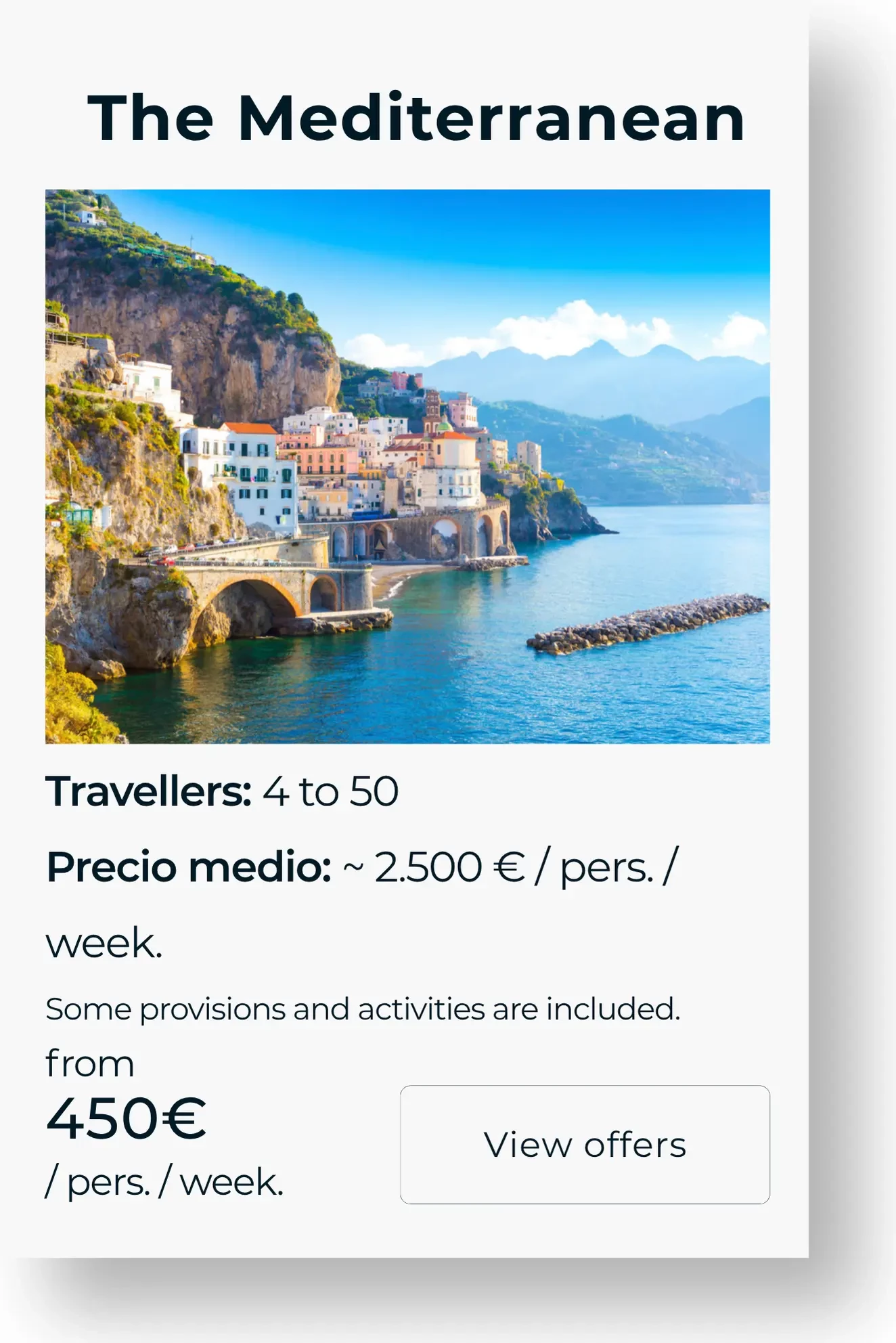
For a whole-boat charter, the Mediterranean is the most affordable area: from around €1,500 per week for a monohull out of season, and in the region of €3,000 to €4,000 for a catamaran, to be split between the crew. You can charter the boat alone if you're qualified, or add a skipper, or even a full crew, if you'd rather sail without constraints. It's also the area with the widest supply, which keeps prices competitive and offers a broad choice of boats and departure bases.
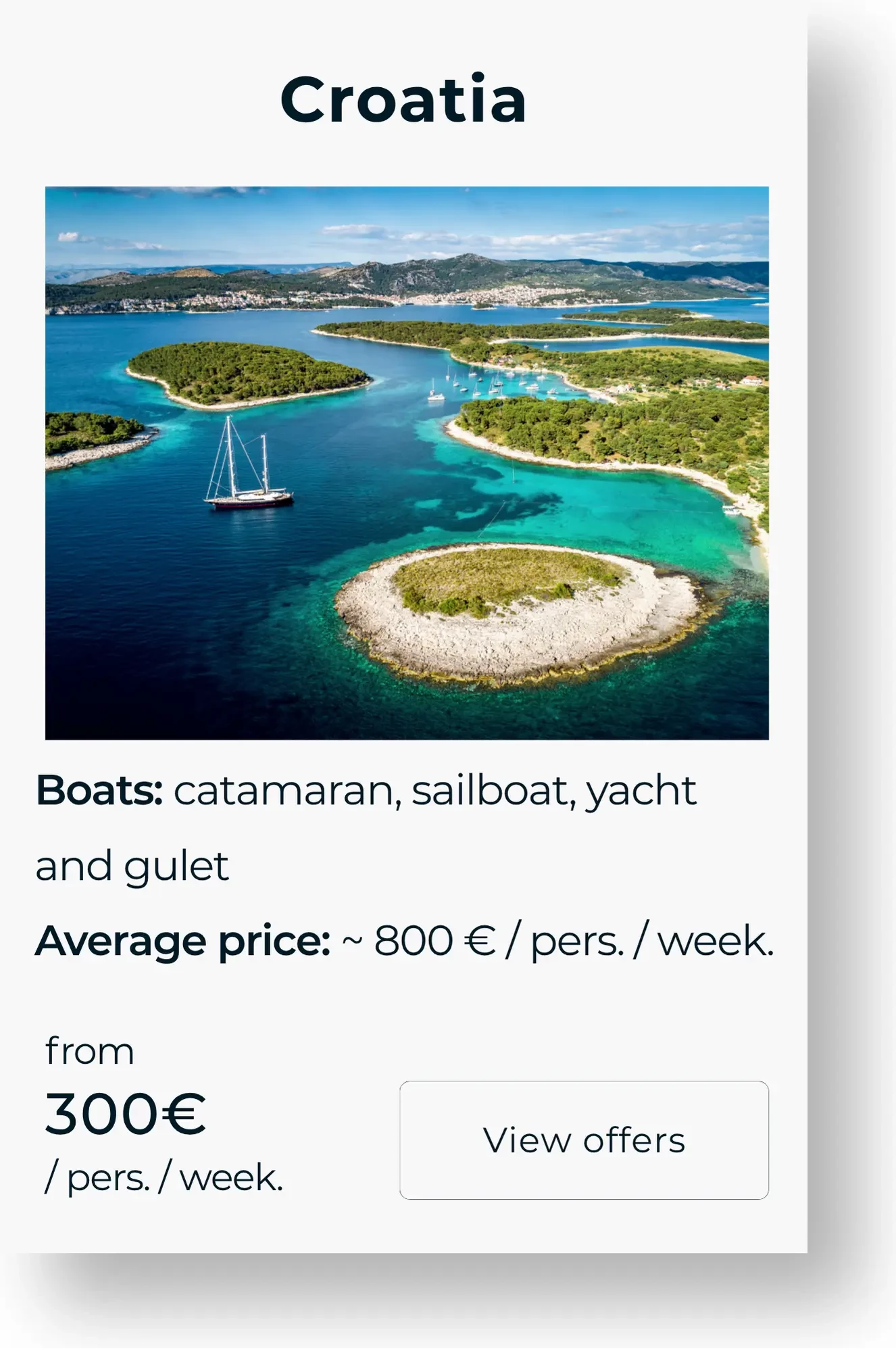
It's the ideal destination for a first cruise. The distances between islands are short, often two to three hours of sailing a day, the waters generally calm and sheltered, and every port of call has its own heritage. A typical week takes you from secluded coves for a morning swim, to lunch at anchor, then a small fishing port or authentic village for dinner and the night. The Mediterranean thus combines lazing about, swimming, cultural discovery and local cuisine, all under a reliable climate. Discover all our Mediterranean cruises.
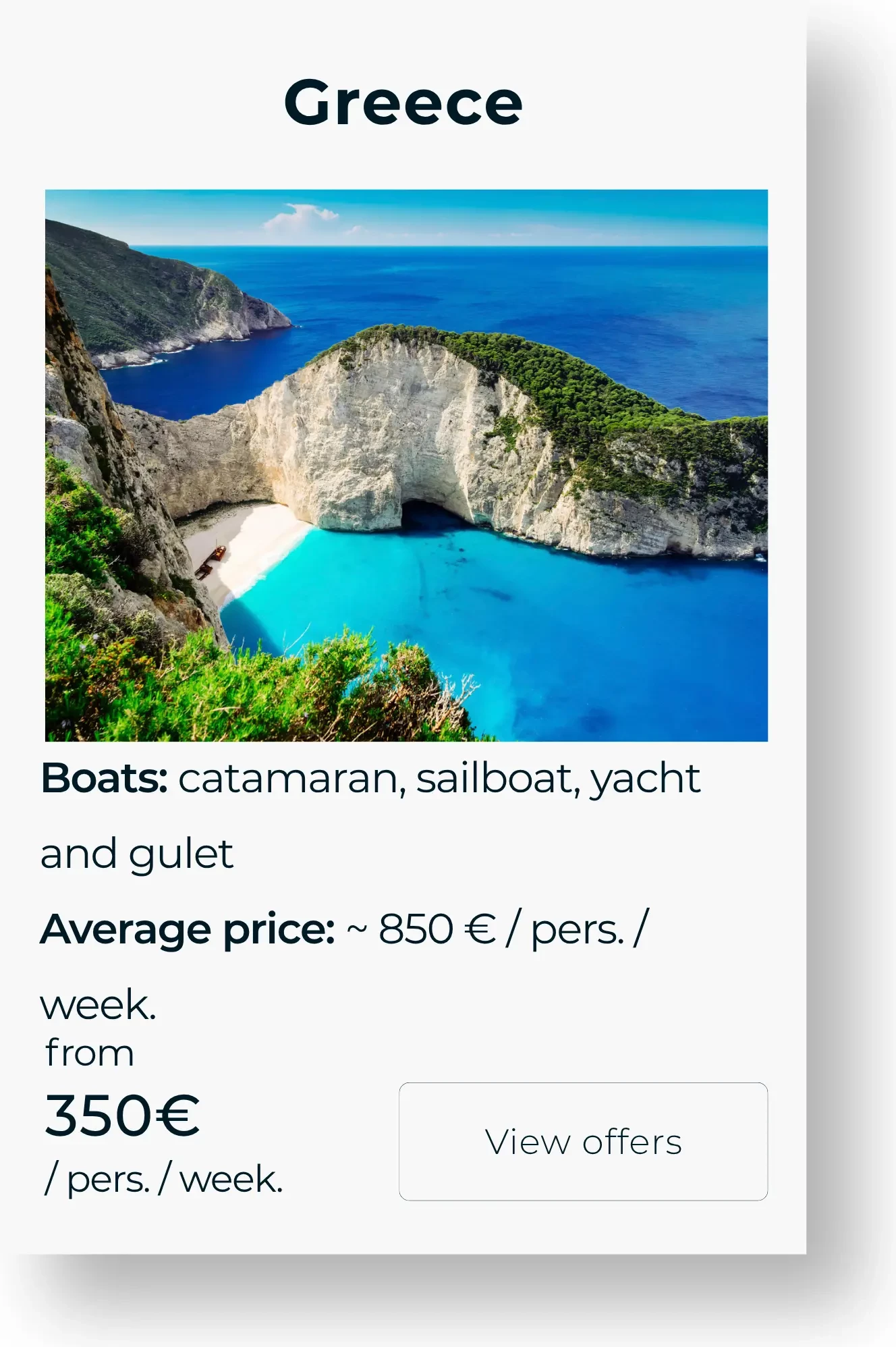
Greece, Croatia, Italy: the nuances. Within the Mediterranean, the sub-destinations show comparable prices but very distinct atmospheres. A Greece cruise and its Cyclades offer a complete change of scene: whitewashed villages, deep waters and islands as far as the eye can see, sometimes with the Meltemi, that northerly wind that delights seasoned sailors. A Croatia cruise, with its hundreds of closely packed islands and exceptionally clear waters, is probably the easiest for a first cruise: short passages, sheltered sea, well-equipped ports. An Italy cruise, from Sardinia to the Aeolian Islands, plays the dolce vita card, between gastronomy, wild coves and hilltop villages. All three fall within a range of €2,500 to €5,200 per week for two in a cabin.
 |  |
Nile cruise prices
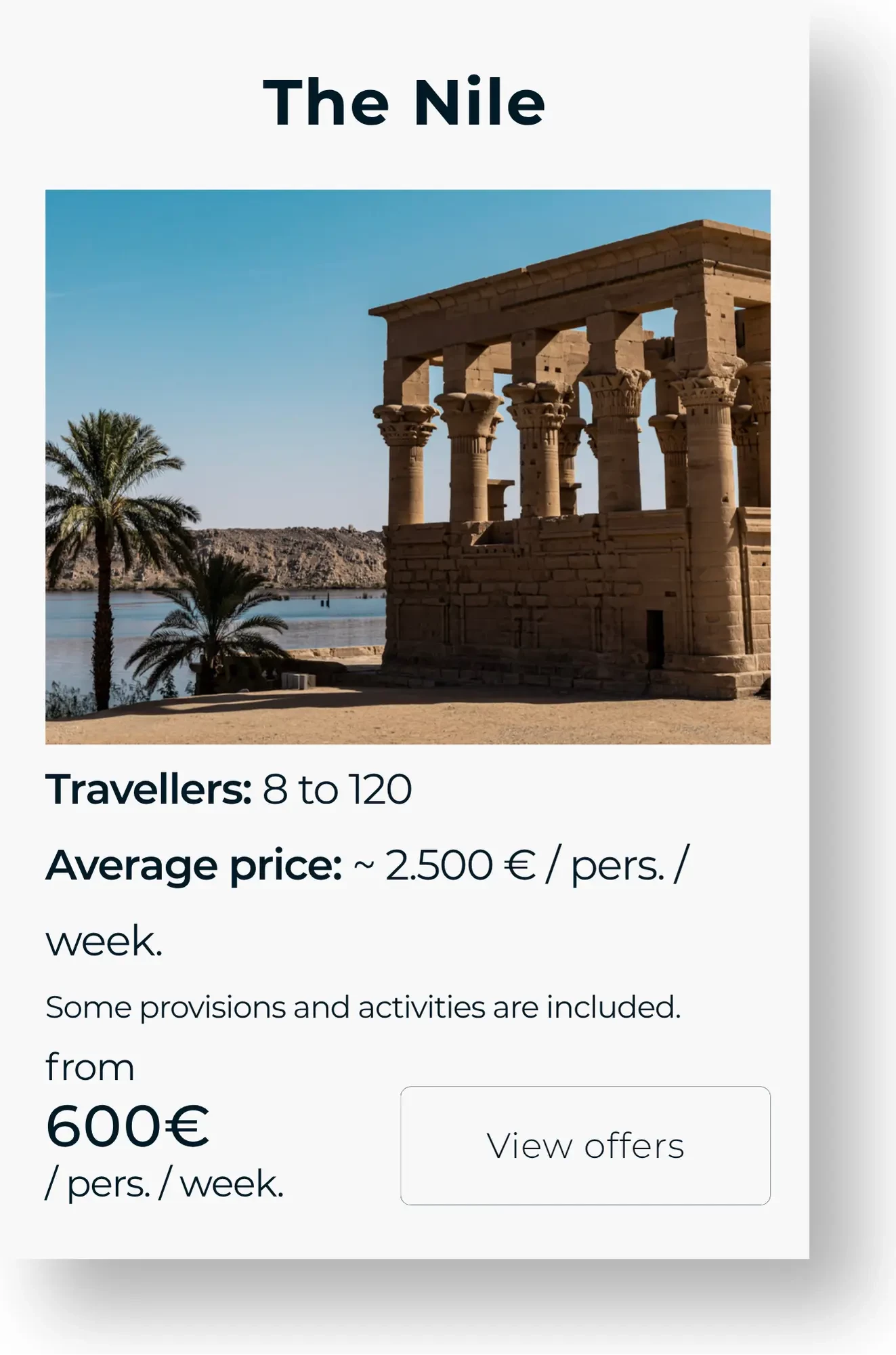
By cabin, the Nile cruise is one of our most sought-after packages, and one of the most exotic: you sail aboard a dahabiya, a traditional sailing boat with lateen sails, heir to the vessels that plied the river in the age of the pharaohs. Count on €2,500 in low season (June to August, when the heat is intense) to €3,000 in high season (November to March) for two in a standard double cabin, and up to €3,900 in a suite with private terrace. Entry-level prices start from €450 per person, making it an affordable cruise.
For a private charter, there is no crew-free rental on the Nile: navigation is always done with a crew. You can, however, privatise an entire dahabiya for your group or family: count on €8,000 to €15,500 per week depending on the season, crew and full board included. It's the ideal option for a tribe or several couples wishing to experience the adventure exclusively.
It is above all a cultural and contemplative journey, the opposite of a seaside cruise. The sailing is slow, carried by the current and the wind, punctuated each day by visits to major sites accessible only by the river: the temples of Edfu and Kom Ombo, the Valley of the Kings, the ancient quarries. Between two stops, you make the most of the deck to watch the green banks, villages and feluccas drift by. The atmosphere on board is intimate, the dahabiyas have only a few cabins, and full board, prepared by a chef, is generally included. The best time runs from November to March, when temperatures become mild again; summer, very hot, explains the lower rates.
Caribbean and West Indies cruise prices
By cabin, for a Caribbean cruise (Martinique, Guadeloupe, Saint Martin, the Virgin Islands, the Bahamas), count on €2,600 in low season (July to October) to €4,300 in high season (December to April) for two people in a standard double cabin, with entry-level prices from €2,000. High season here corresponds to the European winter: this is when the trade winds make for ideal sailing, when the sea is at its finest, and when you swap the cold of mainland France for 28°C and turquoise waters.
For a whole-boat charter, the West Indies are a dream playground, but the budget is higher than in the Mediterranean: count on from around €3,000 per week for a monohull and in the region of €5,000 to €7,000 for a catamaran, to be split between the crew. The catamaran reigns here, for its stability and comfort in the tropics. Again, you sail alone if you're experienced, or with a skipper or a crew for greater peace of mind. On top of these prices comes the long-haul flight to the West Indies, to be factored into the overall budget.
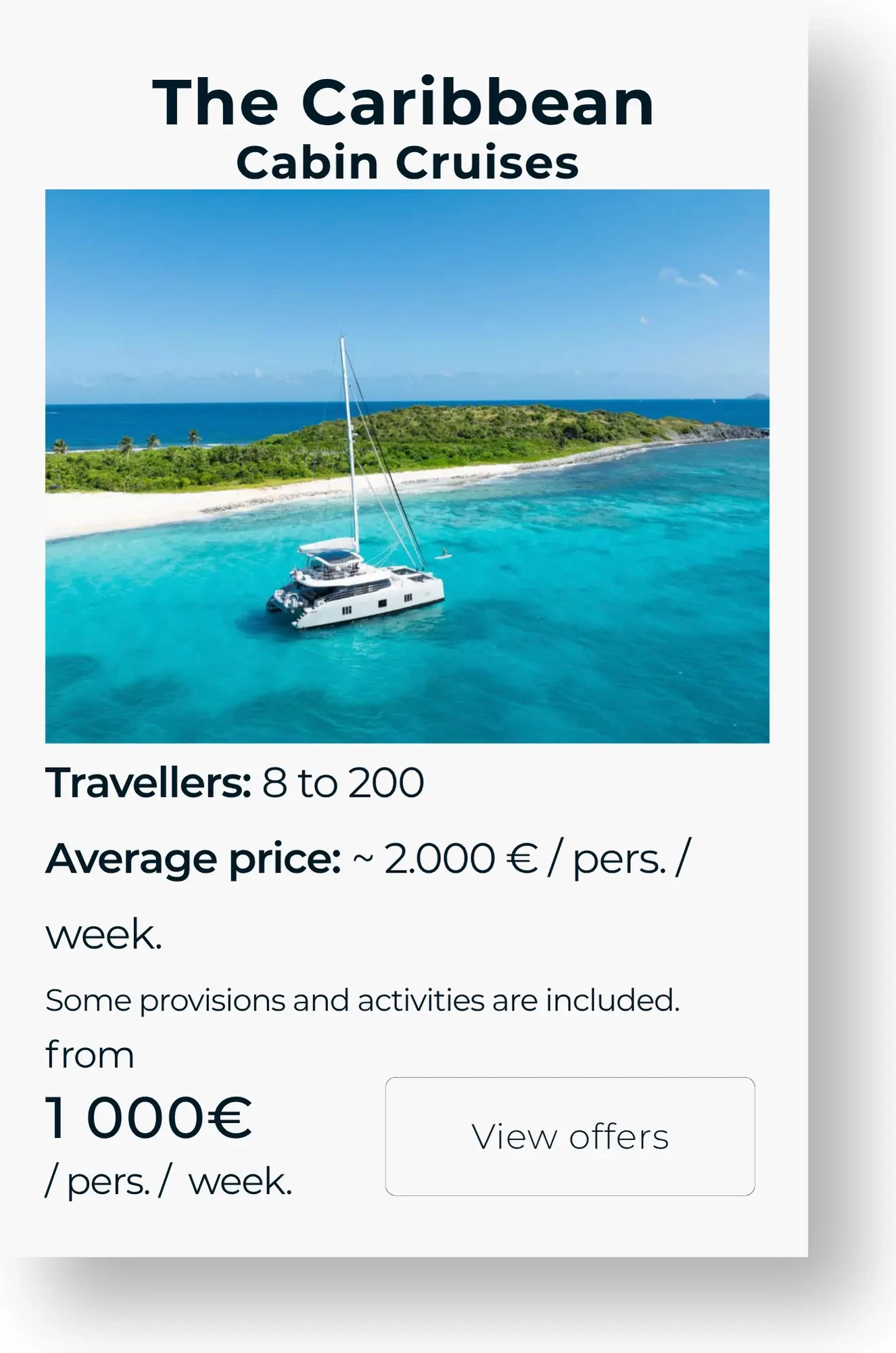 | 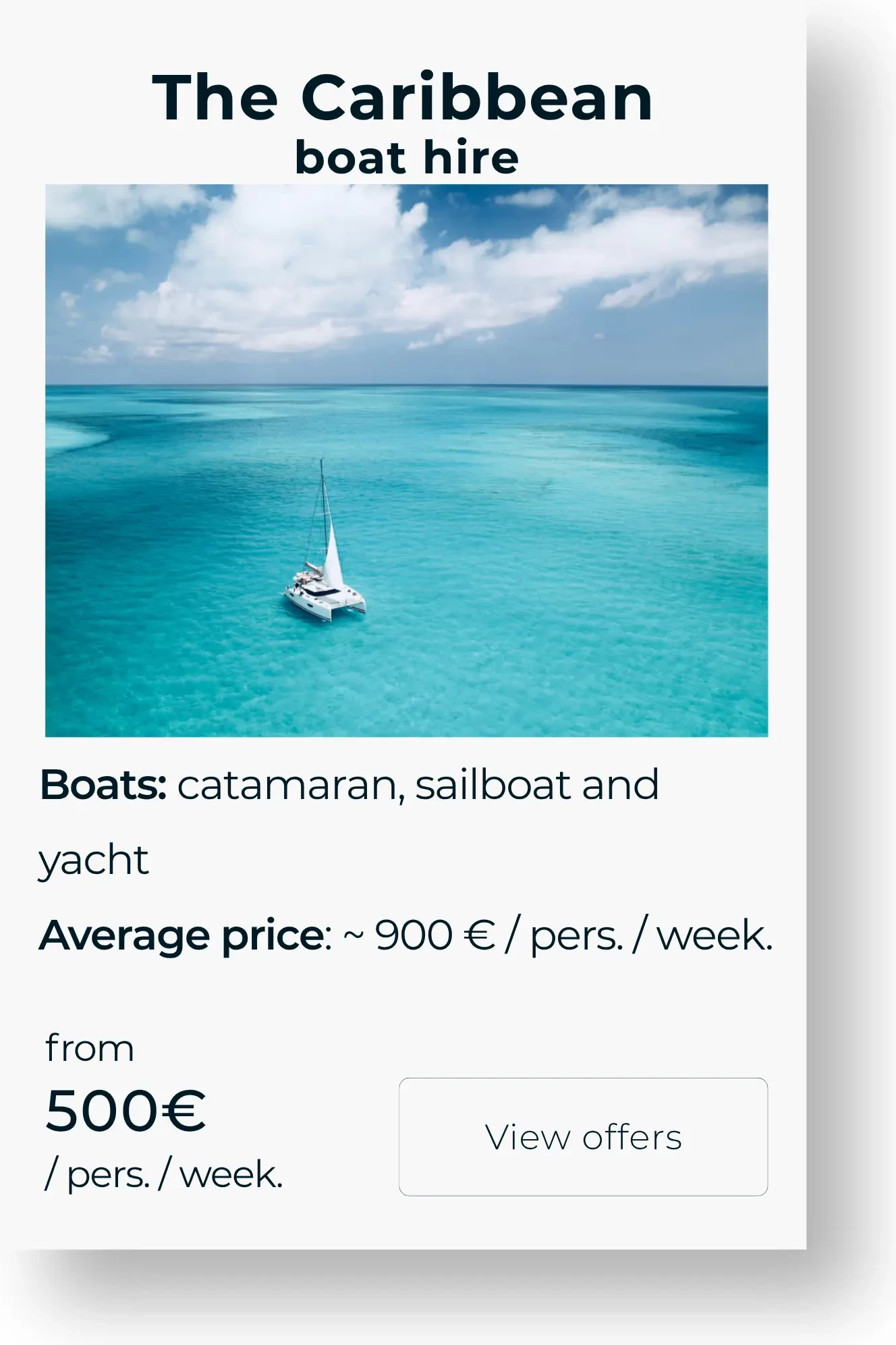 |
The Caribbean trip is the postcard that becomes reality. A typical week alternates long white-sand beaches lined with coconut palms, anchorages off deserted islets, coral seabeds among the most beautiful in the world for snorkelling and diving, and lively stops to the sound of zouk and reggae. The distances between islands are moderate and the sailing, carried by the steady trade winds, remains pleasant. Worth noting for the budget: the July-to-October period, which is cheaper, corresponds to the cyclone season. Departures remain possible and well supervised, but the high winter season offers the safest and sunniest conditions. If you're considering a departure during this period, we recommend checking the weather conditions with your advisor and taking out suitable insurance.
Norwegian fjords cruise prices
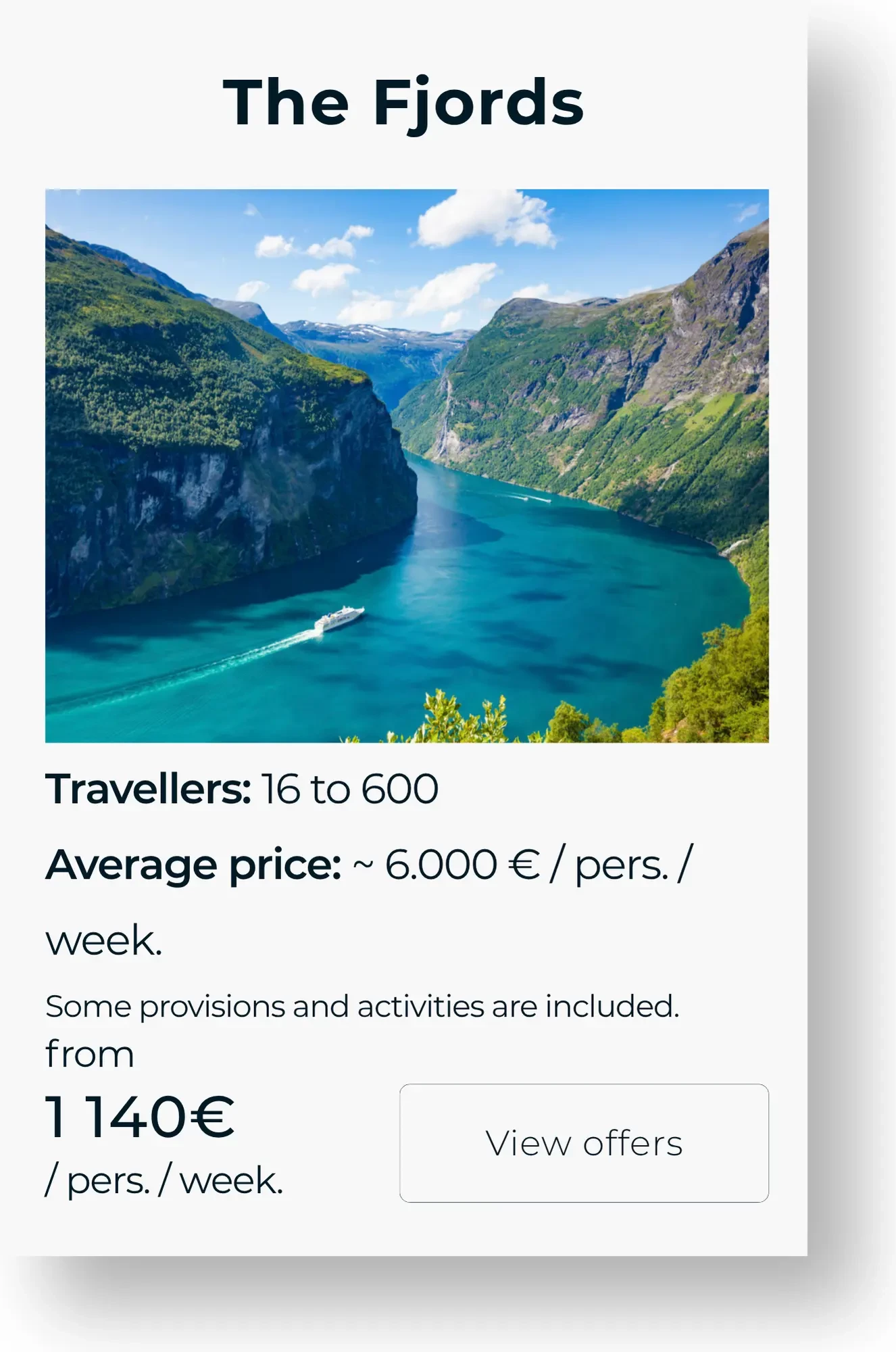
By cabin, for a full-board cruise in the fjords of Norway, count on a median price in the region of €5,882 for an outside cabin in autumn (September to November) against around €8,024 in summer (June to August), based on our real-price database for the 2026-2027 season. It's the most expensive destination in this selection, and for good reason: the remoteness, a very short sailing season and a limited number of berths push prices upwards.
On the private charter side, the fjords lend themselves poorly to classic chartering: the vast majority of cruises there take place aboard expedition ships or crewed boats, in a cabin package. To sail independently in this demanding area (cold waters, changeable weather), solid experience and a suitable boat are essential; your advisor will guide you towards the few options available according to your profile.
But the spectacle matches the price. The fjords offer landscapes of raw, incomparable beauty: dizzying rock faces plunging sheer into dark, deep waters, waterfalls cascading hundreds of metres, hanging glaciers and colourful hamlets clinging to the rock. Summer is the best season there for the light (the midnight sun offers almost endless days and surprisingly mild temperatures), while autumn appeals through its more affordable rates and its blazing colours. It's a contemplative cruise, to be experienced as a once-in-a-lifetime trip rather than a seaside holiday. Given the small number of berths and strong demand, it's a cruise to book well in advance, ideally a year ahead. In the same spirit, we also offer Antarctica cruises and Arctic cruises. Discover our Norwegian fjords cruises.
All-inclusive Corsica cruise prices
By cabin, for an all-inclusive Corsica cruise, the Island of Beauty falls within the Mediterranean range: from €2,500 to €4,200 per week for two people in a cabin, crew and full board included. Corsica's major asset is to combine the change of scene of a wild, unspoilt island with the simplicity of a French destination: no long-haul flight, no currency exchange, no formalities, and easy access from the main mainland ports.
For a whole-boat charter, Corsica is a prime destination: from around €1,800 per week for a monohull and in the region of €3,500 to €4,500 for a catamaran, departing from Ajaccio, Propriano or the neighbouring Côte d'Azur. Chartering the whole boat (alone, with a skipper or with a crew depending on your experience and wishes) lets you craft your own itinerary along the Corsican coast at your own pace, sharing the costs between crew members.
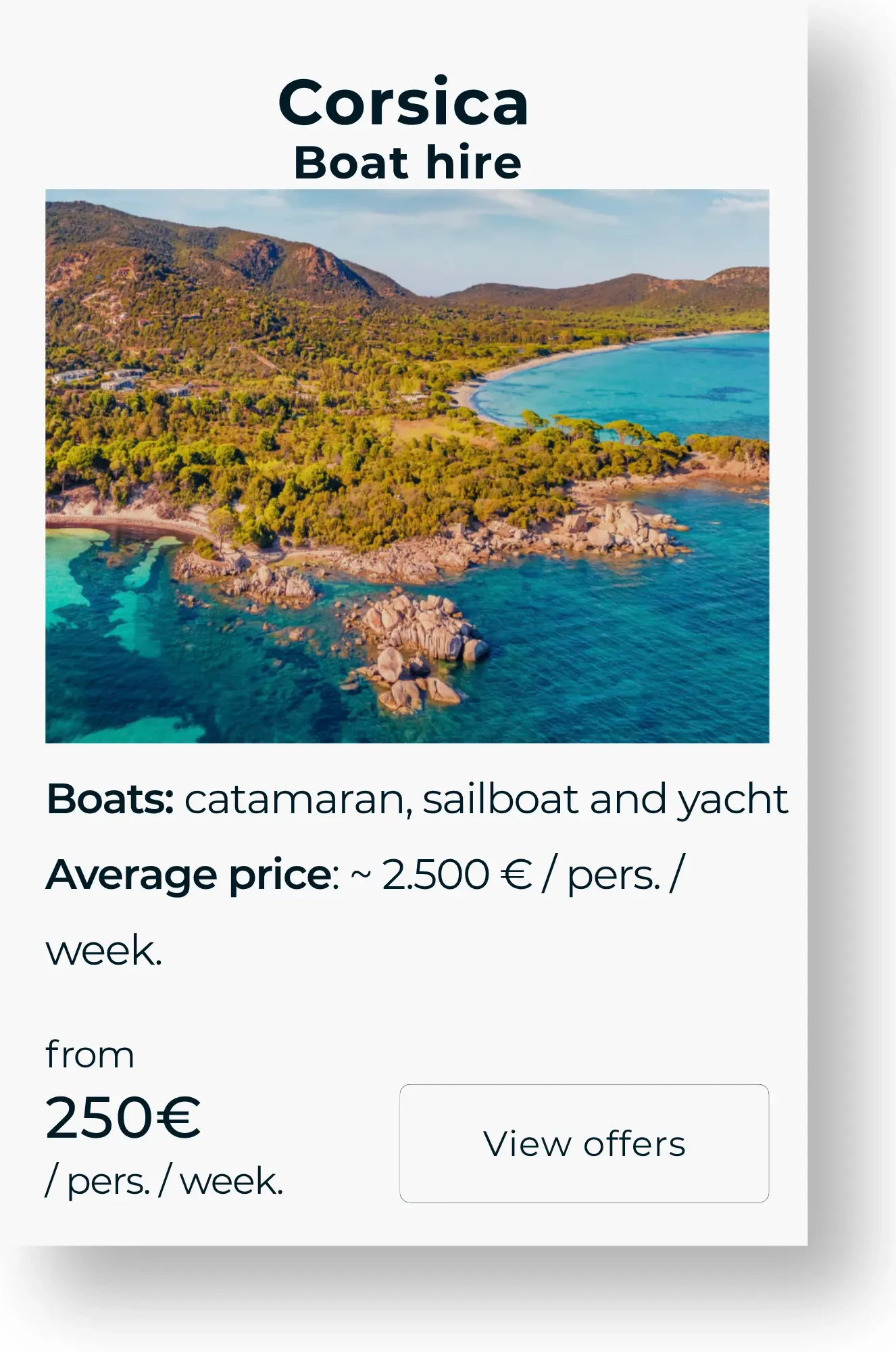 | 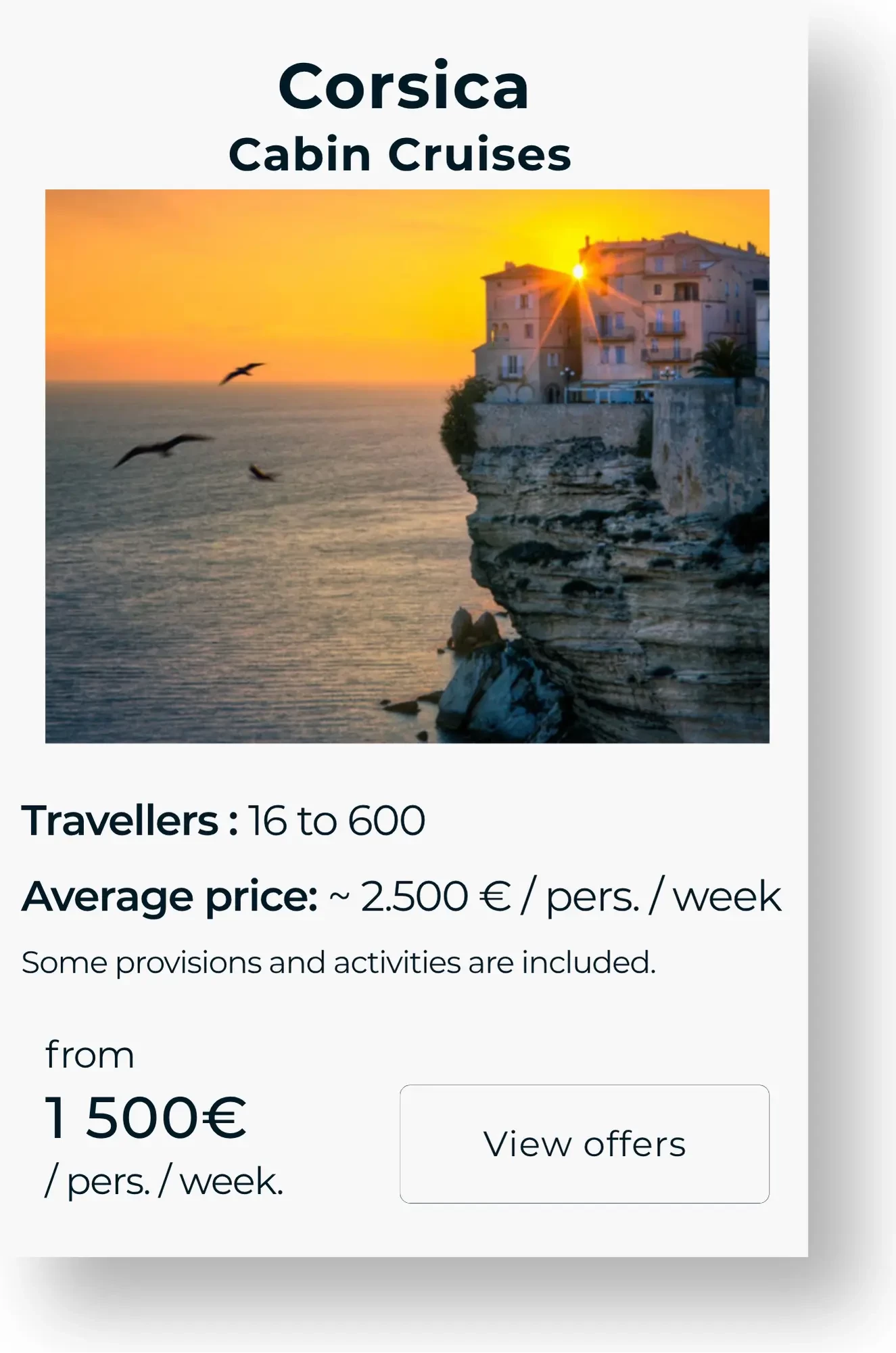 |
Whatever the package, your course leads you to the island's finest anchorages, some accessible only by sea: the Scandola nature reserve, a UNESCO World Heritage site, with its red porphyry organ-pipe rocks; the translucent waters of the Lavezzi Islands at the far south, a veritable lagoon; the Calanques de Piana with their erosion-sculpted rocks; or Bonifacio, spectacularly perched on its white limestone cliffs. Between two anchorages, you alternate swimming in deserted coves, short walks ashore and tastings of Corsican charcuterie and wines. The best time runs from May to September, with a clear preference for June and September to combine fine weather, warm water and reasonable rates, far from the crowds of high summer. See our Corsica cruises.
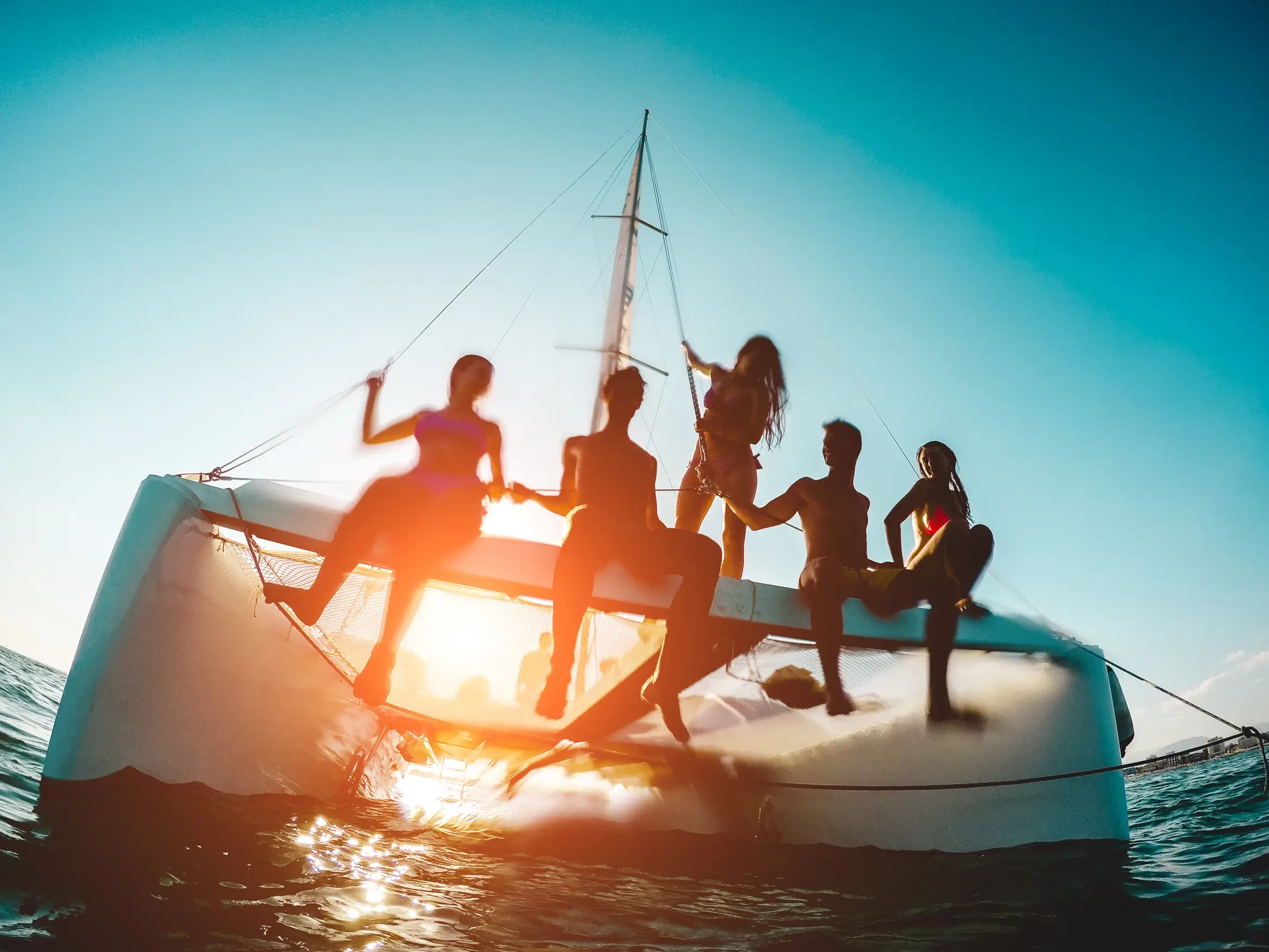
Chartering a whole boat: how much to budget for a private cruise?
Chartering a boat changes the calculation logic: you no longer pay per person, but for the boat as a whole, which you fill with your family or friends. The more of you there are, the lower the cost per head. A concrete example is worth more than a long table.
A worked example: a 4-cabin catamaran in Greece, in June, for 8 people
The result: a private cruise, in complete autonomy, for a per-person budget close to that of a cabin package, with the added bonus of freedom to choose your own itinerary. |
On the "whole-boat" rates without a skipper, count on around €4,500 per week for a monohull and €10,500 for a catamaran, all sizes combined. With a skipper or crew, private cruises start at €4,000 in the Mediterranean (40-foot catamaran, low season), €4,700 in the Caribbean and €5,500 in the Indian Ocean. Each time, remember that this price is divided by the number of crew members on board.
Beyond the advertised price: the real budget for a one-week cruise
The advertised rate is never quite the final budget. A few items are added, and it's best to anticipate them to avoid surprises. Here are the main ones, with orders of magnitude.
| Expense item | Order of magnitude |
| Onboard kitty (crewed boat) | The APA (Advance Provisioning Allowance) is an onboard kitty paid in advance, in the region of 25% to 30% of the pre-tax charter price |
| Onboard kitty (cabin cruise) | Variable depending on the destination (taxes and mooring fees), stated at booking |
| Tips for the crew (cabin) | Around $5 per person per day |
| Mandatory fees (bareboat) | End-of-charter cleaning and fuel consumed |
| Comprehensive insurance (Travel Pack) | In the region of 5% of the cruise price |
| Flights and transfers | Not included, to be budgeted depending on the destination and departure airport |
Two concepts come up often and deserve to be distinguished. The security deposit protects the boat: it is held for the duration of the charter and returned on your return, barring damage. The deposit waiver, taken out through our partner Gritchen, reduces the amount retained in the event of damage. To understand it all, see our article on deposit waiver insurance.
On the payment side, plan for a booking deposit of 40% or 50% of the charter amount depending on the contract, with the balance payable before departure. The pay of the onboard staff (skipper, hostess, cook) is generally settled on site, on the day of boarding.
How to pay less for your cruise: 6 tips to save
A few simple trade-offs can noticeably reduce the bill without cutting into the experience:
- Book early or at the last minute: early booking secures the best prices, last minute unearths the unsold boats.
- Aim for June or September: the best compromise between weather and price, far from the July-August peak.
- Choose a destination with good value for money: Egypt, for example, often offers better value than a Mediterranean packed in high summer.
- Travel as a group: on a private boat, the more of you there are, the more the cost per person drops.
- Prefer the monohull over the catamaran: for equal capacity, the price gap is significant.
- Compare on the "all-inclusive", not on the raw price: a slightly more expensive but genuinely all-inclusive offer can work out cheaper in the end.
Frequently asked questions
How much does a one-week cruise in the Mediterranean cost?
For a cabin cruise in the Mediterranean, count on €2,500 in low season to €4,200 in high season for two people, crew and full board included. To charter a boat with a skipper, prices start at around €4,000 for the boat in low season.
How much does a one-week cruise on the Nile cost?
A one-week cruise on the Nile in a standard double cabin costs €2,500 to €3,000 for two depending on the season, up to €3,900 in a suite with terrace. Entry-level prices start from €450 per person, cultural visits included.
What is the cheapest cruise package for a week?
The cabin cruise is the most affordable package: you only pay for your berth, with crew and board included. Entry-level prices start at a few hundred euros per person depending on the destination.
Is the price of a cabin cruise per person or per cabin?
Rates are generally per cabin occupied by two people, or sometimes shown per person. In the case of single occupancy, a supplement may apply. Your advisor will specify the calculation method when drawing up your quote.
Can you pay for a cruise in instalments?
Yes. Payment is usually made in two stages: a deposit of 40% or 50% at booking, then the balance before departure. The exact terms are set out in your charter contract.
Does a cruise price drop at the last minute?
It can happen on boats that remain available as the departure date approaches. The trade-off is a reduced choice of boats and dates. For popular destinations and periods, early booking often remains more advantageous.
Do you need a boat licence to rent bareboat?
Yes. Bareboat rental (without a skipper) requires a licence and sufficient sailing experience: in France, the coastal licence is generally required, and most operators in the Mediterranean accept the International Certificate of Competency (ICC). If you're not qualified, opt for a rental with a skipper or a cabin cruise, with no nautical skills required.
Is the security deposit included in the cruise price?
No. The security deposit is held separately for the duration of the charter, then returned on your return barring damage. You can reduce the amount retained in the event of damage thanks to the deposit waiver, taken out through our partner Gritchen.
When should you book to pay less?
Two strategies work: book several months in advance to benefit from early-booking offers, or try last minute on the unsold boats. For high-demand periods such as July-August, book as early as possible.
You now have all the keys to estimate the budget for your one-week cruise. For an accurate rate tailored to your project (destination, dates, number of crew members), request a free quote: one of our specialist advisors will guide you in choosing the package that's right for you.