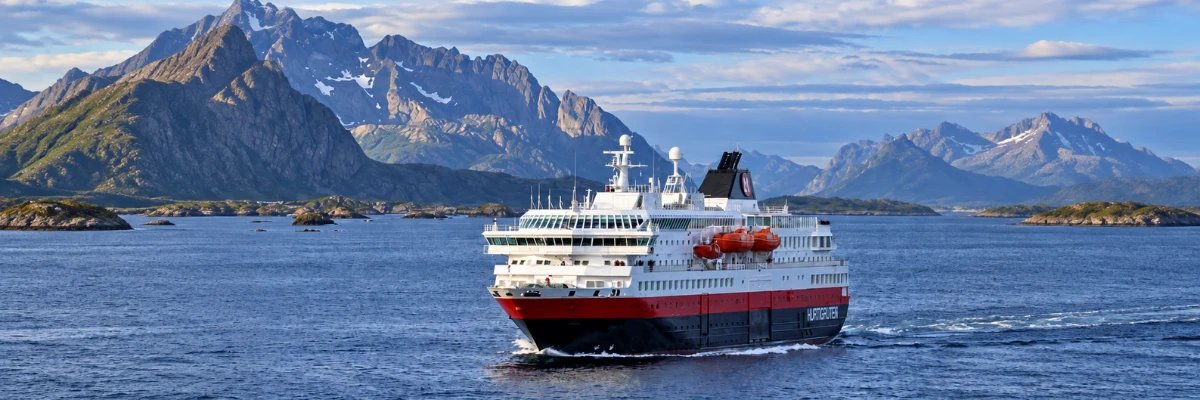
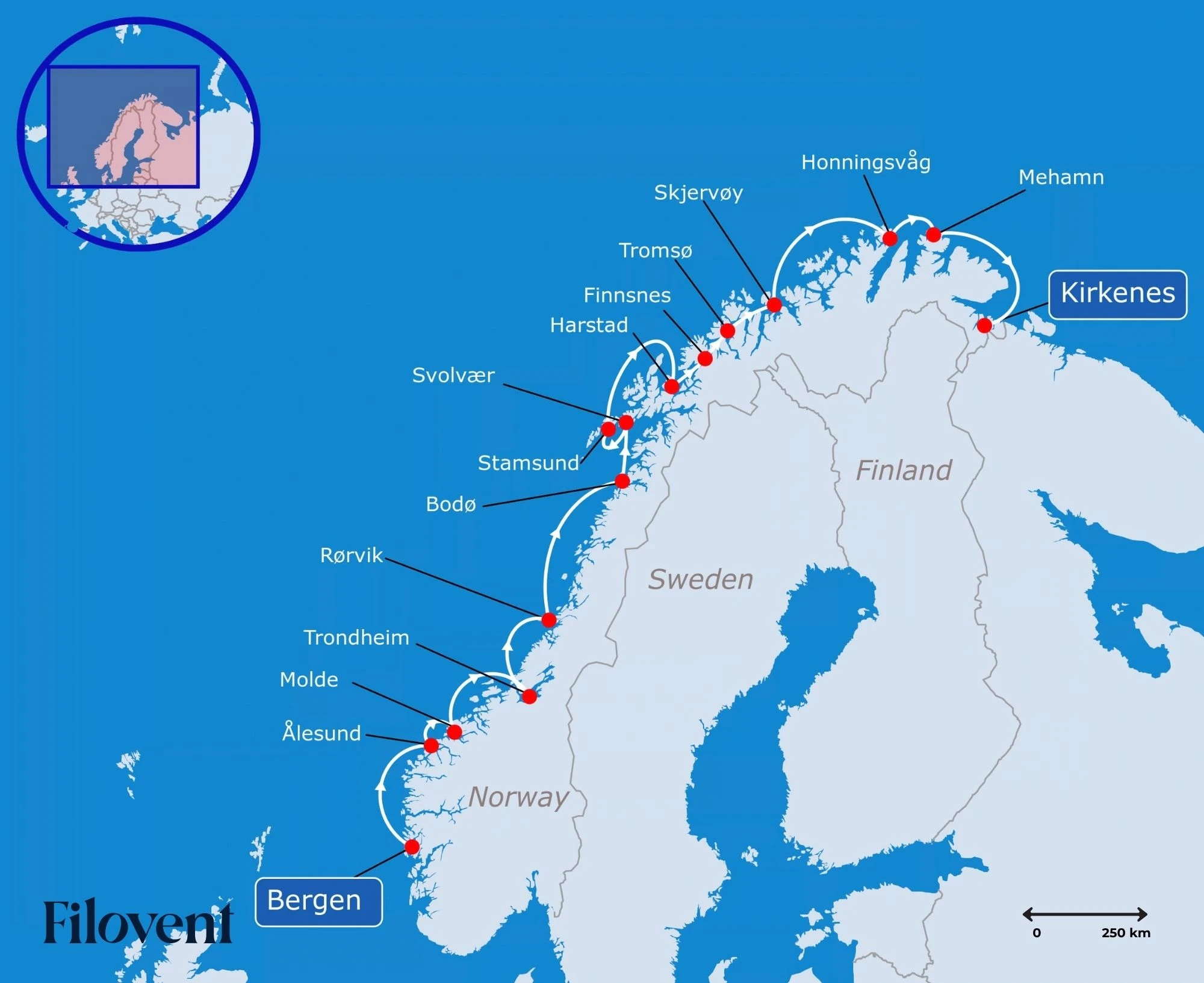
Since 1893, the ships of the Norwegian Coastal Express have sailed this coast; today they link Bergen and Kirkenes every day, all the way to the doorstep of Russia. Its Norwegian name means ‘fast route’: for decades, this scheduled service was the only link between the south of the country and the isolated villages of the far north. Post, goods, fishermen, doctors, families: everything travelled on it.
Today, the line still provides year-round transport, but it also carries travellers who come to discover it on a cruise: northbound from Bergen to Kirkenes (7 days), southbound from Kirkenes to Bergen (6 days) or the full round trip (12 days). Below, we trace how a postal lifeline turned into a cruise, and what a voyage on it looks like today.
Summary
- 1. A story that began in 1893
- The first voyage
- A lifeline for the coast
- Who travelled on board?
- Hazardous waters
- From transport to tourism
- 2. The Coastal Express today: the cruise experience
- The route and its highlights
- How many days on board?
- Life on board
- Ports of call and excursions
- Book your cruise with Filovent
- 3. FAQs
A story that began in 1893
The first voyage
In the late 19th century, travelling from southern to northern Norway was an expedition in itself. There was no road or railway along the coast, and in winter a letter posted in Trondheim could take months to reach Finnmark. The authorities were looking for a company able to run a regular service, even during the polar night. Most shipowners considered the venture far too dangerous.
Captain Richard With took up the challenge. On 2 July 1893, his steamship, the Vesteraalen, left Trondheim and reached Hammerfest in 67 hours, a record at the time. To navigate at night and in bad weather, With and his pilot relied on meticulous records of courses and sailing times, kept over many years. The service was a success: it was extended to Bergen in 1898, then to Kirkenes in 1908, tracing the route still sailed today.
A lifeline for the coast
For coastal communities, the arrival of the ship changed everything. It carried:
- the post, which now arrived in a few days instead of several weeks
- dried fish and cod, which reached the markets of the south more quickly
- manufactured goods, newspapers and medicines, which finally reached the most remote villages
- passengers, for whom the ship became the safest and fastest way to get around the coast
In many ports, the ship's call set the rhythm of local life: people came down to the quay to load and unload, catch up on the news or simply watch it go by.
Who travelled on board?
Far from being a cruise for the privileged few, the Coastal Express has always carried a thoroughly mixed crowd. The ships combined cargo and passengers, split into several classes. First class, usually at the stern, welcomed civil servants, merchants, doctors and wealthy travellers. The lower classes, further forward or on deck, were taken up by fishermen heading for the Lofoten fishing grounds, seasonal workers, traders and families visiting relatives.
The line was an everyday means of transport, not a luxury. You didn't need to be rich to board, as long as you were prepared to accept basic comfort. Before long, a handful of foreign travellers, drawn by the scenery and the North Cape, joined the passengers too.
Hazardous waters
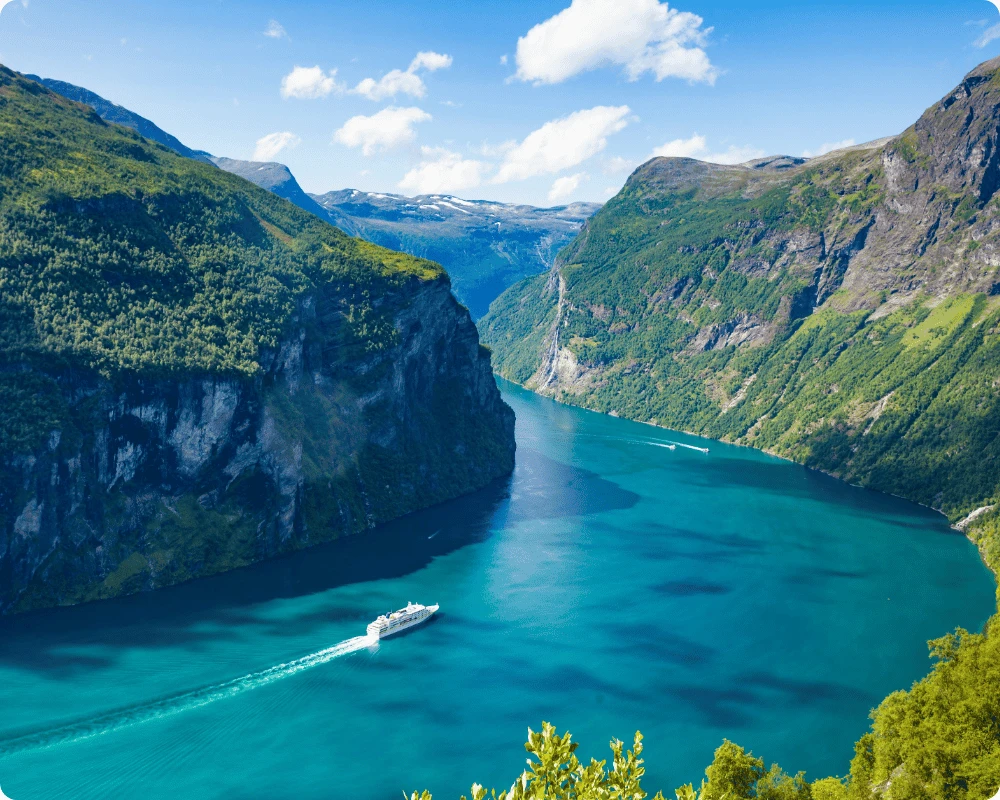
Sailing along this jagged coastline, scattered with islets and reefs, is no small matter. In winter, crews faced almost constant darkness, storms, ice and stretches exposed to the Atlantic swell. Before lighthouses, radar and accurate charts became widespread, every crossing depended on the experience of captains and pilots, who knew every passage by heart.
The darkest period was the Second World War. The line kept running under the occupation, but its ships became targets. In all, 17 Coastal Express ships were lost during the conflict, and more than 700 Norwegians died in these shipwrecks. According to Museum Nord, it is still not known how many German soldiers, also on board, lost their lives.
From transport to tourism
After the war, Norway modernised. Roads, bridges, tunnels and small regional airports gradually made coastal villages less dependent on the ship. The line kept its public service role, but increasingly turned towards travellers coming to see the coast. Ships grew larger, cabins became more comfortable, panoramic lounges appeared, and the voyage itself became the reason to come aboard.
Key dates of the Coastal Express at a glance:
| Date | Milestone |
| 1893 | First voyage Trondheim-Hammerfest |
| 1898 | Extended to Bergen |
| 1908 | Kirkenes becomes the northern terminus |
| 1940-1945 | 17 ships lost during the war |
| Today | 34 ports served all year round |
The Coastal Express today: the cruise experience
The route and its highlights
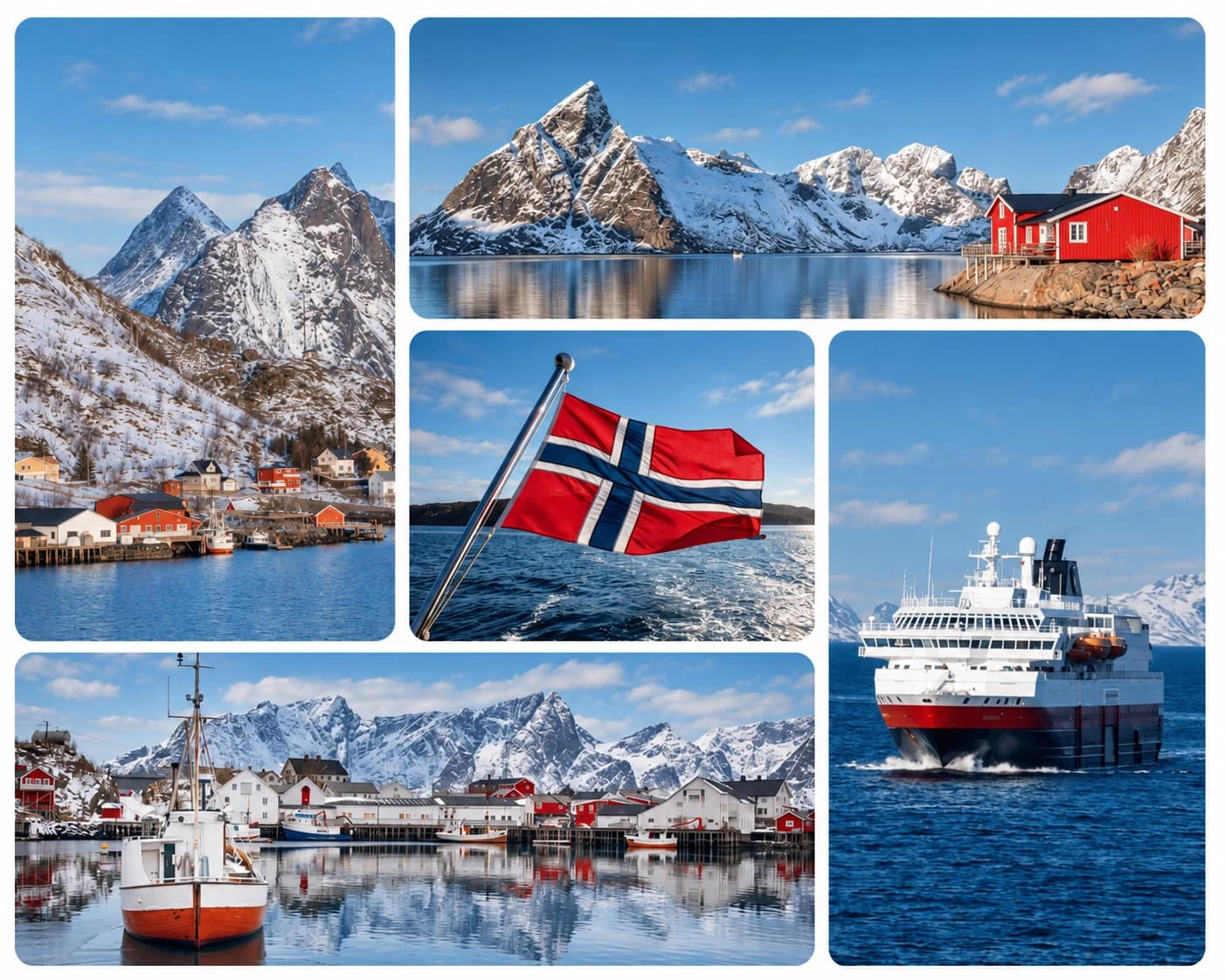
The route links Bergen and Kirkenes, calling at 34 ports, from major cities to hamlets of just a few dozen inhabitants. Stops not to miss include:
- Bergen, with the colourful houses of Bryggen and its fish market
- Ålesund, rebuilt in a unique Art Nouveau style after the fire of 1904
- Trondheim and Nidaros Cathedral, a landmark of Norwegian history
- the Arctic Circle, whose crossing is often celebrated on board
- the Lofoten Islands, with their fishing villages and peaks plunging into the sea
- the Trollfjord, a fjord so narrow that the ship seems to brush its walls
- Tromsø, capital of Arctic Norway
- Honningsvåg, gateway to the North Cape
- Kirkenes, the end of the line, close to the Russian border
One quirk of the route: ports called at in daylight on the way north are mostly reached at night on the way back, and vice versa. A full round trip therefore lets you see most ports in daylight.
And for those captivated by the far north, the adventure can continue well beyond the North Cape: a Spitsbergen cruise takes you to the heart of the Svalbard archipelago, among glaciers, pack ice and polar wildlife.
How many days on board?
The length of your trip depends on the route you choose:
- Northbound, Bergen-Kirkenes: 7 days
- Southbound, Kirkenes-Bergen: 6 days
- Full round trip: 12 days
- Short sections: from a few hours to a few days, between any two ports
Because the line remains a scheduled service, you can sail just part of it, for example to reach the Lofoten Islands or Tromsø, and combine the voyage with a stay ashore. The scheduled line isn't the only option: expedition ships and sailing boats also let you explore the Norwegian coast.
Life on board
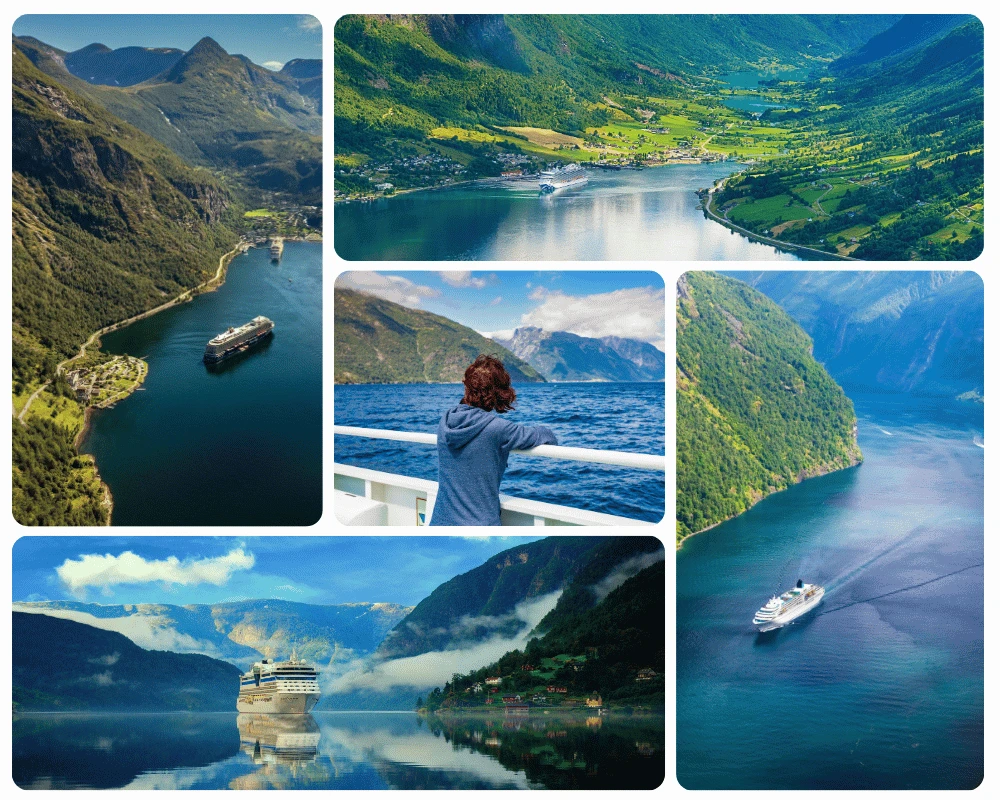
Coastal Express ships are nothing like large cruise liners. Mid-sized, they are designed to slip into the fjords and dock at small ports, carrying cargo, and sometimes cars, as well as passengers. The newest ships run partly on batteries, allowing them to sail silently through some fjords. Their main features:
- Length: about 100 m to 135 m
- Capacity: a few hundred passengers, a far cry from the thousands on large cruise ships
- Cabins: around 180 per ship
- Cruising speed: around 15 knots (about 28 km/h)
- Flag: Norwegian
Life on board reflects this. There's no casino and no shows, just panoramic lounges, outer decks for taking in the scenery and a calm mood where the landscape takes centre stage. Cruise passengers travel alongside locals who take the ship for a few stops, a reminder that it is first and foremost a means of transport.
Every evening, a talk presents the next day's programme: the ports of call, the scenery not to miss and the excursions on offer. To unwind, passengers can also use the gym, hot tub and sauna.
The food showcases produce from the coast: fresh fish and seafood, lamb, cheeses and berries from the far north. Cabins vary in size depending on the category, and some offer direct sea views. Each has a button you can press to be woken if the Northern Lights appear, so there's no need to stay up all night to catch the show.
Ports of call and excursions
Some calls last only a few minutes, just long enough to load cargo and welcome passengers. Others are longer, leaving time to go ashore to visit a town or join an excursion. Depending on the season, you can head out to the North Cape, go dog sledding, watch seabirds or visit a fishing village.
Some stops deserve more than a port call. Further north, a cruise in the Lofoten Islands lets you explore its fjords, beaches and fishing villages on stilts at your own pace.
Book your cruise with Filovent
Filovent can arrange a cabin cruise along the Norwegian fjords: browse our Norway cruise options, and our advisers will help you choose the itinerary and time of year that suit you best.
FAQs
How long does a Coastal Express cruise last?
The northbound voyage from Bergen to Kirkenes takes 7 days and the southbound voyage 6 days. The round trip takes 12 days rather than 13, because you arrive in and leave Kirkenes on the same day. You can also sail just part of the route, for a few hours or a few days.
Can you sail just part of the route?
Yes. As the Coastal Express is a scheduled service, you can board and disembark at any of the 34 ports on the route, for a journey of a few hours or several days.
When is the best time to go?
It depends on what you want to see. Summer brings the midnight sun and endless days, while autumn and winter are the seasons for the Northern Lights and snowy landscapes. Spring marks the return of the light and is often a good compromise. You'll find a month-by-month breakdown in our guide on when to visit Norway.
Will I get seasick on the Coastal Express?
Rarely. For most of the route, the ship follows the coast, sheltered by islands and fjords, where the sea stays calm. Only a few exposed stretches, notably around Stad, Hustadvika and parts of Finnmark, can make the ship roll, especially in winter. If you're prone to seasickness, choose a cabin midship on a lower deck: that's where you'll feel the motion least.
Sources
- Hurtigruten (coastal route), Wikipedia. Accessed 5 October 2026.
- Richard With, Wikipedia. Accessed 5 October 2026.
- Hurtigruten at war, Museum Nord. Accessed 5 October 2026.
- The Coastal Express Route, Visit Norway. Accessed 5 October 2026.