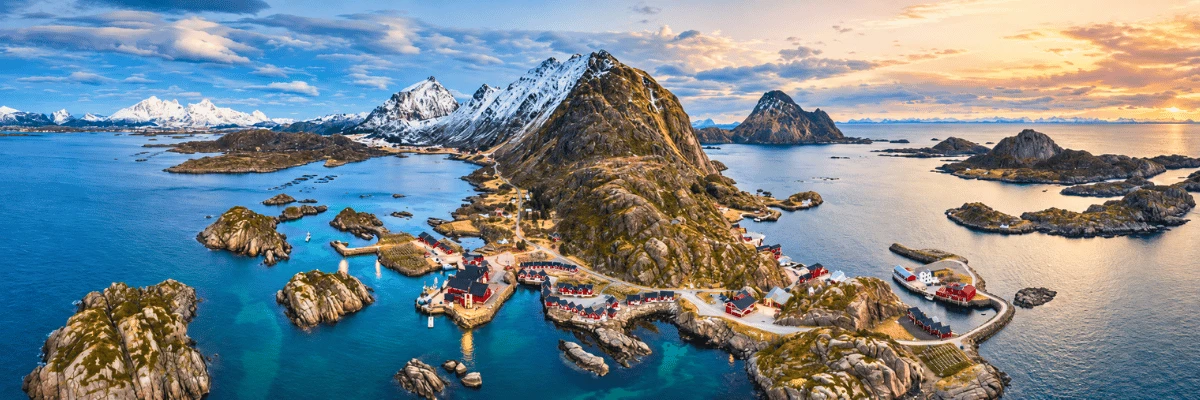
Fjords in summer, the Northern Lights in winter: in Norway, the season shapes the whole trip. Here is when to visit Norway, and how to pick the best time for what you have in mind, whether that's a cruise, hiking, skiing, wildlife watching or chasing the aurora.
“Our cruise in Norway was the best trip of my life. On the very first night we were lucky enough to see the Northern Lights painting the sky in incredible colours. It was absolutely magical!” says Valérie, who spent 10 days exploring the Norwegian fjords with her children.
Summary
- 1. Visiting Norway in summer (June to August)
- 2. Visiting Norway in winter (December to February)
- 3. Visiting Norway in spring or autumn
- 4. When to go to Norway to see the Northern Lights
- 5. When to go hiking in Norway
- 6. When to visit Norway with children
- 7. When to go to Norway for wildlife
- 8. When to visit the Norwegian fjords
- 9. When to go to Svalbard
- 10. When to visit Oslo
- 11. When to visit Norway's west coast
- 12. Practical guide to your trip to Norway
- 13. FAQs about the best time to visit Norway
In short: when is the best time to visit Norway?
The best time to visit Norway is from June to August for the fjords, hiking and the midnight sun, with temperatures of 10 to 22 °C. To see the Northern Lights, head to the north of the country (Tromsø, the Lofoten Islands) between late September and late March. May and September strike the best balance between decent weather, fewer crowds and lower prices.
| What you're after | Best time | Where to go |
|---|---|---|
| Fjord cruise | June to August | Geirangerfjord, Sognefjord, Nærøyfjord |
| Northern Lights | Late September to late March | Tromsø, Lofoten, Finnmark |
| Midnight sun | Mid-May to late July | North of the Arctic Circle |
| Hiking | Mid-June to mid-September | Rogaland, Hardanger, Romsdal |
| Skiing | December to April | Trysil, Hemsedal, Geilo |
| Wildlife | Depends on the species | Vesterålen, Tromsø, Runde |
| Svalbard | June to August | Longyearbyen |
| Tighter budget | May, September | Oslo, Bergen, fjords |
Norway's climate varies widely between the south, kept milder by the Gulf Stream, and the Arctic north. Below are the average monthly temperatures in the Oslo area, based on MET Norway's 1991–2020 climate normals. North of the Arctic Circle, expect it to be several degrees colder in winter:
| Temperatures | Jan | Feb | Mar | Apr | May | Jun | Jul | Aug | Sep | Oct | Nov | Dec |
|---|---|---|---|---|---|---|---|---|---|---|---|---|
| Air min (°C) | -7 | -6 | -3 | 1 | 6 | 10 | 13 | 12 | 8 | 3 | -1 | -5 |
| Air max (°C) | -1 | 0 | 4 | 10 | 16 | 20 | 22 | 21 | 16 | 10 | 3 | 0 |
| Sea (°C) | 3 | 3 | 3 | 7 | 10 | 15 | 17 | 17 | 14 | 10 | 6 | 3 |
And to pick your month at a glance:
| Month | Conditions | Ideal for |
|---|---|---|
| January | Cold, polar night in the north | Northern Lights, skiing |
| February | Cold, the light returns | Aurora, skiing, snowy fjords |
| March | Longer days | Aurora, spring skiing |
| April | Mild in the south, snowy in the north | Easter skiing |
| May | Mild, few visitors | Waterfalls, National Day on 17 May |
| June | Mild, very long days | Fjords, hiking, midnight sun |
| July | Warm, peak season | Fjords, Lofoten, Svalbard |
| August | Warm, peak season | Hiking, fjords, Svalbard |
| September | Cool, fewer visitors | Autumn colours, first auroras |
| October | Wet in the west | Aurora, city breaks |
| November | Cold, short days | Aurora, orcas and whales |
| December | Cold, polar night in the north | Aurora, Christmas markets |
1. Visiting Norway in summer (June to August)
Summer is the only season when every mountain road, hut and trail is open. From June to August, temperatures range from 10 to 22 °C. In June, days last more than 18 hours in the south and, north of the Arctic Circle, the sun never sets.
It's the ideal time to sail the fjords and around the Lofoten Islands on a cruise. Oslo and Bergen come alive with open-air festivals, and conditions are good for sea kayaking. The one drawback: it's also peak season, with the biggest crowds and the highest prices. Book several months ahead.
When can you see the midnight sun in Norway?
The midnight sun is only visible north of the Arctic Circle, and the dates depend on latitude: roughly 4 June to 8 July in Bodø, late May to mid-July in the Lofoten Islands and 20 May to 22 July in Tromsø. The further north you go, the longer it lasts.

2. Visiting Norway in winter (December to February)
From December to February, Norway becomes a polar landscape and the fjords lie under snow. In the south, temperatures usually stay between -7 and 0 °C, but they drop much lower inland and in the north. It's the best season for seeing the Northern Lights and for winter sports in resorts such as Trysil, Hemsedal and Geilo.
North of the Arctic Circle, the polar night bathes some towns in a bluish half-light for weeks on end: in Tromsø, the sun doesn't rise between late November and mid-January. Pack technical clothing to keep the cold out: thermal base layers, a waterproof jacket, gloves and a hat.

3. Visiting Norway in spring or autumn
Spring (March to May) and autumn (September to November) are shoulder seasons, with fewer visitors and more affordable prices. Temperatures usually range from 0 to 15 °C.
In spring, snowmelt swells the waterfalls along the fjords and the orchards of Hardanger blossom in May. In autumn, birch and rowan turn yellow and red, and the first Northern Lights appear in the north from late September. The weather remains changeable, especially on the west coast, where rain becomes frequent from September onwards. Some high-altitude trails and scenic routes stay closed until June or shut as early as October, so check they're open before you set off.

4. When to go to Norway to see the Northern Lights
The Northern Lights in Norway can be seen from late September to late March, when the nights are dark enough. They're impossible to see in summer because of the midnight sun. December to February brings the longest nights, while September, October and March combine good odds with more bearable temperatures.
The best spots are north of the Arctic Circle: Tromsø, the Lofoten Islands, Vesterålen, Alta and Finnmark. To improve your chances, get away from city lights and allow several nights in the area, as solar activity and cloud cover are always unpredictable. The Coastal Express (Hurtigruten) route between Bergen and Kirkenes is also a popular way to look for the aurora from the sea.

5. When to go hiking in Norway
The hiking season runs from mid-June to mid-September. Before that, snow still blocks many high trails; after it, the mountain huts close and the weather turns. Long summer days give you time to tackle demanding routes without rushing.
| Hike | Region | Return distance | Difficulty |
|---|---|---|---|
| Preikestolen | Rogaland | 8 km | Moderate |
| Romsdalseggen | Åndalsnes | 10 km | Challenging |
| Trolltunga | Odda (Hardanger) | 14 to 27 km | Hard |
- Preikestolen (Pulpit Rock): in the county of Rogaland, this rocky plateau towers 604 metres above the Lysefjord. It's one of Norway's most famous hikes.
- Romsdalseggen: starting from Åndalsnes, this ridge walk looks out over the Romsdalsalpane mountains, the Romsdalen valley and the Isfjorden.
- Trolltunga: near Odda, this rocky outcrop juts out some 700 metres above Lake Ringedalsvatnet. Plan for a long day on foot; the distance depends on which car park you start from.

6. When to visit Norway with children
Summer is still the best time for children: pleasant temperatures, long days, short fjord cruises and plenty of outdoor activities. The UK summer holidays fall in Norway's peak season, so book early. To show younger ones the Northern Lights, February half-term or October half-term are good options, as long as the whole family is well kitted out against the cold.
7. When to go to Norway for wildlife
In Norway, the best time depends on the species you want to see:
| Species | When | Where to see them |
|---|---|---|
| Sperm whales | May to September | Andenes (Vesterålen) |
| Orcas and humpback whales | November to January | Tromsø, Skjervøy |
| Puffins | Late April to early August | Runde, Røst, Hornøya |
| Musk oxen | June to September | Dovrefjell |
| Reindeer | All year round | Finnmark, Troms |
| Polar bears, walruses | June to August | Svalbard |
Sperm whales can be spotted off Andenes, in Vesterålen, mainly from May to September, while orcas and humpback whales follow the herring shoals around Tromsø in the depths of winter. Puffins nest on the coastal cliffs, such as on the island of Runde, from late April to early August. Guided safaris in Dovrefjell let you watch musk oxen in summer, keeping a safe distance of at least 200 metres. Elk, lynx and Arctic foxes live in the forests and mountains inland but are elusive: dawn and dusk give you the best chance of a sighting.

8. When to visit the Norwegian fjords
The best time to visit the Norwegian fjords is June to August, when the days are long and temperatures mild. May and September are good alternatives if you want to avoid the crowds. The Geirangerfjord, a UNESCO World Heritage Site, is famous for the Seven Sisters waterfall and its sheer rock walls. The Nærøyfjord, also listed, is a branch of the Sognefjord and one of the narrowest fjords in Europe. The Sognefjord, the longest and deepest in the country, is perfect for a Norwegian fjords cruise.
New for 2026: zero-emission World Heritage fjords
Since 1 January 2026, passenger ships under 10,000 gross tonnage must operate with zero emissions in the five UNESCO-listed fjords (Geirangerfjord, Nærøyfjord, Aurlandsfjord, Sunnylvsfjord and Tafjord). Larger cruise ships have until 2032 to comply. Smaller ships, such as those used on small-group cruises, are therefore the first to be covered by the rule.

9. When to go to Svalbard
Expedition cruises to Svalbard mainly run from June to August, when the sea ice retreats and you can get close to glaciers, bird colonies, walruses and polar bears. Here the midnight sun shines from roughly late April to late August. Departures are from Longyearbyen, on board expedition ships.
10. When to visit Oslo
Oslo has no real off-season:
- In summer, from June to August: Vigeland Park, the islands of the Oslofjord and open-air festivals.
- In spring and autumn: culture, such as the Munch Museum or the Deichman library, and walks in the hills of Nordmarka.
- In winter, from December to February: Christmas markets, ice skating and skiing at Holmenkollen, a metro ride from the centre.
If you can only go once, go in June, when the days last almost 19 hours and the whole city lives outdoors, in its parks and on the fjord.
11. When to visit Norway's west coast
The west coast is best explored from May to September, with activity peaking in July and August. This is the land of the great fjords, Bergen and Ålesund, rebuilt in Art Nouveau style after the great fire of 1904. Local ferries cross from shore to shore with spectacular views, and the region's glaciers are ideal for guided walks.
Expect rain, too. Bergen is one of the wettest cities in Europe, especially from September to January. Further inland, Jotunheimen National Park draws hikers with Norway's highest peaks, while stave churches such as Urnes, a UNESCO World Heritage Site, are a reminder of the country's medieval past.

12. Practical guide to your trip to Norway
What to pack for Norway
All year round
Dress in three layers, with a breathable base layer, a warm mid-layer (fleece or wool) and a waterproof, windproof jacket. Add sturdy walking boots for excursions.
In winter
Add thermal underwear, gloves, a hat and insulated boots.
On a cruise
Bring something smarter for evenings on board.
How to get to Norway
There are direct flights from London and several other UK airports to Oslo, and some to Bergen. To reach Bodø, Tromsø or the Lofoten Islands, you'll usually need to change in Oslo. Norway is in the Schengen area but not the EU: UK travellers need a valid passport (issued within the last ten years and valid for at least three months after the day you leave) and can stay up to 90 days in any 180-day period without a visa. Since October 2025, the EU Entry/Exit System (EES) records your fingerprints and photo on your first entry into the Schengen area, and the ETIAS travel authorisation is due to follow from late 2026, so check the GOV.UK travel advice for Norway before you go.
Getting around Norway
The train is ideal for taking in the scenery, particularly on the Oslo-Bergen line and the Flåm Railway. Buses serve the more remote areas, a car gives you the most freedom and ferries are essential for crossing the fjords and reaching the islands.
Why take a cruise in Norway?
A cruise links the Geirangerfjord, Sognefjord, Lysefjord and Hardangerfjord in just a few days without changing accommodation, and reaches shores no road can. Filovent, a sailing and cruise travel agency founded in 1995, offers cruises departing from Bergen, Bodø, Longyearbyen and Kirkenes.
How much does a cruise in Norway cost?
Here are indicative prices per person, in euros, for an 8-day itinerary in Norway, based on a double cabin. Prices vary with the season and cabin category:
| Type of ship | Standard, high season | Superior, high season | Standard, low season | Superior, low season |
|---|---|---|---|---|
| Eco-luxury ship | €6,200 | €6,600 | €5,100 | €5,300 |
| Premium cruise ship | €5,500 | €5,800 | €2,800 | €3,000 |
| Expedition yacht | €5,000 | €5,300 | €3,300 | €3,500 |
Where to stay in Norway
Hotels, youth hostels, cabins (hytter), holiday lets and campsites: there's plenty of choice. In the busiest areas, such as the Lofoten Islands or the Geirangerfjord, accommodation is limited in summer, so book as early as you can.
13. FAQs about the best time to visit Norway
When is the best time to visit Norway?
June to August for the fjords, hiking and the midnight sun, with temperatures of 10 to 22 °C. Late September to late March for the Northern Lights in the north of the country.
What is the cheapest month to go to Norway?
May, September and, outside the holidays, January are usually the best value. Cruise prices can drop by 15 to 50% in low season, depending on the ship.
When can you see the Northern Lights in Norway?
From late September to late March, anywhere north of the Arctic Circle, with Tromsø and the Lofoten Islands among the most reliable spots. December to February brings the longest nights.
Can you see the Northern Lights and the midnight sun on the same trip?
No. The midnight sun runs from May to July, when the nights never get dark enough for the aurora.
How many days do you need to see the Norwegian fjords?
Allow 7 to 10 days for a cruise through the main west coast fjords, and 10 to 12 days to go up to the North Cape or the Lofoten Islands.
What currency is used in Norway?
The Norwegian krone (NOK). Cards are accepted almost everywhere, even for small amounts.
Sources
- Filovent. (2026). Norway cruise price list [internal data].
- Government of Norway. (n.d.). Zero-emission requirements for passenger ships in world heritage fjords. Regjeringen.no. Accessed September 2026.
- Norwegian Meteorological Institute (MET Norway). (n.d.). Climate normals 1991-2020. Norsk Klimaservicesenter, seKlima database. Accessed September 2026.
- Time and Date AS. (n.d.). Sunrise and sunset: Bodø, Svolvær, Tromsø, Longyearbyen. Accessed September 2026.
- UNESCO World Heritage Centre. (2005). West Norwegian Fjords – Geirangerfjord and Nærøyfjord.
- UNESCO World Heritage Centre. (1979). Urnes Stave Church.
- Visit Norway (Innovation Norway). (n.d.). Northern Lights, midnight sun and wildlife watching in Norway. Accessed September 2026.