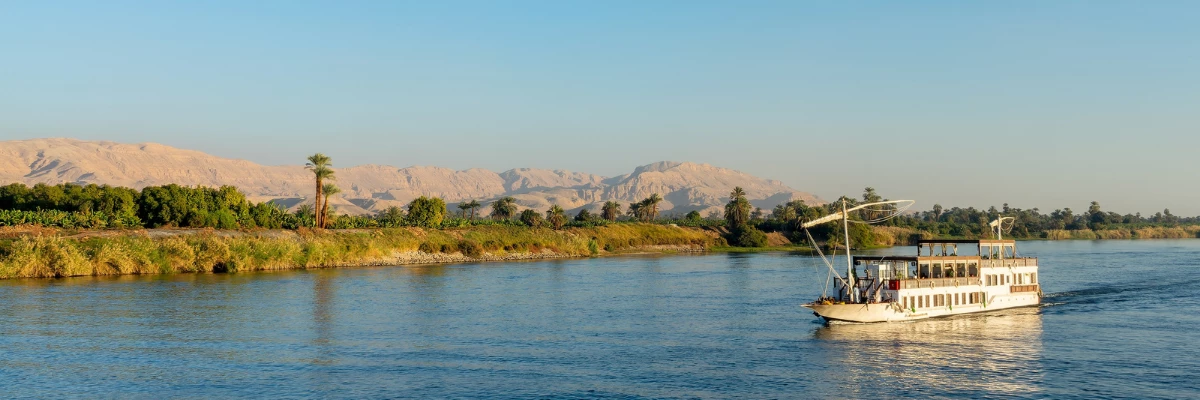
Sailing the Nile does not have to mean boarding one of the large cruise ships lined up along the quays of Luxor. There is a far quieter alternative: the dahabiya, a traditional Egyptian sailing boat with two masts, a handful of cabins and a small crew. Its shallow draught lets it slip close to the banks, anchor beside islands and stop at villages the big ships can never reach. On board, eight to twenty guests share the deck, the meals and the rhythm of the river between temple visits. It is a way of travelling up the Nile that owes as much to cultural discovery as to unhurried sailing. "An unforgettable cruise to the rhythm of the Nile," says Prisca, who sailed with Filovent on a five-day Nile cruise from Esna.
Summary
- 1. What is a dahabiya?
- 2. How does a dahabiya cruise work?
- 3. Dahabiya, felucca or cruise ship: what are the differences?
- 4. Why choose a dahabiya to discover the Nile?
- 5. When to go and how to plan a dahabiya cruise
- When is the best time to go?
- How many days should you allow?
- What budget should you allow?
- What to pack
- 6. Frequently asked questions about dahabiya cruises
- What is the difference between a dahabiya and a felucca?
- How many passengers can travel on a dahabiya?
- Does a dahabiya have an engine?
- Is there air conditioning on a dahabiya?
- Can you sleep on a dahabiya?
- Can you charter a dahabiya privately?
- Is a dahabiya cruise suitable for older travellers?
- Can you take a dahabiya cruise with children?
What is a dahabiya?
A dahabiya is a traditional Egyptian boat under sail, built to carry passengers on a shallow river. The same word appears in several spellings, including dahabiya, dahabieh, dahabeah and dahabiyeh, depending on how the Arabic is transcribed.
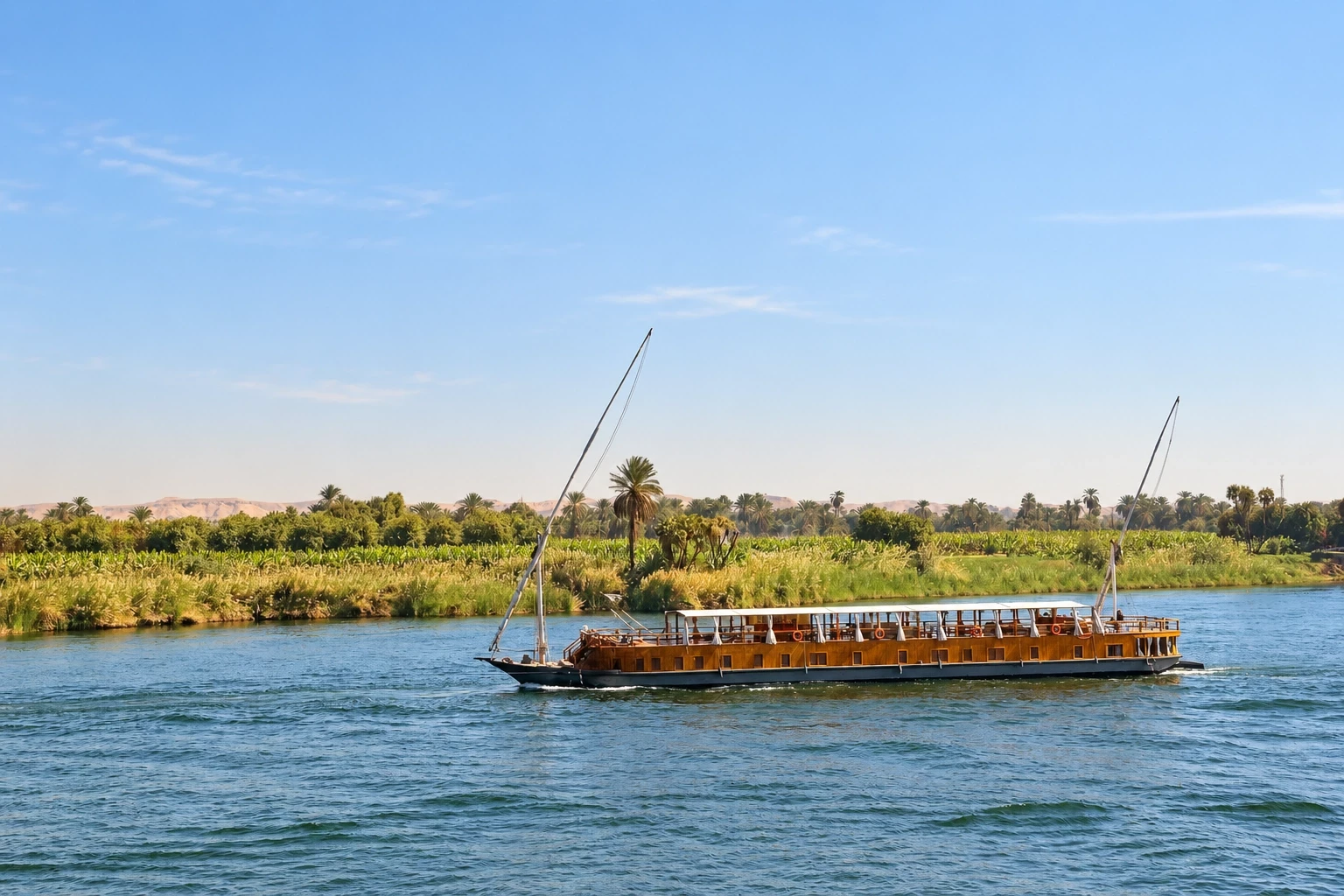
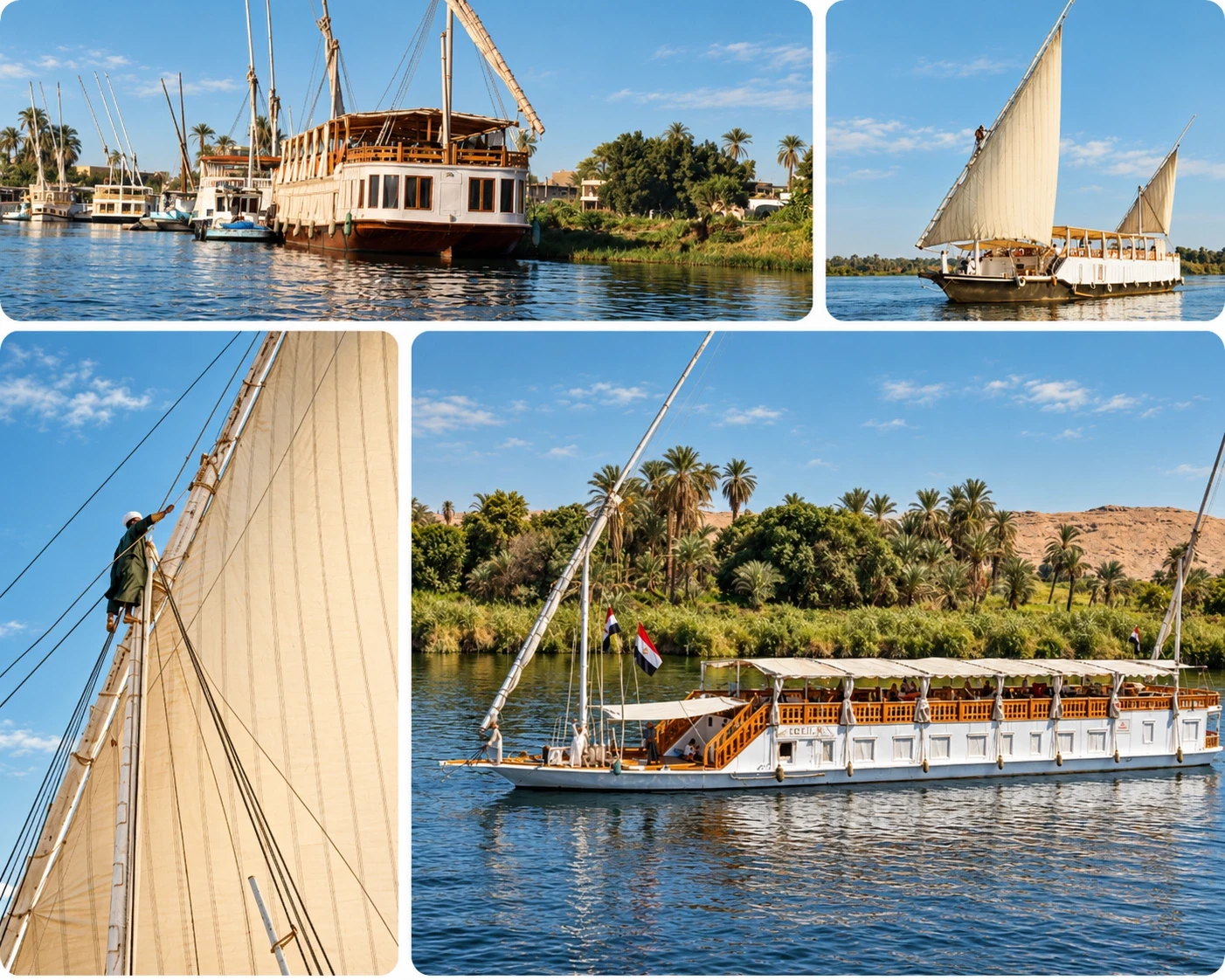
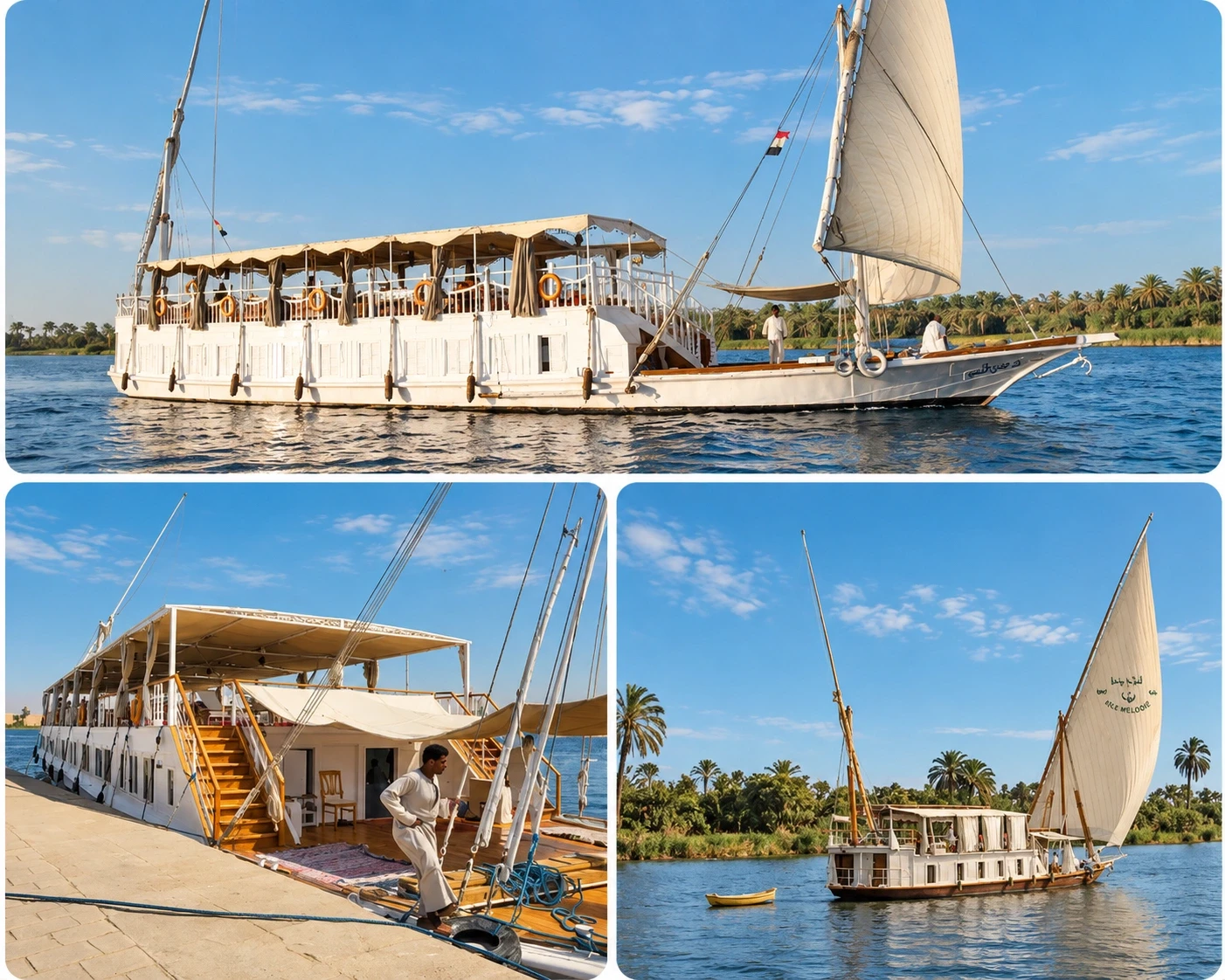
Its features set it apart at once from every other vessel on the river. The hull is long, slender and sits very low in the water. Two masts carry triangular lateen sails, inherited from traditional river and Mediterranean sailing. The upper deck is largely open and takes up much of the boat's length, while the cabins sit below it or on the main deck.
Scale is the other decisive factor. Where a conventional cruise ship regularly carries more than a hundred passengers, a dahabiya takes eight to twenty guests, looked after by a crew that is large for the number of guests. That changes the nature of the trip entirely: the shared areas stay quiet, meals are taken in a small group, and the boat can anchor in places closed to the bigger vessels.
One point is often misunderstood and worth making clear: the dahabiya is a sailing boat, but sailing is almost always supplemented by mechanical assistance.
Source: Adobe Stock
The history of the dahabiya on the Nile
For thousands of years the Nile was Egypt's main transport route, and sailing on it is documented from antiquity onwards. The wind pattern largely explains the shape of these boats: the prevailing winds blow from the north, which allows a boat to work its way south up the river under sail, while the current carries vessels back north on its own. A simple lateen rig is therefore enough to travel in both directions.
The dahabiya as we know it descends from the barges of notables used in the Ottoman and khedival periods. Those private boats were larger and better appointed than ordinary cargo craft, and served the travels of dignitaries and large landowners. The name is usually traced to the Arabic word "dhahab", meaning gold: the most common explanation points to the gilded decoration of the ceremonial barges of the Ottoman elite. That etymology is plausible and widely repeated, but it remains the accepted interpretation rather than a documented certainty.
The rest of its history falls into three phases:
- The nineteenth century, its golden age: before the railway and the steamers, the only way up the Nile to Upper Egypt was by boat. European travellers heading for the temples chartered a dahabiya and its crew, often from the Cairo area, for journeys that could last several weeks or months, as far as Aswan and beyond. Amelia Edwards's account, published in 1877, describes chartering the boat, life with the crew, waiting for wind and the long stops at the sites.
- The decline, from the end of the nineteenth century: steam navigation, and then organised cruises, stripped the dahabiya of its practical role. Slower and dependent on the wind, it gave way to motorised boats able to keep to a fixed schedule. By the twentieth century the river had been left to feluccas for short outings and to large cruise ships for the tours.
- The revival, since the late 1990s and above all the 2000s: new boats have been built to old plans, but fitted out for contemporary guests. The exterior, the rig and the silhouette follow the historic model; the interior has been rethought around cabins with private bathrooms, a lounge and a fitted deck.
What does a dahabiya look like?
The design of a dahabiya answers a simple constraint: it has to sail a river whose depth varies considerably with the season, the banks and the sandbanks. The hull is therefore shallow, almost flat, and its draught is usually around one metre to one and a half metres. That is what makes it possible to anchor along the banks, beside an island or close to a village, where a cruise ship drawing several metres has to stay in the channel and tie up at a built quay.
Boats are built in wood or steel depending on the yard and the age of the vessel. Recent ones often have a steel hull with substantial woodwork on the superstructure, the decks and the interior.
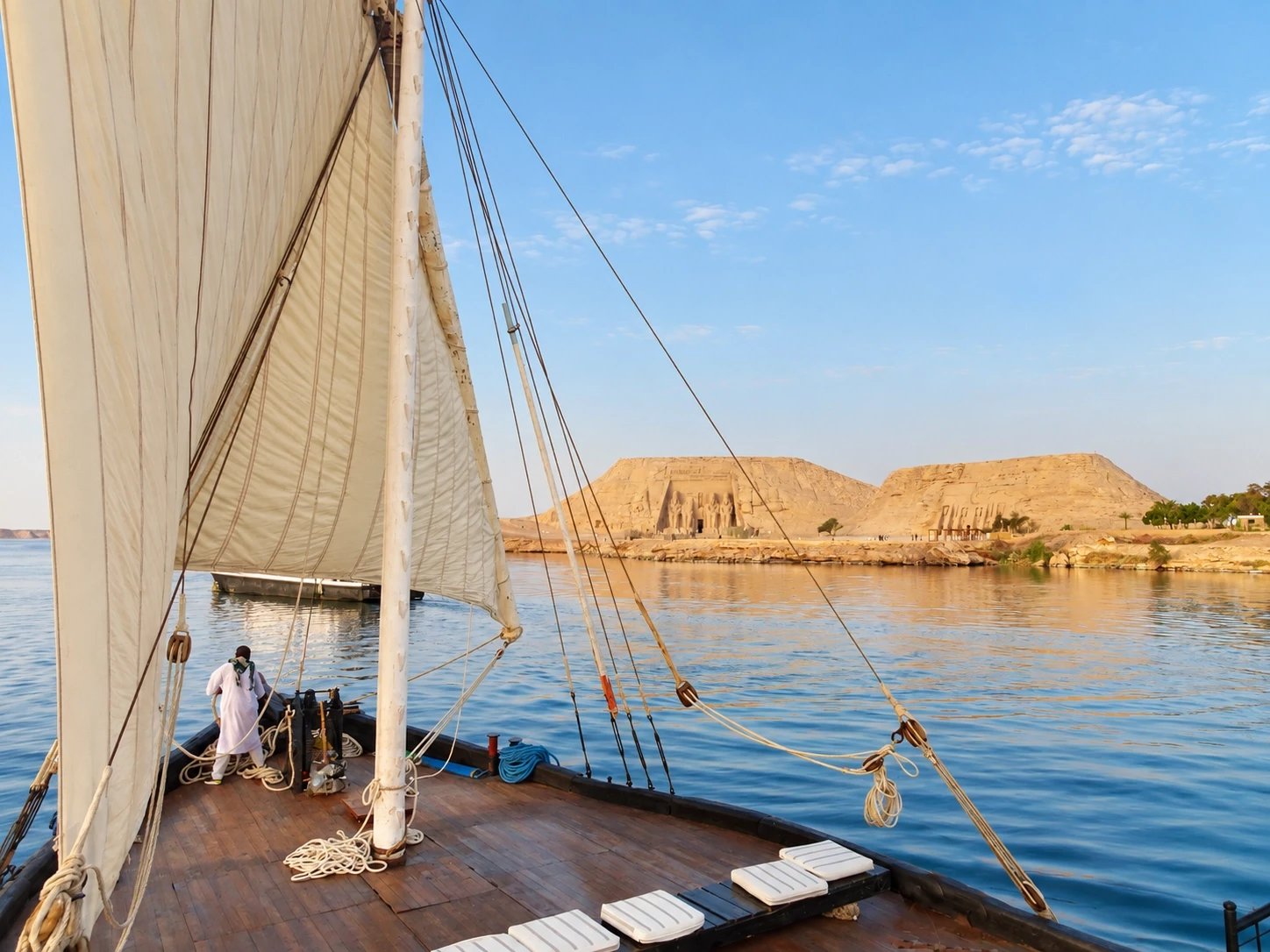
The rig usually consists of two masts carrying lateen sails, the forward mast generally being the taller. Some boats, especially the smaller ones, carry only one. The sails are handled by the crew, with no winch and no automation: hoisting them is one of the moments that punctuate the day on board.
The layout follows a consistent logic. The largely open upper deck is the real centre of life on board: sun loungers, armchairs, tables and a shaded area under a stretched awning or a light structure. Below it are the cabins, on either side of a passageway, along with a lounge or dining room used for meals and for the cooler hours. The cabins on a dahabiya are generally more spacious than those on a cruise ship, with large windows just above the water, and each has a private bathroom.
Fittings vary noticeably from boat to boat and from operator to operator. Depending on the vessel, you may find air conditioning in the cabins, a library, a bar, more spacious suites, a tender or more elaborate deck furniture. It is therefore worth checking the specification of the particular boat rather than relying on a general description: between a very simple four-cabin dahabiya and a recent ten-cabin boat with suites, the level of comfort is not remotely the same.
The dahabiya in numbers
| Capacity | Most boats take 8 to 20 guests, with the largest carrying around twenty people. |
|---|---|
| Cabins | A boat generally has 4 to 12 cabins, sometimes including one or two suites. |
| Length | The hull usually measures between 25 and 45 metres, depending on the yard and the age of the boat. |
| Crew | The crew normally numbers 8 to 15 people, a high ratio given the number of guests. |
| Masts | Most boats carry two masts, with a single mast on some smaller vessels. |
| Cruise length | The programmes on offer usually run for 4 to 7 nights. |
These figures are indicative ranges: every boat has its own specification and the differences within the category are wide.
Source: Shutterstock
How does a dahabiya cruise work?
A dahabiya cruise alternates sailing and sightseeing, at a far gentler pace than the conventional cruise ships. The daily programme is built around a few hours under way, one or two cultural visits and long stretches of time on deck.
The sailing itself deserves a precise explanation. The dahabiya is a sailing boat: when the wind is strong enough and in the right quarter, it moves under sail, and that is obviously the intended way of travelling. Dahabiyas do not, however, generally carry a main engine. When the wind drops, turns against the boat or the programme calls for a certain distance to be covered, a small support vessel, a tug or a pusher boat, takes over. This is the norm rather than the exception: it would be misleading to present a dahabiya cruise as sailing alone. How much of the trip is actually spent under sail depends on the conditions, the route and the boat.
Days start early, particularly when a temple visit is planned: the sites are more pleasant and less crowded first thing in the morning. The boat then sails for part of the day, often in the late morning and the afternoon, with stops for lunch or a swim depending on the programme and conditions.
There is no night sailing. The dahabiya anchors in the evening along a bank, beside an island or near a village, and the crew sometimes puts out a gangplank so guests can go ashore. The nights are therefore silent, with no engine vibration, and the view on waking is wherever the boat stopped the evening before.
Life on board a dahabiya
The spaces are laid out in much the same way from one boat to the next.
- The cabins: timber fittings, large windows just above the waterline and, in the vast majority of cases, a private bathroom with a shower, the hot water being produced on board. Suites, where the boat offers them, give more space and sometimes direct access to the deck.
- Air conditioning: fitted on only some dahabiyas, and dependent on the boat's generator. On certain vessels it runs continuously; on others only at set times, often overnight, to preserve quiet and electrical capacity. This is always worth checking, especially for a trip at the start or the end of the hot season.
- The open deck: a sunny area for watching the sailing and the banks, and a shaded part under an awning or canopy, furnished with armchairs and low tables.
That deck is where most free time is spent: drinking tea, reading and watching the sugar cane fields, the palm groves, the buffalo led down to the water and the fishermen's boats go by.
Meals are cooked on board by a chef and served at set times, on deck when the temperature allows and in the lounge when it does not. The cooking is mainly Egyptian, with plenty of vegetables, pulses and mezze: fava bean purée (ful), bean fritters (taameya), salads, rice, stuffed vegetables, fresh bread, grilled meat or poultry, and desserts based on fruit or dairy. Hibiscus infusions and tea run through the day. Special diets can generally be accommodated if they are flagged before departure, since everything is cooked on board rather than bought in.
The crew, large relative to the number of guests, handles the sailing, the service, the maintenance and the cooking. The captain, often from the river region himself, decides the anchorages and the use of the sails. Many programmes also include an English-speaking Egyptologist who accompanies the visits, explains the temples and answers questions on board. Their presence changes how the sites read; when it is not included in the price, it can often be added as an option.
A typical day begins early, with breakfast on deck and then a temple visit during the morning. The boat sails afterwards, lunch is served under way, and the afternoon is spent on deck or ashore at a village. The boat anchors in the late afternoon, dinner is served at sunset, and the evening stays quiet, sometimes with tea and music played by the crew.
Routes and stops along the Nile
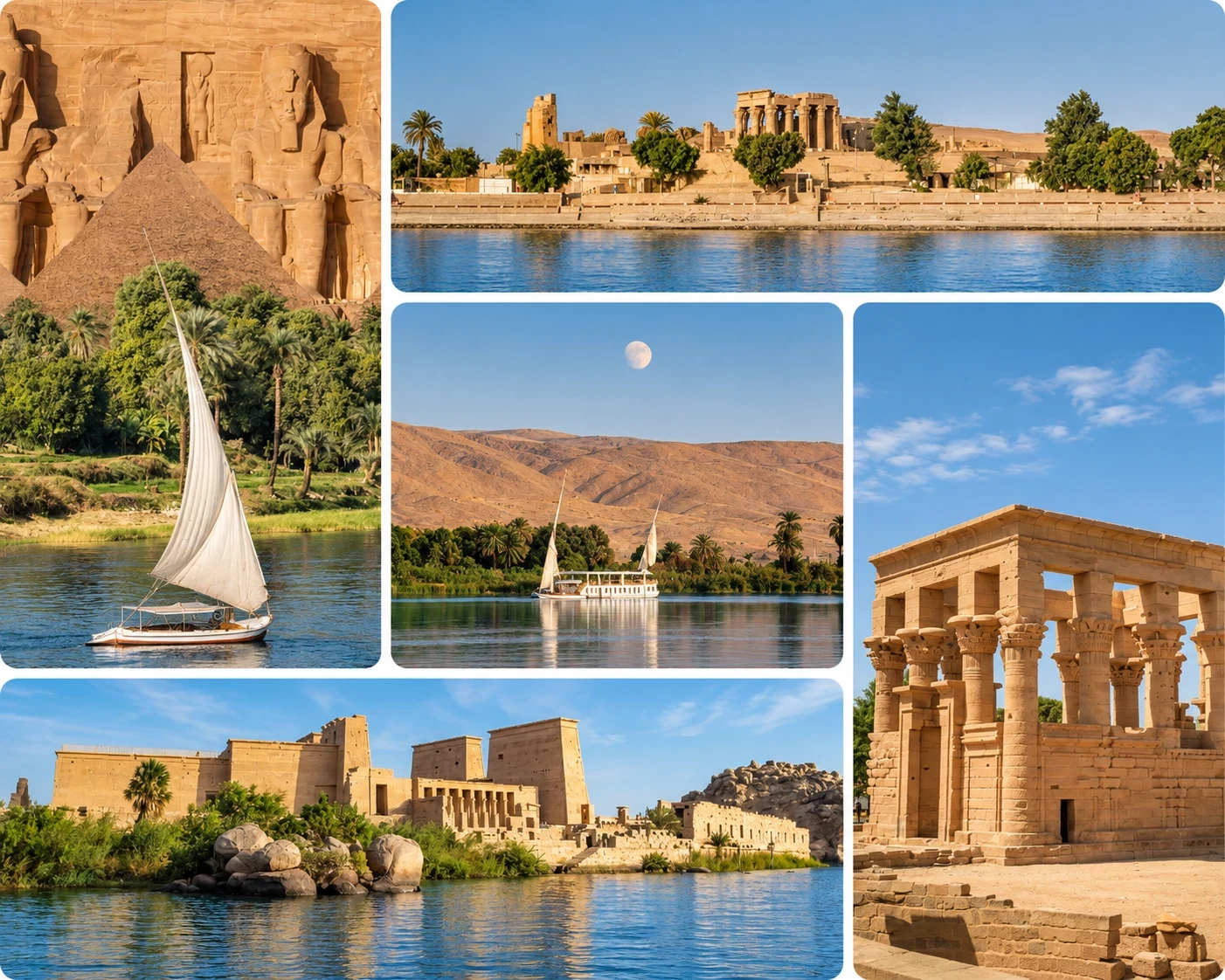
The most common route links Esna to Aswan, or Aswan to Esna in the other direction, along roughly 150 kilometres of the Nile. Esna serves as a start or finish point for practical reasons: the lock there is an unavoidable bottleneck, and many programmes arrange boarding upstream or downstream of it, with a road transfer from or to Luxor.
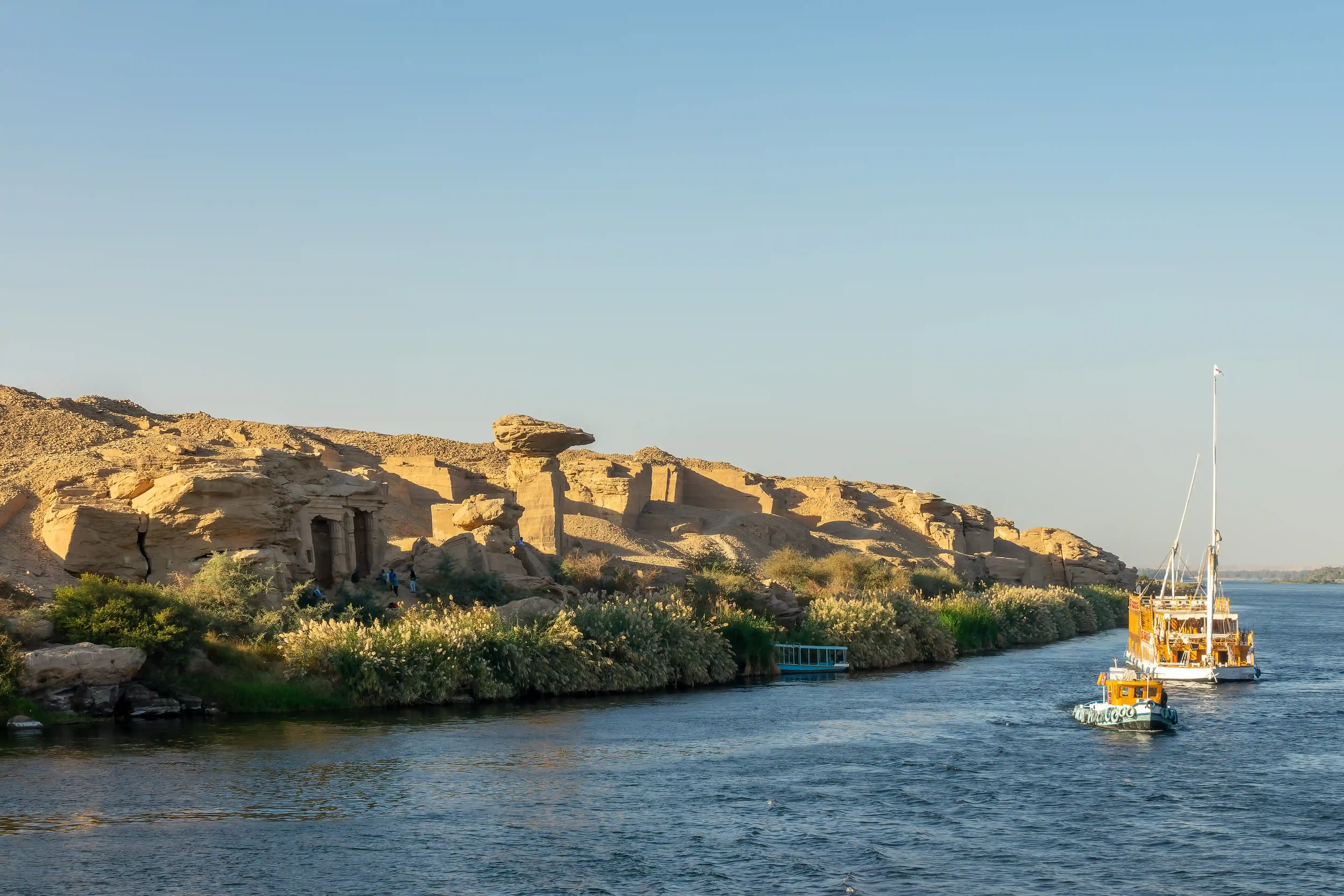
Which stops are included depends on the programme chosen, the length of the trip and sailing conditions. No two cruises follow exactly the same course, and the order of the visits can change. Among the most frequent stops are Esna and its temple to Khnum, Edfu and the great temple of Horus, one of the best preserved in Egypt, and Gebel el-Silsila, an ancient sandstone quarry whose stone built part of the temples of the valley, with its inscriptions and rock-cut chapels. Kom Ombo is another classic stop, with its double temple dedicated to Sobek and Haroeris. At the end of the route, a cruise to Aswan opens onto the region of the First Cataract, the Nile islands and the temple of Isis at Philae, moved in the twentieth century to the island of Agilkia during the building of the High Dam.
Source: Adobe Stock
It is between those major sites that the dahabiya stands out. Its low draught and small size let it anchor along undeveloped banks, beside islands or close to small farming villages, and offer stops the conventional cruise ships cannot manage: a walk through a hamlet, a visit to a local market, a meeting with farmers, a Nile island explored on foot. Some programmes also allow swimming from the boat or stops on sandbanks, depending on the season and the captain's judgement.
On the other hand, this kind of cruise covers a shorter distance than the motorised tours: a dahabiya does not usually reach Luxor, Dendera or Abydos by river. The west bank, Karnak and Abu Simbel are generally visited as land extensions added to a cruise from Luxor, before or after boarding.
Dahabiya, felucca or cruise ship: what are the differences?
There are three ways to approach a river cruise on the Nile, and they work on very different principles. The felucca is a small sailing boat with no cabins, used for outings of a few hours or for very basic mini-cruises where you sleep on deck. The cruise ship is a motorised vessel of large capacity, organised like a floating hotel. The dahabiya sits between the two: a traditional sailing boat of small capacity, but with cabins and private bathrooms.
| Criterion | Dahabiya | Felucca | Cruise ship |
|---|---|---|---|
| Capacity | The boat usually carries 8 to 20 guests. | The boat takes 6 to 12 people depending on size, with no cabins. | These ships commonly carry 100 to 300 passengers. |
| Accommodation | Every guest has an enclosed cabin, sometimes a suite. | You sleep on deck, on mattresses laid out by the crew. | The cabins are standardised, on a hotel model. |
| Bathroom | Each cabin has its own bathroom. | There is no bathroom on board and facilities are ashore. | Every cabin has a private bathroom. |
| Propulsion | The boat sails, with assistance or a tow when the wind fails. | Progress is under sail only, sometimes with help from towing along the bank. | Engines handle the sailing, whatever the wind. |
| Comfort | Comfort ranges from decent to high depending on the boat and its build year. | Conditions remain very basic. | Comfort is consistent and backed by hotel facilities. |
| Atmosphere | Life on board is quiet and in a small group, with the crew close at hand. | The feel is informal and rough and ready, close to backpacking. | The atmosphere is communal and lively, with many passengers. |
| Type of stops | Stops combine built quays, wild anchorages, islands and villages. | Stops are made along the banks, at simple camps. | Stops are essentially limited to the quays of the major sites. |
| Pace | Progress is slow and partly dependent on the wind. | The pace is slow and highly variable. | Timings are fixed and sailing can continue overnight. |
The choice therefore comes down largely to expectations. The felucca suits young travellers, or those with few demands on comfort, who are happy to sleep under the stars for a small budget and direct contact with the river. The cruise ship appeals to anyone wanting a packed programme, guaranteed timings, full hotel facilities and a price often kept down by passenger numbers. The dahabiya is for travellers who want real comfort and a cabin of their own, but reject the atmosphere of the big ships and accept a shorter route and a less predictable pace. The same trade-offs shape a river cruise in France, on a smaller scale.
Why choose a dahabiya to discover the Nile?
It all starts with the number of guests. With eight to twenty people on board there is no queue at the buffet, no crush on deck and no amplified entertainment in the evening. Visits are made in a small group, which also cuts the waiting around at transfers and at site entrances. It is the same logic behind our selection of intimate cruises.
The slowness changes how you look at the river. The boat stops early in the evening and does not sail at night, so the landscape really does go past, including the unremarkable stretches that give the best sense of life on the Nile: the water wheels, the irrigation canals, the children bringing the animals home, the brick kilns, the boats loaded with hay.
The design of the boat also brings the banks closer. A dahabiya anchors a few metres from the shore, with no quay, and the landscape is seen at water level rather than from a deck several metres above it. That vantage point changes how the scenes read, and allows guests to step straight ashore, sometimes over a plank laid on the sand.
Source: Shutterstock
Some stops simply do not exist elsewhere. A halt at Gebel el-Silsila, a walk through a farming village or a pause on a Nile island appear in no big ship's programme, for want of a quay and of time: only the shallow hull and the small crew make them possible.
That leaves an uncommon combination: traditional sailing, with the crew working the rig, and a serious cultural programme built around the temples of Esna, Edfu, Kom Ombo and the Aswan region, often explained by an Egyptologist. The trip is neither simple transport between two sites nor a cruise detached from the country's heritage.
When to go and how to plan a dahabiya cruise
Three questions decide most of the planning: when to travel, how long to go for and what budget to work with. The season governs how comfortable the visits are and how available the boats running a cruise in Egypt will be; the length of the trip determines how much of the river you cover; the budget depends on many factors, notably the choice between booking a cabin and chartering the whole boat. A few practical points about what to bring round off the preparation.
When is the best time to go?
Working out when to go to Egypt for a Nile cruise comes down first to the climate. Upper Egypt has a desert climate, very hot in summer and dry all year. Rainfall is almost non-existent, so it is not a deciding factor; the temperature gap between seasons, on the other hand, is considerable, and it becomes decisive as soon as the programme involves several hours of sightseeing outdoors. The window running roughly from November to April is therefore the most suitable: daytime temperatures remain compatible with walking around sites that offer no shade, and the mornings are pleasant.
| Period | Conditions | Suitability for a cruise |
|---|---|---|
| November to December | The days are warm but manageable, mornings and evenings are cool, and the sunshine is constant. | Very favourable for sightseeing, with strong demand around the end-of-year holidays. |
| January to February | This is the coolest part of the year, with distinctly cold nights on the river and dry, clear weather. | Sightseeing conditions are excellent, provided you pack warm clothes for evenings on deck. |
| March to April | Temperatures climb steadily and spells of sand-laden wind are possible in spring. | March remains very pleasant, while April marks an often hotter end to the season. |
| May to October | The heat becomes intense in Upper Egypt, with very high maximums at the height of summer. | Poorly suited to visiting temples, and some boats reduce or suspend their departures. |
These are general patterns, and they rule out neither unusually hot days in winter nor milder spells in early summer. Because demand is concentrated in the favourable season, dahabiyas and their handful of cabins are often full several months ahead on the most sought-after dates.
How many days should you allow?
A short dahabiya cruise of 4 to 5 nights is the most widespread format. It covers the classic stretch between Esna and Aswan, takes in the main temples along the way, Edfu and Kom Ombo among them, and leaves time for a few anchorages along the river. It works well when the cruise fits into a wider tour and time is tight.
A week shifts the balance of the trip. Daily distances shorten, the proportion of time under sail rises simply because the programme is less constrained, and the number of secondary stops grows: villages, islands, less-visited sites, free time on deck. This is the length that makes the most of what a dahabiya does differently.
A longer trip of ten days to a fortnight allows the Nile to be combined with other parts of the country, and the question then becomes where to go in Egypt alongside the river. The most common pairings add Luxor and its west bank, with the Valley of the Kings and the mortuary temples, the Aswan region and Abu Simbel, the Giza plateau and the museum in Cairo, or a few days on the Red Sea after the cruise. In that configuration the dahabiya cruise is the cultural core of the holiday rather than the whole of it.
What budget should you allow?
The price of a dahabiya cruise varies widely, and quoting a typical figure without saying what it covers would be unwise. Several factors come into play.
- The length of the trip and the category of boat: between a simple four-cabin vessel and a recent dahabiya with suites, a fitted lounge and permanent air conditioning, the gap is considerable.
- The season: rates are higher in periods of strong demand, particularly around the end-of-year holidays and during school holidays.
- How you book: booking by cabin, that is one or two places on a shared departure, remains the most affordable option; chartering the whole boat is priced on its full capacity and means a much larger overall budget.
- The number of guests on board: on a chartered boat, the price per person falls as the group fills up.
- What the package includes: visits and entrance fees, an Egyptologist, meals, drinks, transfers from Luxor or Aswan, crew tips and any land extensions may or may not be covered.
Two offers at seemingly similar prices can therefore cover very different services, and only a line-by-line comparison gives a realistic budget.
Source: Adobe Stock
What to pack
Light clothing in natural fibres for the daytime, and an extra layer, a jumper or a jacket, for evenings and early mornings on deck, which can be genuinely cool from November to February. Closed, comfortable shoes for the visits, as the ground at archaeological sites is uneven and dusty.
High-factor sun protection, sunglasses and a hat are essential: the temples offer very little shade and the glare off the river is strong. For site visits and walks through villages, clothes covering the shoulders and knees are appreciated and save any awkwardness. A small torch, a reusable water bottle and a versatile scarf completes the kit.
Frequently asked questions about dahabiya cruises
What is the difference between a dahabiya and a felucca?
The felucca is a small sailing boat with no cabins: you sleep on deck, on mattresses, and there is no bathroom on board. The dahabiya is a larger boat, with enclosed cabins and private bathrooms, a lounge or dining room and a sizeable crew. Both sail the Nile, but the level of comfort and the nature of the trip are nothing alike.
How many passengers can travel on a dahabiya?
Most dahabiyas take between eight and twenty guests, with generally four to twelve cabins. The smallest boats sometimes carry only six people. That is far below the numbers on conventional cruise ships, which frequently exceed a hundred passengers.
Does a dahabiya have an engine?
Two things need separating here. The dahabiya is a sailing boat: its own means of propulsion is the wind, caught by its lateen sails, and it generally carries no main engine. Almost every cruise, however, relies on outside mechanical assistance when the wind is too light or against the boat: a small tug or pusher boat accompanies the vessel and tows or pushes it so the programme can be kept. Some boats also have a generator on board for electricity, air conditioning and hot water, which has nothing to do with propulsion. A dahabiya cruise therefore combines sailing and assistance, in proportions that depend on the conditions encountered.
Is there air conditioning on a dahabiya?
On some boats only. Recent dahabiyas often offer air conditioning in the cabins, powered by a generator, but it may run only at certain times, usually overnight, for reasons of noise and electrical capacity. Other, simpler boats have none and rely on natural ventilation. This is worth checking before booking, especially for a departure in March or April.
Can you sleep on a dahabiya?
Yes, that is the whole point of this kind of cruise. Every guest has an enclosed cabin with a proper bed and, in the vast majority of cases, a private bathroom with a shower. The boat anchors for the night along a bank or an island and does not sail after nightfall, which makes the nights particularly quiet.
Source: Shutterstock
Can you charter a dahabiya privately?
Yes, and it is common practice for families, groups of friends, anniversary trips and established groups. A private charter covers the whole boat and is priced on its full capacity, whatever the actual number of guests. It allows the programme, the visit times and the meal arrangements to be partly adapted, within the limits of sailing constraints and the rules in force on the river.
Is a dahabiya cruise suitable for older travellers?
Generally yes, thanks to the slow pace, the absence of night sailing, the small number of guests and the closeness of the crew. Two points deserve attention, though: traditional boats have stairs and raised sills, with no lift and no provision for reduced mobility; and some stops involve a gangplank laid on a sandy bank, with uneven ground underfoot. Temple visits also mean walking on uneven surfaces. Any mobility difficulty is best flagged in advance so the layout of the particular boat can be checked.
Can you take a dahabiya cruise with children?
Yes, in most cases, and the format even has advantages: space on deck, freedom to move about, contact with the crew, stops in villages and, depending on the programme, the chance to swim. Two caveats apply. Safety on board a traditional boat rests on parental supervision, as the guard rails are not designed for very young children. And the cabin layout, often set up for two people, sometimes limits how a family can be accommodated: a private charter, or connecting cabins where they exist, solves that. Some operators set a minimum age on shared departures, to keep the group balanced.
Sources:
- The best way to see the Nile? Take a slow cruise aboard a dahabiya, National Geographic
- Sailing the Nile on a Dahabiya, Dahabiya Abundance on the Nile channel
- Nile Cruising History, Dahabiyas.com
- Nile Boat, Cairo, photograph by Wilhelm Hammerschmidt, around 1860, The Nelson-Atkins Museum of Art
- Nile Notes of a Howadji: American Travellers in Egypt, 1837-1903, Smithsonian Institution Libraries