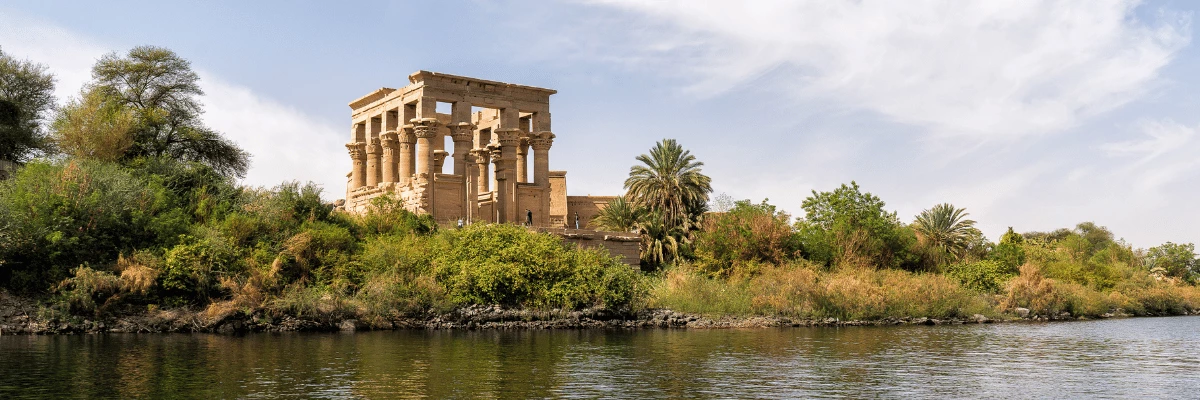
There are monuments in Egypt that time should have erased and that are still standing, columns intact, ceilings in place, hieroglyphs legible at hand height. Three of them follow one another along the southern stretch of the Nile, between Luxor and Aswan: Edfu, Kom Ombo and Philae. Each owes its survival to a different circumstance. The first lay buried under sand for centuries, the second lost part of its walls to the river, the third spent seventy years with its feet in the water before being dismantled block by block and rebuilt higher up.
It is worth noting that an Egyptian temple is not a church. It is not a gathering place but the earthly dwelling of a deity: a sacred house where the statue of the god is housed, washed, dressed and fed every day in a sanctuary the people never enter. Today we have the privilege of visiting these temples and, in doing so, stepping into a genuine journey through time.
Summary
- 1. Egyptian temples, bridges between past and present
- Three temples, three ways of reading ancient Egypt
- Edfu, the temple of Horus that the sand protected
- Kom Ombo, the sanctuary shared by two gods
- Philae, the temple of Isis saved from the waters
- 2. The cruise, the finest way to discover the temples of the Nile
- Temples built to be seen from the river
- The dahabieh, the boat that moors closest to the temples
- Days along the river, between sailing and sightseeing
- 3. Frequently asked questions
- Can you visit Edfu, Kom Ombo and Philae in a single day?
- How long should you allow for each temple?
- Which is the best-preserved temple in the Nile valley?
- When should you visit the temples of the Nile?
- Are the temples accessible to people with reduced mobility?
- Do you need a guide to visit the temples of the Nile?
Egyptian temples, bridges between past and present
Three temples, three ways of reading ancient Egypt
Edfu, Kom Ombo and Philae are three temples from the Ptolemaic period, dating back three centuries before our era. Egypt was then ruled by sovereigns of Greek origin who continued to build in the Egyptian manner. That is precisely what explains their state of preservation: they are far more recent than Karnak or the pyramids, and they have had fewer centuries to survive. They preserve the classic Egyptian temple plan almost intact: entrance pylon, columned courtyard, hypostyle hall, then the darkness of the sanctuary.
| Temple | Dedicated to | Location | What makes it unique |
| Edfu | Horus | Left bank of the Nile, between Luxor and Kom Ombo | The best-preserved temple in Egypt, saved by the sand |
| Kom Ombo | Sobek and Haroeris | Right bank, on a terrace overlooking the river | The only large temple built entirely as a double |
| Philae | Isis | On an island, south of Aswan | Dismantled and rebuilt stone by stone to escape the waters |
Edfu, the temple of Horus that the sand protected
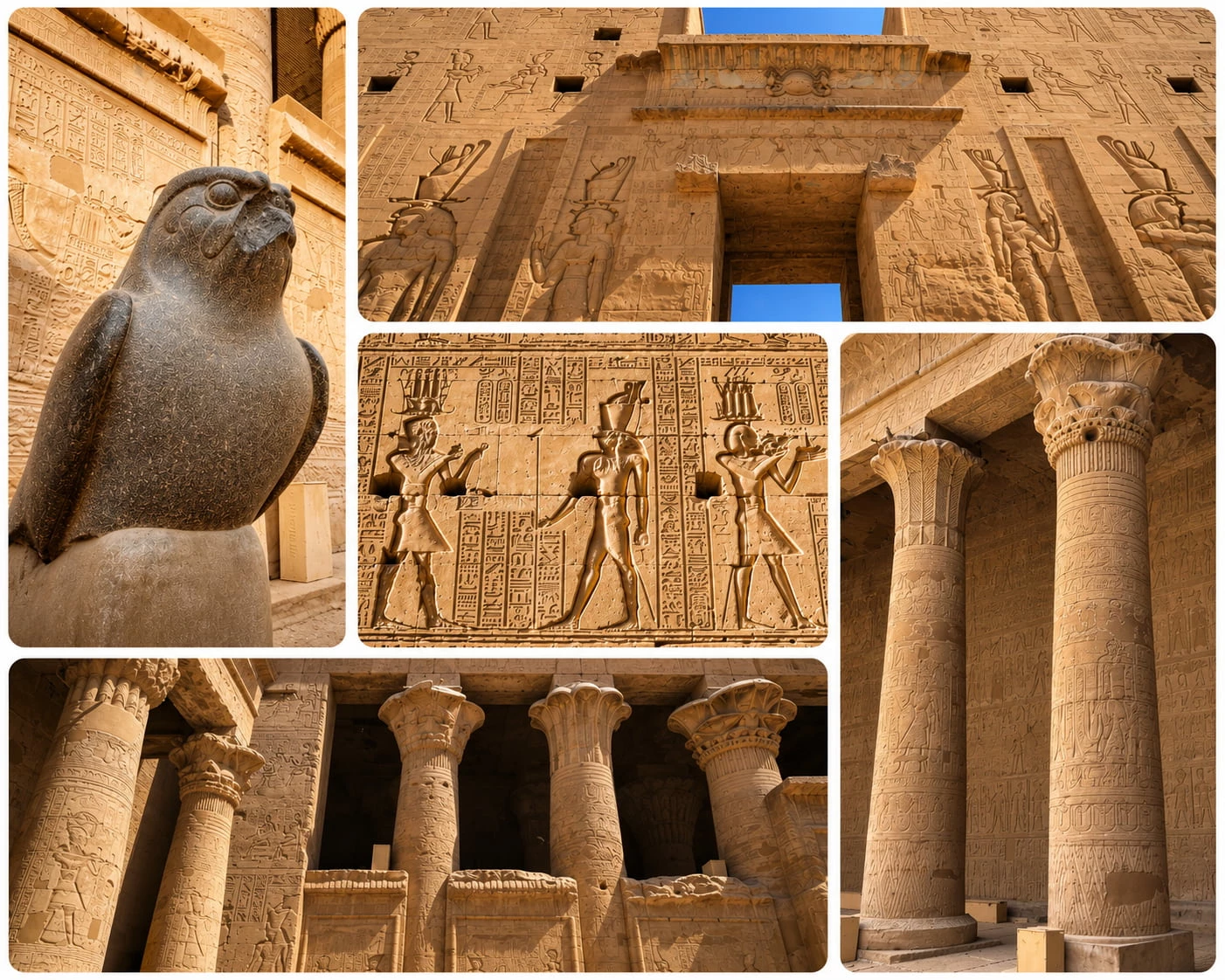
On the left bank of the Nile, halfway between Luxor and Aswan, the temple of Edfu is considered the best preserved in all of Egypt. Its entrance pylon still rises some thirty metres, its ceilings are in place and its walls retain texts of rare precision on the rites, the festivals and the founding myth performed there. Carved into the stone, you can follow the battle of Horus against Seth, re-enacted every year in the temple courtyard.
The sanctuary is dedicated to Horus, the falcon-headed god, son of Isis and Osiris, protector of kingship. Its construction spanned nearly two centuries from 237 BC. The temple was then abandoned, the desert sands covered it, and an entire village eventually settled on what remained visible of its terrace. Paradoxically, that burial is what saved it: sheltered from the air, from looting and from the reuse of its stone, it came through the centuries almost intact.
It was not until 1860 that the French Egyptologist Auguste Mariette began clearing it. The excavation revealed a monument in a condition no one expected. Even today, the visit begins with that impression: you are not walking through a ruin, you are entering a building.
Kom Ombo, the sanctuary shared by two gods
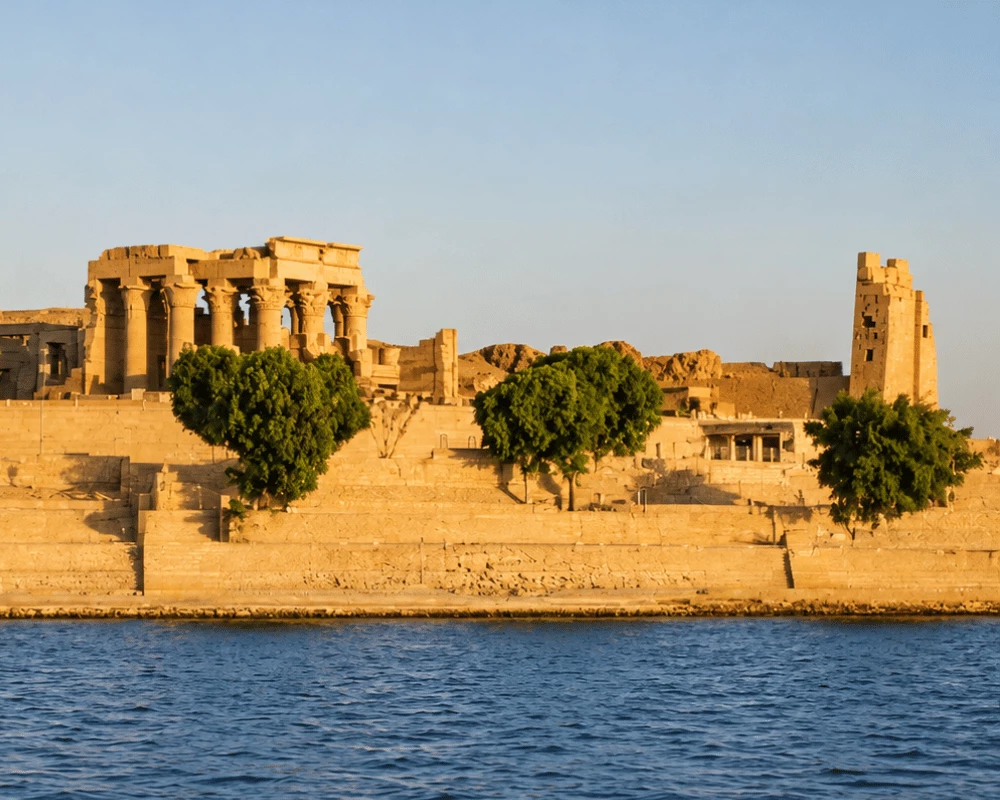
Some forty kilometres north of Aswan, Kom Ombo occupies a terrace directly overlooking the Nile. It is the only large Egyptian temple to be entirely doubled: two entrances, two halls, two sanctuaries, separated by an invisible but rigorous central axis. Each half belongs to a deity, and the whole is perfectly symmetrical.
The deities to whom the temple is dedicated:
- The northern side belongs to Haroeris, Horus the Elder, shown as a man with a falcon's head. He was credited with ordering the sky: thanks to him the Moon and the Sun never cross paths and follow one another according to the hours.
- The southern side is that of Sobek, god of water and fertility, depicted as a man with a crocodile's head. The choice of site is no accident: crocodiles used to bask on the sandbanks along this stretch of the river, and the neighbouring museum holds mummified specimens found in the site's necropolis.
Kom Ombo holds a surprise found almost nowhere else. Some of the temple's columns have kept their original colours; this matters, because the colours of Kom Ombo remind us that temples were once full of colour rather than shades of beige alone. That detail changes the way you look at every other temple.
The temple also bears the river's scars: part of the structure, including the pylon, collapsed into the Nile over successive floods.
Philae, the temple of Isis saved from the waters
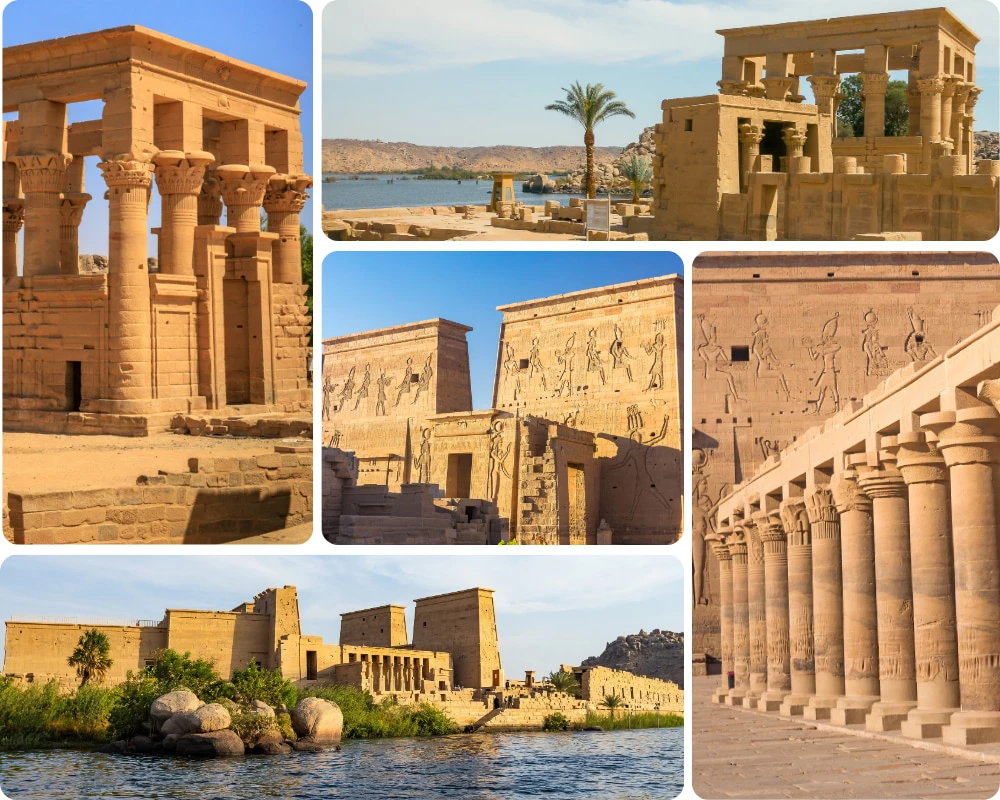
South of Aswan, the temple of Philae stands on an island. It is a sanctuary of Isis, mythical queen and funerary goddess whose cult spread far beyond Egypt, throughout the Roman world. Over the years, the Ptolemaic rulers continued to inscribe their names on the temple, Cleopatra among them. Philae was also one of the last places in Egypt where the ancient religion survived, several centuries after the end of the pharaohs.
From 1902, the commissioning of the first Aswan dam condemned the island to disappear under water for several months a year. The French writer Pierre Loti, who discovered the temple of Philae at that time, drew from it a book with an unambiguous title, La Mort de Philae, in which he describes what he held to be “the pearl of Egypt” sinking away.
The construction of the High Dam in the 1960s threatened Philae for good. UNESCO then organised the temple's rescue: between 1972 and 1980 the complex was dismantled into some 40,000 blocks, then rebuilt identically on the neighbouring island of Agilkia, which lies higher up. A few years earlier, the same campaign had saved the temples of Abu Simbel.
The cruise, the finest way to discover the temples of the Nile
Temples built to be seen from the river
These sanctuaries were not built beside the Nile for convenience, but because the river was part of the cult. The Egyptians regarded the Nile as a divine gift. Statues of the gods travelled by boat from one temple to another during the great festivals, landing stages were part of the architecture, and the axis of the buildings was conceived in relation to the water. Arriving by the Nile therefore means taking the route of access intended from the outset, the one that gives the monument its true scale as it comes into view from the deck on a slow approach.
The river has never stopped writing the history of these temples, in one direction or the other. It carried away part of Kom Ombo. It came close to swallowing Philae. And at Edfu it laid down layers of earth that gradually helped bury the sanctuary.
The comfort of the itinerary matters too. By road, linking Luxor, Edfu, Kom Ombo and Aswan means several hundred kilometres, very early departures and long hours in a minibus in the heat. On a cruise, the distance is covered while you have lunch or sleep, and each temple lies a few minutes from the mooring.
The dahabieh, the boat that moors closest to the temples
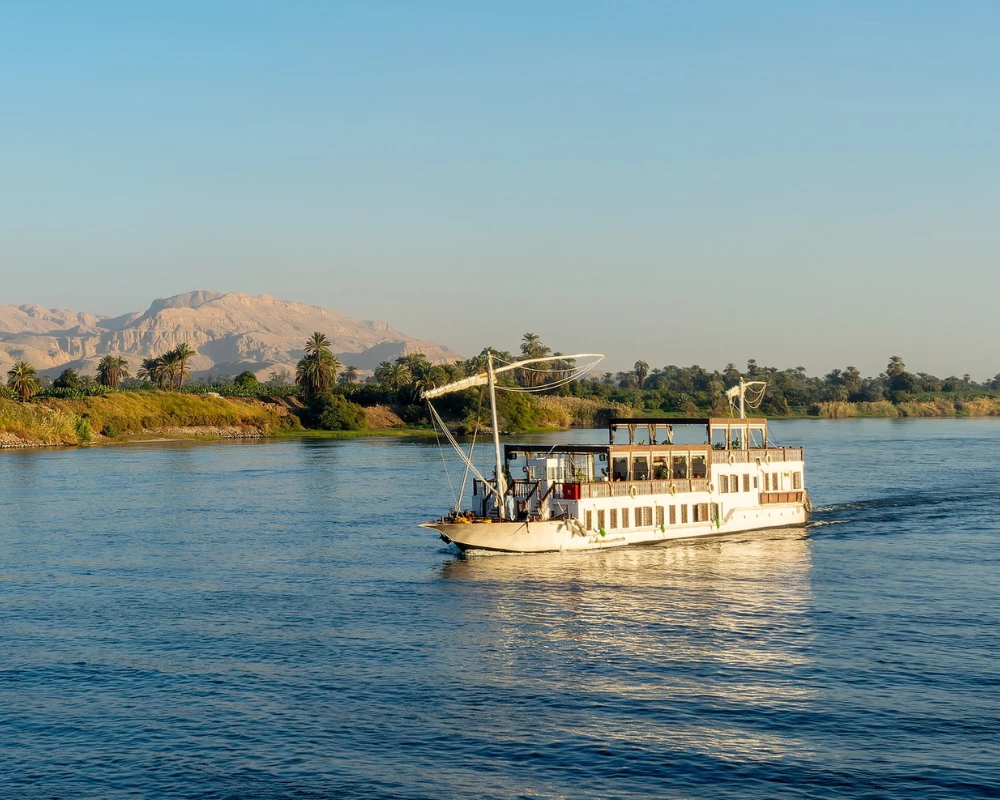
The dahabieh is a traditional river sailing boat with two lateen sails, the very type used by nineteenth-century travellers. Today's vessels generally take ten to twenty passengers in a handful of cabins and suites opening onto the river, with a large shaded upper deck that serves as lounge, dining room and observation point.
The difference with the large Nile cruise ships, which often carry between 100 and 300 passengers, is not only a matter of numbers. Travelling the Nile by dahabieh also has a practical advantage: a dahabieh has a shallow draught and can moor along banks, islets and small villages that larger vessels cannot reach, whereas river cruisers have to line up at the quay, sometimes three or four abreast, forcing passengers to cross the neighbouring boat to reach land.
| Dahabieh | Large cruise ship | |
| Capacity | Around twenty passengers | 100 to 300 passengers |
| Propulsion | Lateen sails, tug for assistance | Engine |
| Stops | Banks, islets and villages larger vessels cannot reach | Fitted quays in the main towns |
| Visits | In very small groups, flexible timings | In set groups, fixed timings |
| Atmosphere | Family house on the water | Floating hotel |
Days along the river, between sailing and sightseeing
The rhythm of a dahabieh cruise is designed to balance visits and time under sail. A typical day pairs a morning visit, while the heat is still bearable, with several hours of sailing in the afternoon and, finally, a mooring for the night along a bank, often far from any road.
That alternation is what allows you to absorb what you see. Two temples visited back to back can blur into one. The time spent sailing between visits, by contrast, helps you tell them apart and enjoy the landscapes of the Nile. Sailing is not time lost between two sites: it is what turns a series of visits into a genuine cultural odyssey.
Frequently asked questions
Can you visit Edfu, Kom Ombo and Philae in a single day?
Yes, but at the cost of a very full day. From Aswan, a road excursion combining the three sites means around 220 km there and back and some ten hours, with inevitably rushed visits and the hottest hours spent in the car. On a cruise, the three temples are spread over two to three days, each visited early in the morning: the same programme, in incomparably better conditions. Most of these itineraries are in fact offered as an all-inclusive Nile cruise, with transfers, visits and meals included.
How long should you allow for each temple?
| Temple | Length of visit | Access from the mooring |
| Edfu | 1 hr 30 to 2 hrs | Horse-drawn carriage or shuttle, about 10 minutes |
| Kom Ombo | 1 hr to 1 hr 30, including the Crocodile Museum | On foot from the quay, a few minutes |
| Philae | 1 hr 30 to 2 hrs | Motorboat from the landing stage, about 10 minutes |
Allow around thirty minutes more per site if you want to take photographs at leisure or listen to a guide in detail.
Which is the best-preserved temple in the Nile valley?
Edfu, with no real rival. Being buried under sand for centuries preserved it from looting, from the reuse of its stone and from erosion. Its ceilings, its walls and much of its carved decoration are still in place, making it the most complete record of what a working Egyptian temple was like. Kom Ombo comes next for the quality of its reliefs and its original pigments, even if the river has carried part of it away.
When should you visit the temples of the Nile?
The comfortable season runs from October to April, with days between 25 and 30 °C in Upper Egypt and cool nights. From June to September the region regularly exceeds 40 °C and visiting becomes gruelling, even early in the morning. December and January draw the biggest crowds; November, February and March offer the best compromise between temperature and visitor numbers. In every case, visit at opening time or late in the afternoon: the low light brings out the relief of the carvings that full sun flattens. The choice of month also depends on how busy the sites are and on the level of the river.
Are the temples accessible to people with reduced mobility?
Accessibility remains partial and varies widely from one site to another. Kom Ombo is the easiest: the quay is close, the ground relatively flat and most of the temple can be seen on the level. Edfu requires a transfer by carriage or shuttle, then crossing an esplanade and uneven ground, with thresholds to negotiate. Philae is the most demanding, since it involves boarding and leaving a motorboat, followed by a few steps. Inside all three temples the ancient floors are uneven throughout, with occasional changes of level. Flag the situation in advance: on a small vessel the crew can arrange boarding and provide assistance, which is far harder on a large ship.
Do you need a guide to visit the temples of the Nile?
It is strongly recommended. The sites have almost no explanatory panels and the carved decoration is unreadable without a key: with no commentary, a wall of hieroglyphs is just a wall. An English-speaking Egyptologist guide lets you follow the myth of Horus at Edfu, understand the logic of the doubling at Kom Ombo, and pick out the calendar or the instruments carved into the stone. Dahabieh cruises generally carry a guide for the whole route, which gives a continuous reading from one temple to the next rather than three separate visits.
Edfu, Kom Ombo and Philae ultimately tell the same story in three different forms: the way a river gave rise to, threatened and saved the monuments of a civilisation. Sand for one, floods for another, an unprecedented international campaign for the third.
Discovering them from the water, at the pace of a river sailing boat, means taking the route by which the Egyptians reached them. A cruise in Egypt built around these three sanctuaries simply follows that thread. Between two temples there is still time to watch the banks go by, and perhaps that is where the journey takes on its full meaning.
Sources
- Egyptian musem, https://egyptianmuseum.org/explore/
- Tyler Braun, Temple of Kom Ombo & Crocodile Museum, Kom Ombo, Egitto.
- Tempile of Edfu, Wikipedia.
- Sky History, The temple of Philae : Egypt's jewel saved from the flood, https://www.history.co.uk/articles/the-temple-of-philae-ancient-egypt