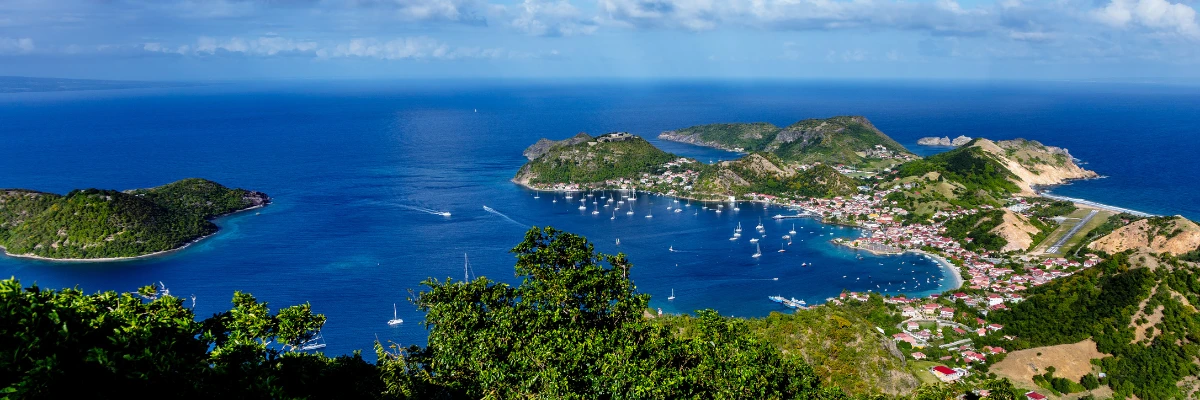
On Sunday 1 November 2026 at 1.02pm, more than a hundred skippers will leave Saint-Malo to sail single-handed to Pointe-à-Pitre. Between these two towns, the Route du Rhum 2026 links two very different sailing grounds: on one side the English Channel, with its huge tides and granite archipelagos, on the other the warm waters of Guadeloupe, driven by the trade winds. Both race venues can also be explored under sail, with bareboat or skippered hire. This guide covers the best anchorages at both ends of the course, the right season for each, and the paperwork for Jersey and Guadeloupe.
Summary
- 1. Sailing from Saint-Malo, the Route du Rhum start port
- The Route du Rhum start, from the spectator's side
- Saint-Malo Bay and the Emerald Coast
- The Chausey Islands by boat
- Heading for Jersey: formalities in 2026
- Tides and currents: what to know before you set off
- Hiring a sailing boat in Saint-Malo: the conditions
- When to sail in Saint-Malo?
- 2. Sailing in Guadeloupe, the Route du Rhum finish
- The skippers' arrival in Pointe-à-Pitre
- The best sailing stops from Pointe-à-Pitre
- One-week itinerary from Pointe-à-Pitre
- Guadeloupe in November: a good idea?
- Hiring a boat in Guadeloupe: the conditions
- When to sail in Guadeloupe?
- 3. Saint-Malo or Guadeloupe: which sailing trip to choose?
- 4. Frequently asked questions
Sailing from Saint-Malo, the Route du Rhum start port
The Route du Rhum start, from the spectator’s side
For days before the starting gun, the whole of Saint-Malo revolves around the race. The race village opens along the quays on 20 October 2026, with free entry, and crowds peak over the weekend of 30 October to 1 November. Watching the boats lock out of the basins remains the great ritual of the days leading up to the start.
On race day, the best viewpoints are on land: the Grand Bé and the Fort National, which can be reached on foot at low tide, or the Pointe du Grouin further east, from where you can watch the fleet head out to sea.
You can also watch the start from the water, but the area is strictly controlled. The Atlantic maritime prefecture publishes an order a few days before the start: it sets out a no-go zone around the start line and the exit channel, and spectator boats must stay outside it. Given the November weather and the crowds on the water, you are better off joining a launch or a sailing boat run by a professional than hiring a boat without a skipper.
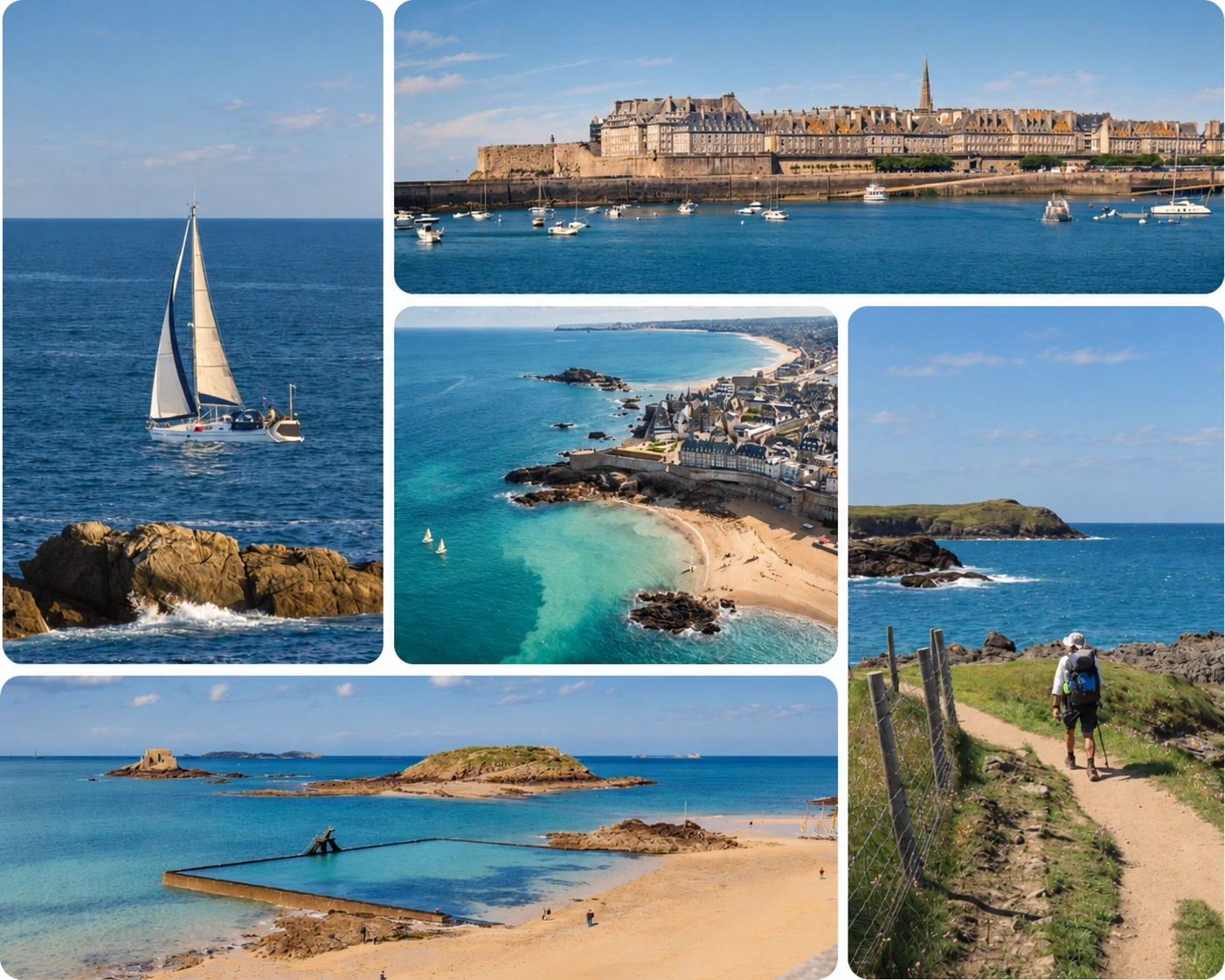 Saint-Malo, Brittany (France): the start of the Route du Rhum (Sources: Shutterstock, Adobe Stock)
Saint-Malo Bay and the Emerald Coast
For the rest of the year, the former corsair town is an ideal base for exploring northern Brittany. From the Bas-Sablons marina or the Vauban basin at the foot of the ramparts, a few miles are enough to reach Dinard, anchor off the island of Cézembre or follow the Emerald Coast as far as Cap Fréhel. Once through the lock at the tidal barrage, the Rance offers sheltered sailing between old shipowners’ mansions and small harbours.
Yacht charter in Saint-Malo lets you combine these stops over a week. The fleet available around the town is mostly monohulls from 9 to 16 metres, departing from Saint-Malo or Granville, around forty kilometres away by road. Much of the pilotage is visual, but it is still demanding: buoyed channels, rocks just below the surface and ferry traffic call for constant attention.
The Chausey Islands by boat
Around 17 miles from Saint-Malo and 9 miles from Granville, the Chausey archipelago is a classic stop for boats sailing from Saint-Malo and Granville. It has 365 islets at low tide, but only 52 at high tide: the landscape changes by the hour, with a tidal range (the difference in water height between low and high water) that can reach 14 metres on spring tides.
The main anchorage is the Sound, in deep water to the north-east of the Grande Île. It was reorganised in 2019 with visitor mooring lines, to group boats together and protect the seabed. Plan your approach according to the tidal coefficient (a French index of tidal range, from 20 to 120) and your arrival time, and respect the seabird nesting areas in the archipelago. Chausey works just as well as an overnight stop as a leg on the way to the Channel Islands.
Heading for Jersey: formalities in 2026
From Saint-Malo or Granville, Jersey is a day’s sail away. Saint Helier, the capital, and the small harbour of Gorey are the island’s two designated ports of entry. Note that new entry rules have applied to Jersey since 2026.
- Electronic Travel Authorisation (ETA): compulsory since 23 April 2026 for visa-exempt non-British nationals, including EU citizens, arriving directly in Jersey or Guernsey, including by pleasure boat. British and Irish citizens do not need one. Apply online on GOV.UK or via the UK ETA app at least three working days before departure, for each person on board who needs one, children included.
- Passport: carry a valid passport for everyone on board, since the boat arrives from France. The exemption allowing travel with an identity card only applies to French nationals on day trips by scheduled ferry.
- Arrival declaration: Jersey requires an online declaration 24 hours before arrival (port of departure, skipper, crew list, type of boat).
- VHF contact: the skipper must notify Jersey Coastguard (channel 82) or St Helier VTS (channel 14) before entering the harbour or anchorage.
Tides and currents: what to know before you set off
In Saint-Malo Bay, the tide sets the day’s programme. The currents are among the strongest in Europe, and the turn of the tide, the moment when the current changes direction, can turn a peaceful sail into a hard slog. Above ten knots or so of wind against tide, the sea quickly builds up.
- Check the tide tables before every outing and time your departures around the turn of the tide.
- Carry SHOM charts (from the French hydrographic office) or Admiralty and Imray equivalents for the western Channel and check that they are supplied with the boat.
- Note which harbours are accessible at any state of the tide and which ones operate with a sill or a lock.
- On big tides, choose deep-water anchorages to avoid drying out.
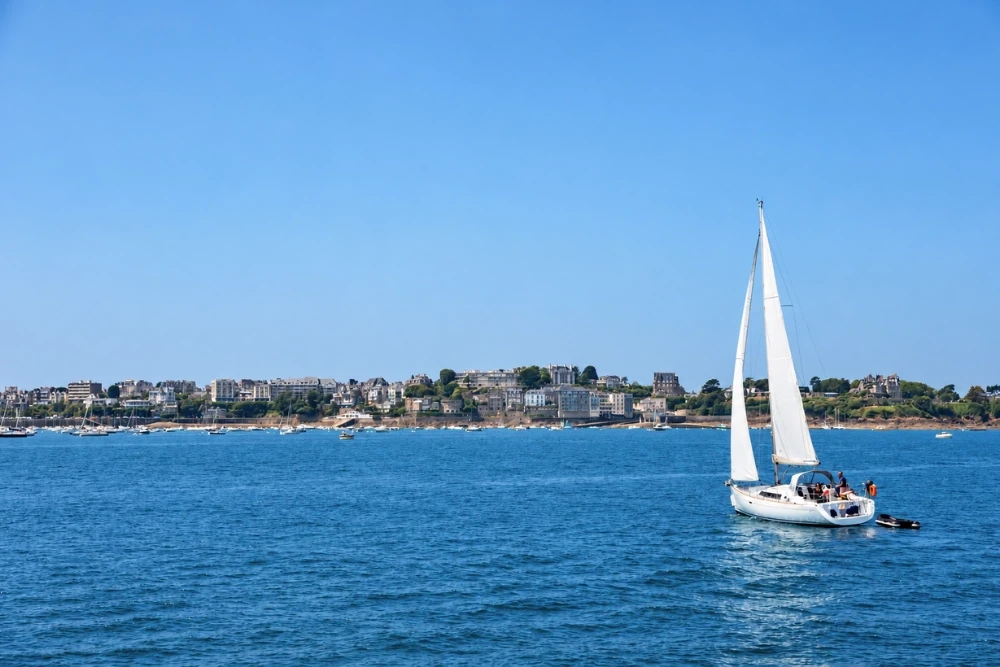 Sailing boat in Saint-Malo, Brittany (Source: Adobe Stock)
Yacht charter in Saint-Malo: licence and experience required
In France, no licence is required to hire a sailing boat. The French offshore licence (permis hauturier), sometimes mentioned for the crossing to the Channel Islands, only applies to motorboats sailing more than 6 miles from shelter. However, for any bareboat charter, the charter company asks for a sailing CV: it compares your experience with the boat you have booked and checks that you have already skippered a boat of similar size and type. If, on the day of departure, it feels your level is not sufficient, it can require you to take a skipper.
In such demanding waters, experience of tidal navigation counts as much as the number of miles sailed. If you are new to the Channel, taking a skipper the first time lets you enjoy Chausey or Jersey without worrying about the currents.
When to sail in Saint-Malo?
| Period | Conditions | Our view |
| May to September | Long days, more manageable sea | Ideal |
| October | First gales, cooler weather | For experienced sailors |
| November to April | Frequent depressions, rough sea | Not recommended |
Sailing in Guadeloupe, the Route du Rhum finish
The skippers’ arrival in Pointe-à-Pitre
After rounding Basse-Terre, the skippers cross the finish line off Pointe-à-Pitre and then berth in the darse, the harbour basin in the heart of the town. Based on the 2022 race times, the Ultims are expected around 8 November, the Ocean Fiftys and IMOCAs around 12 or 13 November, the Class40s around 15 or 16 November, and the last boats in the Vintage classes until the end of November. Every arrival is celebrated on the quayside, even in the middle of the night.
The best sailing stops from Pointe-à-Pitre
From Pointe-à-Pitre, the Guadeloupe archipelago can be explored in short legs, always carried by the trade winds.
- Îlet du Gosier: 3 miles from the marina, the first swim of the trip, at the foot of a small lighthouse.
- Marie-Galante: the island of a hundred windmills, with deserted beaches, distilleries and the Gueule Grand Gouffre in the north.
- Les Saintes: a bay listed by the Most Beautiful Bays in the World club, colourful Creole houses and ideal waters for snorkelling.
- Petite-Terre: two islets classified as a nature reserve, with iguanas and turtles, to be visited only in good conditions.
For a second week, the leeward coast of Basse-Terre, the Cousteau reserve and the Grand Cul-de-Sac Marin extend the voyage.
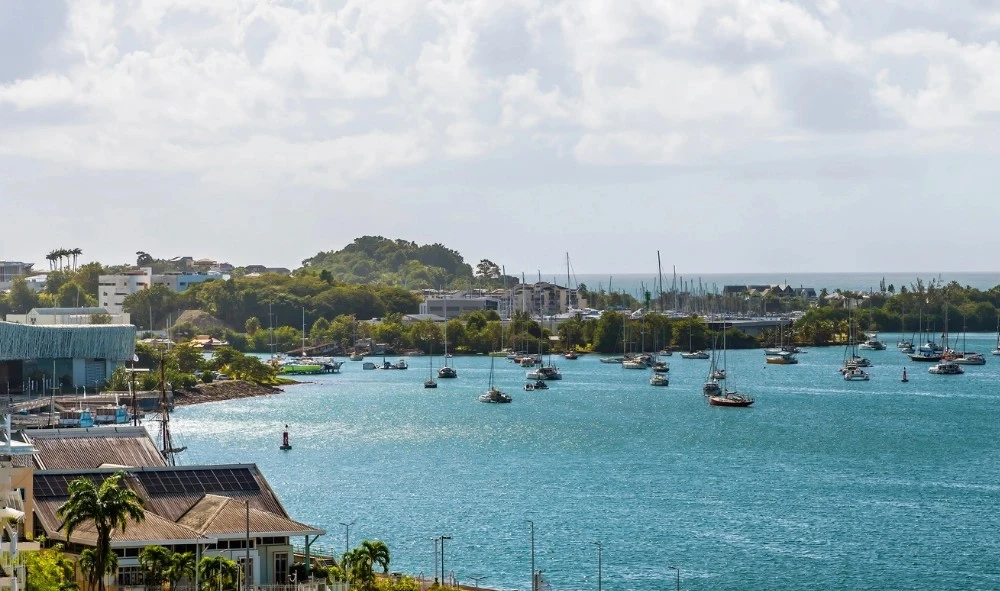 Marina, Pointe-à-Pitre, Guadeloupe (Source: Adobe Stock)
One-week itinerary from Pointe-à-Pitre
This round trip from the Bas-du-Fort marina links the three most iconic islands in the south of the archipelago. Sailing times are based on an average speed of 6 knots.
| Day | Leg | Distance | Sailing time |
| Day 1 | Pointe-à-Pitre > Îlet du Gosier | 3 miles | 30 min |
| Day 2 | Îlet du Gosier > Marie-Galante (Saint-Louis) | 20 miles | 3 hr 30 min |
| Day 3 | Stop in Marie-Galante | A few miles | Free |
| Day 4 | Marie-Galante > Les Saintes (Terre-de-Haut) | 20 miles | 3 hr 30 min |
| Day 5 | Stop in Les Saintes | A few miles | Free |
| Day 6 | Terre-de-Haut > Terre-de-Bas and Îlet à Cabrit | A few miles | 1 hr |
| Day 7 | Les Saintes > Pointe-à-Pitre | 22 miles | 4 hr |
Days 1 to 3, heading south-east. A short warm-up sail to the Îlet du Gosier lets you get to know the boat before crossing to Marie-Galante. In Saint-Louis, on the island’s west coast, you anchor off a long beach before setting off to explore the distilleries, the Château Murat or the Anse Canot, a few miles further north.
Days 4 to 6, the Les Saintes archipelago. Head west to Les Saintes, around twenty miles away. Terre-de-Haut is home to the village, Fort Napoléon and the Pain de Sucre beach; Terre-de-Bas and the Îlet à Cabrit offer quieter anchorages for the last evening.
Day 7, back to Pointe-à-Pitre. The return leg is a beat into the trade winds (sailing close-hauled): an early start means you arrive before the boat is due back.
Petite-Terre option: experienced sailors can add a stop at Petite-Terre between Gosier and Marie-Galante. The reserve requires boats to moor on a limited number of buoys, and its entrance becomes tricky as soon as the swell picks up: decide on the stop on the spot, depending on the weather and the charter company’s instructions.
Guadeloupe in November: a good idea?
November is a month of transition. The hurricane season officially runs until 30 November, but it peaks between August and October: the risk drops sharply as the month goes on. The trade winds gradually return, showers are still possible and the crowds are still moderate before the high season begins. For those who want to combine the atmosphere of the Route du Rhum arrivals with a sailing trip, late November is a good compromise, as long as you follow the Météo-France bulletins before each crossing.
The dry season, from December to April, remains the most comfortable time to sail, with a steadier sea and temperatures of around 26°C. December brings settled trade winds and a lively Christmas season, at the cost of busier anchorages.
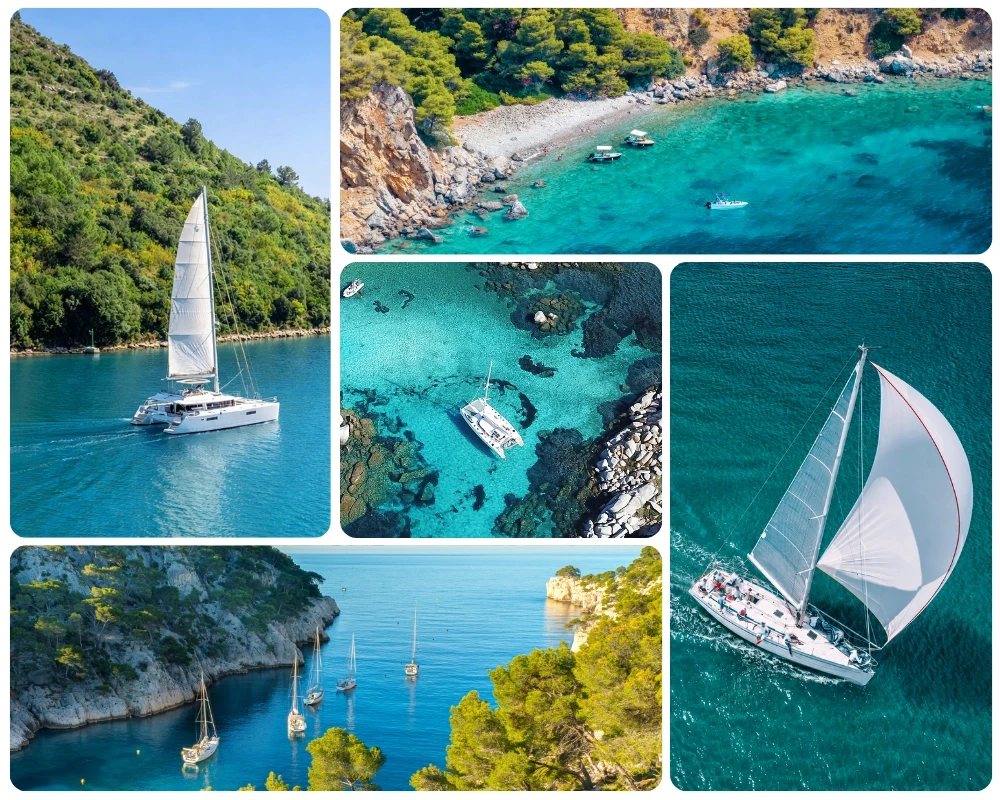 Sailing boats in Guadeloupe, Caribbean: the finish of the Route du Rhum (Sources: Shutterstock, Adobe Stock)
Yacht charter in Guadeloupe: the conditions
Pointe-à-Pitre has several hundred charter yachts, monohulls and catamarans alike, to hire bareboat, skippered or fully crewed. As in Saint-Malo, no licence is required, but a sailing CV is compulsory to set off without a skipper, as is standard practice for any yacht charter in the Caribbean.
Catamarans dominate the local fleet, with boats from 11 to 15 metres and four to six cabins. Guadeloupe is a good place for a catamaran charter in the Caribbean: at anchor, a catamaran gives you a stable platform and a saloon that opens onto the cockpit, so life on board happens almost entirely outdoors. Some boats can also be hired one way between Guadeloupe and Martinique: the same option exists the other way round, from Le Marin, for a yacht charter in Martinique.
When to sail in Guadeloupe?
| Period | Conditions | Our view |
| December to April | Dry season, steady trade winds | Ideal |
| May to July | Hotter, showers, fewer people | Good compromise |
| August to October | Peak hurricane season | Not recommended |
| November | End of hurricane season, trade winds return | Possible, watch the weather |
Saint-Malo or Guadeloupe: which sailing trip to choose?
The two Route du Rhum venues do not attract the same sailors. The Channel suits sailors who enjoy tidal navigation and ever-changing scenery. If you would rather have short legs, warm water and sheltered anchorages off small islets, Guadeloupe is the better fit.
| Criterion | Saint-Malo | Guadeloupe |
| Best season | May to September | December to April |
| Wind | Variable, mainly westerly | Easterly trade wind, steady |
| Tides | Up to 14 m tidal range | Almost none |
| Recommended level | Experienced or with a skipper | Intermediate |
| Main boat type | Monohull | Catamaran |
| Formalities | Passport (and ETA for non-British crew) for Jersey | Passport (French overseas region) |
| Price per week | From €1,600 | From €1,500 |
| Departure bases | Saint-Malo, Granville | Pointe-à-Pitre |
Source: Filovent - Official data from partner charter companies, starting prices displayed in October 2026, bareboat hire.
You can do both: watch the Route du Rhum start in the autumn, sail the Channel the following summer and head for the Caribbean in winter, when the trade winds are reliable.
Frequently asked questions
Do you need a licence to hire a sailing boat in Saint-Malo?
No. In France, no licence is required to hire a sailing boat. The charter company does, however, ask for a sailing CV and can require a skipper if it considers your experience insufficient.
Can you sail to the Chausey Islands on a hired sailing boat?
Yes, the archipelago is around 17 miles from Saint-Malo and 9 miles from Granville. The main anchorage, the Sound, has visitor mooring lines. Plan your approach according to the tide.
What documents do you need to sail to Jersey in 2026?
British and Irish citizens only need a valid passport. Other crew members, including EU citizens, also need an Electronic Travel Authorisation (ETA), compulsory since 23 April 2026. You also need to complete an online arrival declaration 24 hours in advance and notify the authorities by VHF.
Can you sail in Guadeloupe in November?
Yes. The hurricane season officially ends on 30 November and the risk drops sharply after October. You should still check the weather before each crossing.
How long does it take to sail from Pointe-à-Pitre to Les Saintes?
Between 3.5 and 4 hours for 20 to 22 miles, at an average speed of 6 knots. The return to Pointe-à-Pitre is a beat into the trade winds and often takes a little longer.