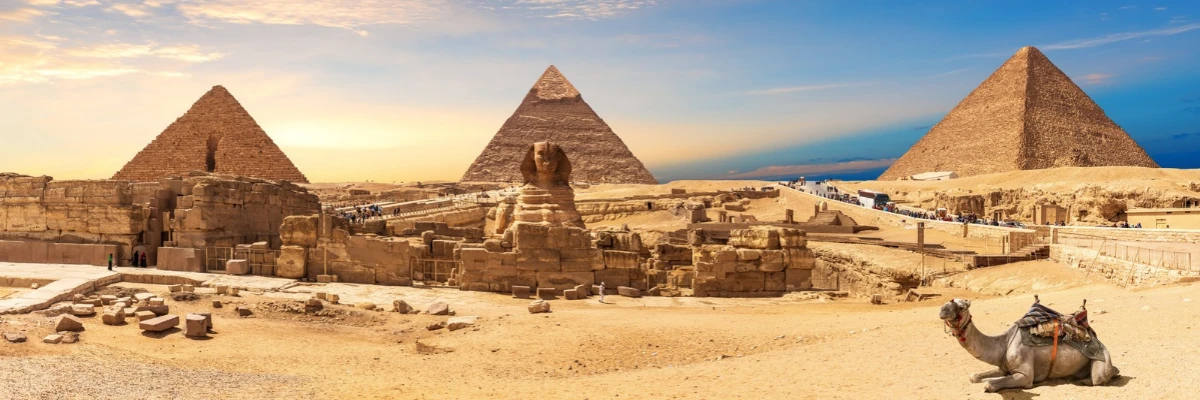
Nile cruises sail through Upper Egypt, between Luxor and Aswan. The Giza pyramids, on the other hand, stand on the outskirts of Cairo, almost 700 km further north along the Nile. So there is no way to see them from the deck of the boat. Even so, the two combine easily: simply plan two or three days in Cairo before or after the cruise, linked to the river by a one-hour domestic flight or an overnight train.
Summary
- 1. Where are the pyramids in relation to Nile cruises?
- 2. Planning your itinerary: Cairo before or after the cruise?
- 3. Getting to the boat from Cairo: plane or overnight train?
- 4. Visiting the Giza pyramids: practical information
- Access, tickets and 2026 prices
- Is it worth going inside the Great Pyramid?
- The Grand Egyptian Museum, to combine on the same day
- 5. Dahabiya or classic boat: which cruise to choose?
- 6. Frequently asked questions
Where are the pyramids in relation to Nile cruises?
Why cruises don’t pass through Giza
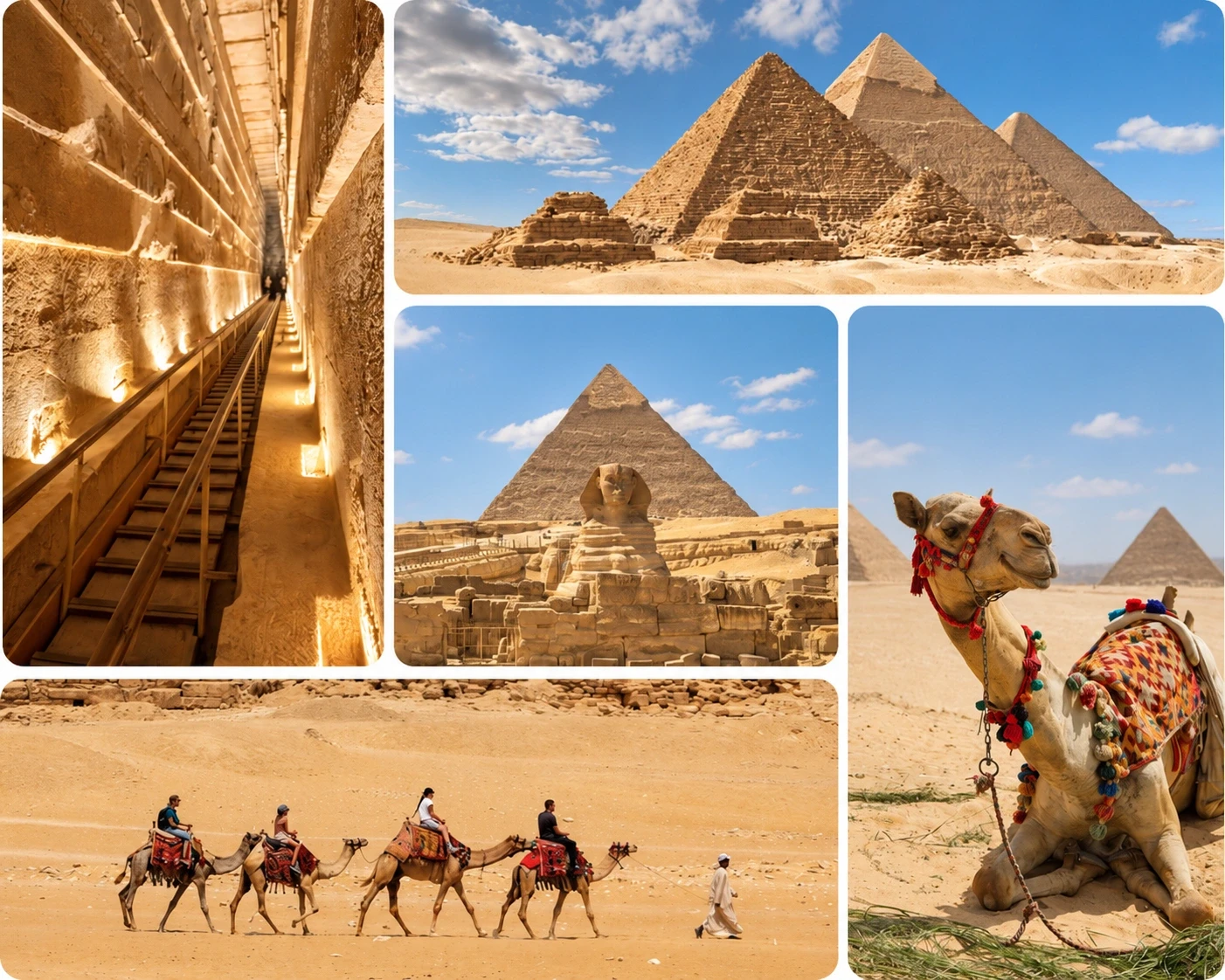
The Giza plateau borders the Egyptian capital, on the west bank of the Nile. The major sites visited on a cruise, from the Karnak Temple to Philae by way of Edfu and Kom Ombo, are concentrated in the Upper Egypt valley instead, along the 200 km or so between Luxor and Aswan. Almost every boat sails on this stretch, from large cruise ships to dahabiyas, the traditional sailing boats of the Nile.
Between Cairo and Luxor, the river crosses Middle Egypt, a farming region that sees very few travellers. For a trip that combines the pyramids and a cruise, you therefore need to arrange a transfer between these two hubs.
Are there cruises departing from Cairo?
A handful of boats offer a ‘long cruise’ that sails up the Nile for nearly 950 km, from Cairo to Aswan. These long cruises last around two weeks and remain a niche option, with very few departures a year. For the vast majority of travellers, the simplest option is still to spend a few days in Cairo and then join the boat in Luxor or Aswan.
Planning your itinerary: Cairo before or after the cruise?
How many days should you plan in Cairo?
Two days in Cairo are enough to cover the highlights:
- Day one: the Giza pyramids, the Sphinx and the Grand Egyptian Museum, right next to the plateau
- Day two: Saqqara, home to the Step Pyramid of Djoser, the oldest in Egypt, usually combined with Memphis, the ancient capital, and its colossus of Ramesses II, with the option of adding Dahshur and its Bent Pyramid
A third day gives you time to explore Old Cairo, the Coptic quarter, the Khan el-Khalili souk or the National Museum of Egyptian Civilization, home to the royal mummies. The Egyptian Museum on Tahrir Square is still open: older than the Grand Museum, it still holds a rich collection of statues and artefacts from ancient Egypt.
Sample splits depending on the length of the trip:
| Trip length | Cairo | Cruise | Transfer |
| 8 days | 2 nights | 4 days | Domestic flight |
| 10 days | 3 nights | 5 to 6 days | Flight or overnight train |
| 12 days | 3 nights | 7 to 8 days | Flight or overnight train |
Start or finish with the pyramids?
It all depends on your flights and your pace. Starting in Cairo lets you recover from the international flight, then end the trip in the calm of the Nile. It is also a logical way to follow Egyptian history in order, from the Old Kingdom pyramids to the later temples of Upper Egypt.
Finishing in Cairo, on the other hand, saves the pyramids for last and brings you closer to the international airport for your flight home. This choice also means you don’t depend on a domestic flight on the day you leave. From the UK, an open-jaw ticket (into Cairo and home from Luxor or Aswan, or the reverse) saves you a domestic flight: check which direct routes operate in your travel season. Some 10-day Egypt itineraries already combine the two, with days in Cairo for the pyramids and the Grand Museum, followed by a dahabiya cruise to Aswan.
When to go?
The best time for a Nile cruise is also the best time for Cairo: October to April. Days are mild in Cairo and warm but rarely punishing in Luxor and Aswan, ideal for sightseeing in the open air. December, January and the February half-term see the biggest crowds at the sites. October, November and March often offer a good balance between weather and visitor numbers.
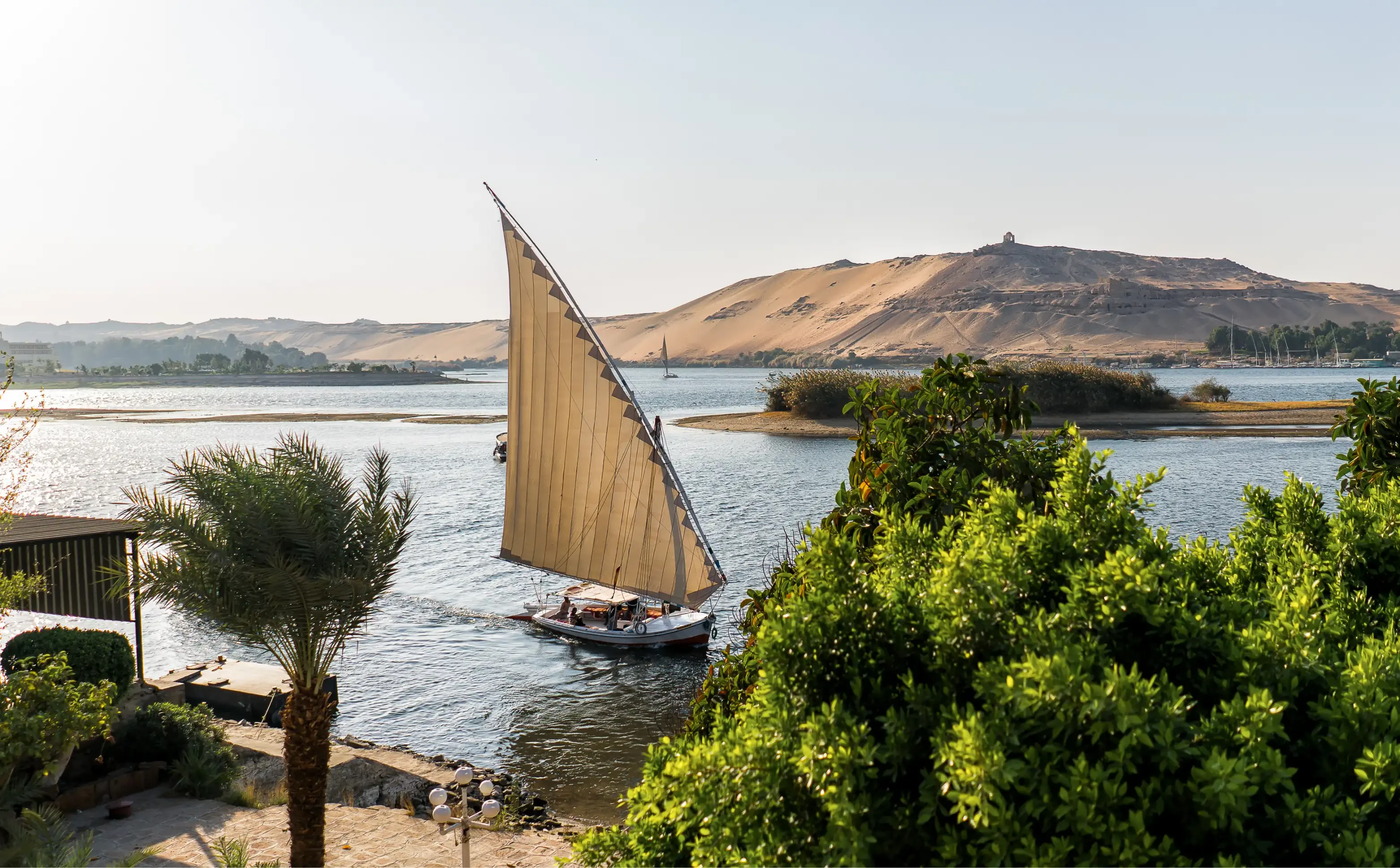
From May to September, the heat becomes gruelling, especially in Upper Egypt, where temperatures regularly exceed 40 °C. Visits then take place very early in the morning.
Cairo to Luxor or Aswan: plane or sleeper train?
The plane, the quick option
Daily domestic flights, including EgyptAir’s, link Cairo to Luxor and Aswan in about an hour. It is the most comfortable option for those short on time: you leave the hotel in the morning and board the boat the same day.
The overnight train, the more adventurous option
The sleeper train run by Watania links Cairo to Luxor and Aswan overnight. The journey takes 10 to 13 hours depending on the destination, leaving in the evening and arriving the next morning. The compartments, basic but clean, sleep one or two people, and both dinner and breakfast are served on board.
A few things to know before booking:
- Foreign travellers buy their tickets on the company’s official website or through an agency, paying in foreign currency
- Booking usually opens four to five months before departure
- Giza station is more convenient than Ramses central station if you are staying near the pyramids
- Delays are frequent and there are no showers on board
| Criterion | Plane | Overnight train |
| Duration | About 1 hr | 10 to 13 hrs |
| Guide price | From €117 one way | $100 to $125 |
| Hotel night | Required | Saved |
| Comfort | High | Basic |
| Ideal for | Short stays | Curious travellers |
Visiting the Giza pyramids: practical information
Access, tickets and 2026 prices
Access to the plateau has been completely redesigned. The main entrance is now through the ‘Great Gate’, on the Fayoum road, to the south of the site. Private cars and coaches no longer drive onto the plateau: a fleet of electric buses leaves the visitor centre roughly every five minutes and serves seven stops, each close to a monument or viewpoint. Be aware that some navigation apps still show the old entrance, near the Mena House hotel.
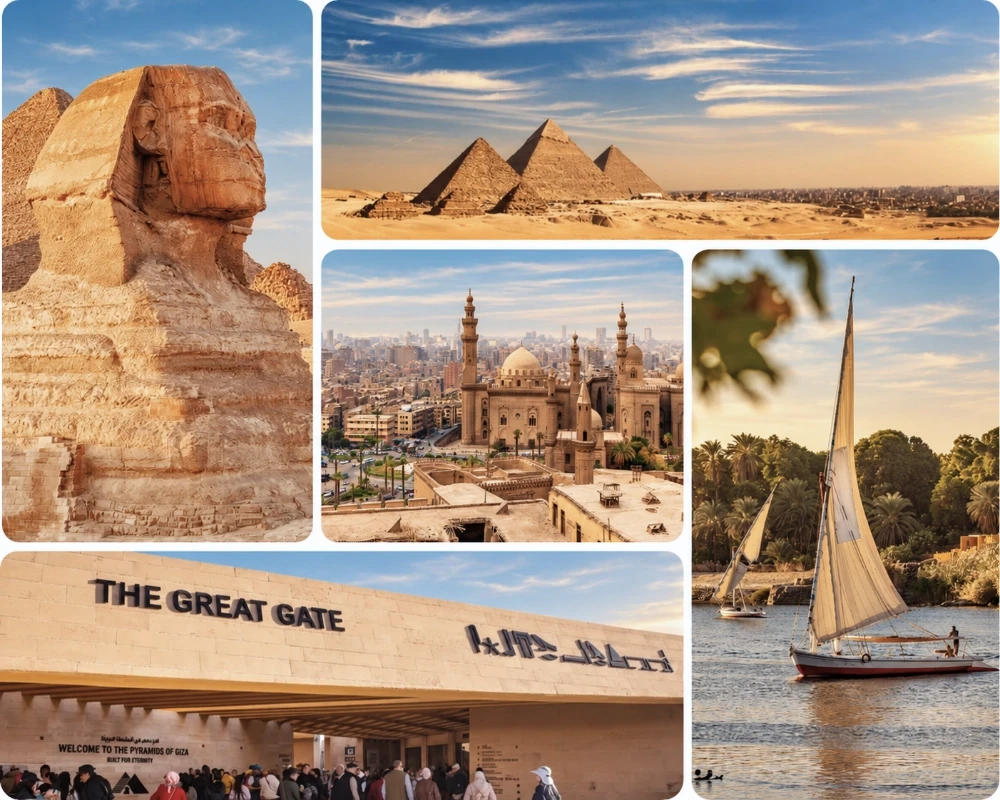
Tickets are sold at the visitor centre’s machines, by card: cash is no longer accepted at most major sites. The general admission ticket covers the area around the three pyramids, the Sphinx and the panoramic viewpoint. The inside of each pyramid requires a separate ticket. For the Great Pyramid of Khufu, buying online from the official website of the Ministry of Tourism and Antiquities is recommended.
On site, offers of camel or carriage rides are still plentiful. It is best to agree the full price before getting on, and to bring water, a hat and sun cream: shade is scarce on the plateau.
| Visit | Adult | Child |
| Giza plateau and Sphinx | 700 EGP (€11) | 350 EGP (€6) |
| Inside Khufu | 1,500 EGP (€25) | 750 EGP (€12) |
| Grand Egyptian Museum | 1,450 EGP (€24) | 730 EGP (€12) |
Source: Egyptian Ministry of Tourism and Antiquities, 2026 prices for foreign visitors. Converted at the rate on 20 October 2026 (€1 = 61 EGP). Prices may change with the Egyptian pound exchange rate.
Is it worth going inside the Great Pyramid?
Going inside Khufu, the largest of the three pyramids, takes some effort: the passage is narrow and steep, it is hot inside and the climb can be tough for anyone claustrophobic or less physically fit. The burial chamber itself is bare.
For the experience with less effort, the Pyramid of Menkaure, the smallest of the three, is a good alternative: the route is shorter, the ticket much cheaper and queues are rare. The tomb of Meresankh III, Khufu’s granddaughter, is also well worth a visit for its remarkably well-preserved paintings.
The Grand Egyptian Museum, to combine on the same day
Opened in November 2025, the Grand Egyptian Museum is 2 km from the plateau. It brings together more than 100,000 artefacts, including Tutankhamun’s entire treasure, Khufu’s solar boat and a grand staircase lined with colossal statues, which opens out at the top onto the pyramids.
A few tips for planning your visit:
- It is best to book online on the official website, especially in high season
- The galleries open every day at 9am, with late opening in the evening on Wednesdays and Saturdays
- Allow at least three hours, ideally four, to enjoy the main galleries and stop for lunch on site
The ideal day: the pyramids at opening time, when the light is beautiful and the heat bearable, then the Grand Museum in the afternoon. The royal mummies, however, are not there: they are on display at the National Museum of Egyptian Civilization, in Old Cairo.
Dahabiya or classic boat: which cruise to choose?
Dahabiya and large boat: the differences
After the bustle of Cairo, the size of your boat shapes the whole trip. Large cruise ships carry several dozen, sometimes more than a hundred passengers, and all follow roughly the same pace, stopping at the major sites at the same times. A Nile cruise on a small boat, by contrast, offers a slower pace and more varied stops.
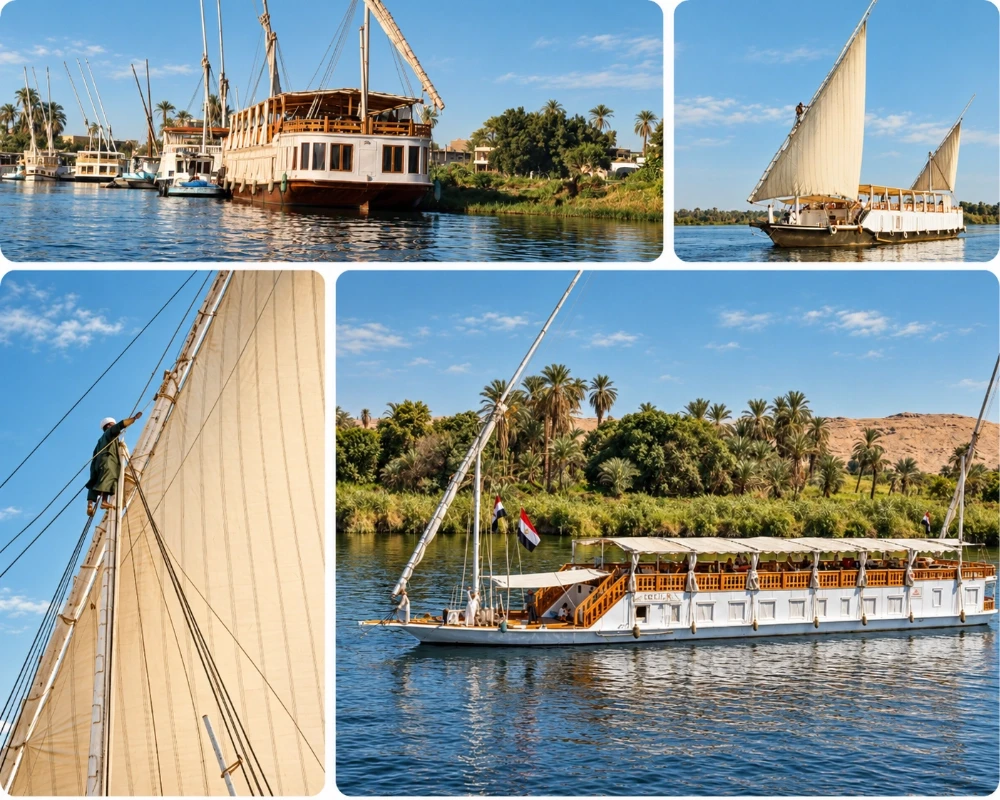
A dahabiya cruise takes place aboard a traditional flat-bottomed sailing boat, inspired by the vessels of 19th-century travellers. A dahabiya generally has between 7 and 12 cabins, so it feels more like a private houseboat than a floating hotel. It travels under sail, so progress depends on the wind, and it can be towed for short stretches when the wind drops. At Filovent, most Nile cruises take place on a dahabiya, and some include an English-speaking Egyptologist guide.
Stops reserved for dahabiyas
Thanks to their small size, dahabiyas stop where large boats cannot moor: the sandstone quarries of Gebel el-Silsila, where the Nile narrows between two cliffs, deserted islands and sandbanks, riverside villages or dinners set up on the bank. Visits to the great temples remain on the programme, often at quieter times.
| Criterion | Dahabiya | Classic boat |
| Passengers | 14 to 24 | Up to 150 |
| Propulsion | Sail | Engine |
| Usual length | 3 to 7 nights | 3 to 4 nights |
| Stops | Major sites and remote spots | Major sites |
| Atmosphere | Intimate | Lively |
Frequently asked questions
Can you see the pyramids during a Nile cruise?
No. Cruises sail between Luxor and Aswan, about 700 km from the Giza pyramids along the Nile. You need to plan a stay in Cairo before or after the cruise, linked to the boat by a domestic flight or an overnight train.
Can you visit Abu Simbel from Aswan?
Yes. The temples of Abu Simbel lie about 280 km south of Aswan. They can be visited on a day trip, by road (3 to 4 hours each way, leaving at around 4am) or on a flight of about 45 minutes. Plan a night in Aswan before or after the cruise to fit it into your trip.
Do you need a visa for Egypt?
Yes, British travellers need a visa for Egypt. The e-visa is available on the official portal visa2egypt.gov.eg for $25 and a 30-day stay. The visa on arrival, paid in cash at the airport, has cost $30 since 1 March 2026. Since 1 August 2026, Cairo airport has also been piloting a digital visa on arrival (QR code) for $36. British travellers need a passport valid for at least six months from the date of arrival. Check the FCDO’s Egypt travel advice on GOV.UK before you travel. Beware of unofficial websites that add service fees to the price of the visa.
Should you book pyramid tickets in advance?
The plateau admission ticket is easy to buy on site, at the visitor centre’s machines. However, it is advisable to book access to the inside of Khufu online. For the Grand Egyptian Museum, it is also best to book online on the official website.
How much should you budget on top of the cruise?
An all-inclusive Nile cruise generally covers full board and the stops set out in the programme, but not flights. Site admission is usually extra. On top of the cruise price, you should therefore allow for:
- Two to three hotel nights in Cairo
- The domestic flight (from €117 one way) or the overnight train ($100 to $125)
- Site admission (700 EGP for the Giza plateau, 1,450 EGP for the Grand Museum, 1,500 EGP for the inside of Khufu, around €60 in total)
- An Egyptologist guide for your visits in Cairo, highly recommended
- The visa ($25 to $36) and tips
Sources
Sources used to write this article:
- Egyptian Ministry of Tourism and Antiquities (2026) Official ticketing for archaeological sites. Available at: https://egymonuments.gov.eg (Accessed: 20 October 2026).
- Nile Empire (2026) Admission prices for Egyptian sites for foreign visitors. Available at: https://www.nileempire.com/egypt-attractions-entrance-fees/ (Accessed: 20 October 2026).
- Sem Elegant Voyage (2026) Grand Egyptian Museum prices and booking. Available at: https://semelegantvoyage.com/en-gb/gem-2026-reservation-tickets-prices-and-official-websit/ (Accessed: 20 October 2026).
- Grand Egyptian Museum (2026) Official ticketing and opening hours. Available at: https://tickets.gem.eg/ (Accessed: 21 October 2026).
- Foreign, Commonwealth & Development Office (2026) Egypt travel advice: entry requirements. Available at: https://www.gov.uk/foreign-travel-advice/egypt/entry-requirements (Accessed: 21 October 2026).
- Egyptian Ministry of Tourism and Antiquities (2026) Egypt launches new digital visa-on-arrival system. Available at: https://www.presseportal.de/en/pm/114692/6319892 (Accessed: 21 October 2026).
- Egyptian Government (n.d.) Official e-visa portal. Available at: https://www.visa2egypt.gov.eg (Accessed: 20 October 2026).
- Alternative Egypt (n.d.) Sleeper trains to Aswan and Luxor. Available at: https://www.alternativeegypt.com/Transport/Sleeper-trains-to-aswan-and-luxor.html (Accessed: 20 October 2026).
- Momondo (2026) Cheap flights from Cairo to Luxor. Available at: https://www.momondo.co.uk/flights/cairo/luxor (Accessed: 21 October 2026).
- We Seek Travel (n.d.) Aswan to Abu Simbel day trip. Available at: https://www.weseektravel.com/aswan-to-abu-simbel/ (Accessed: 20 October 2026).
- 30rates (2026) Euro to Egyptian pound exchange rate. Available at: https://30rates.com/eur-egp (Accessed: 20 October 2026).