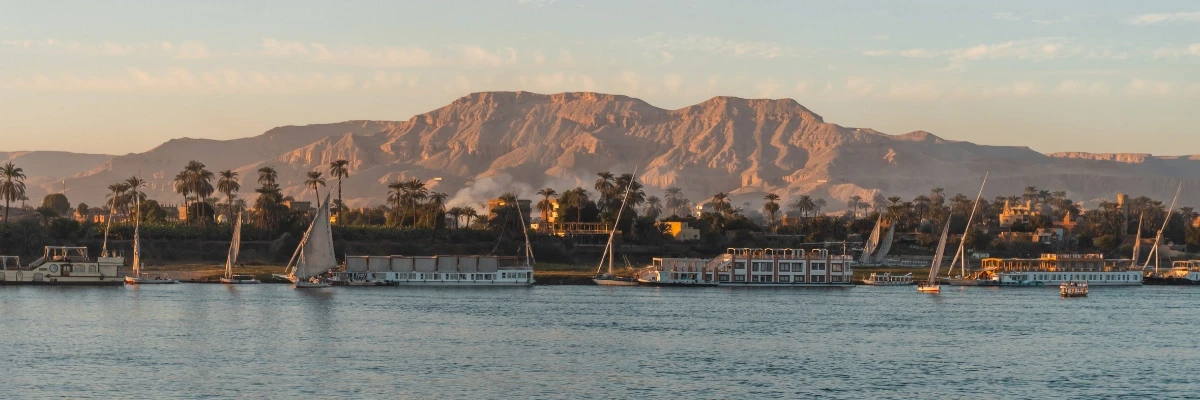
"Up on deck at sunset, the Nile turns to gold, the banks fall silent and a grey heron slowly takes off. You understand why the ancient Egyptians believed the Nile was a god." Julien jotted down these lines on the evening he boarded, somewhere between Aswan and Kom Ombo. With his partner, he spent three days and two nights on board a dahabiya, the traditional Egyptian sailing boat that glides along the Nile under sail. It was part of their first trip to Egypt, a two-week journey he recounts on his website, egypte.osirynx.com.
They had imagined it as a short interlude, and it became the clearest memory of their whole holiday. In this article, I retrace their Nile cruise from Aswan to Luxor via Esna, day by day: boarding in Aswan, the double temple of Kom Ombo and its museum of mummified crocodiles, the sandstone quarries of Gebel el-Silsila, the Temple of Horus at Edfu, and that final morning when the crew hoisted the sails even though there wasn't a breath of wind.
Summary
- 1. A Nile cruise on board a dahabiya
- 2. 3-day Nile cruise itinerary from Aswan
- Day 1: Aswan to Kom Ombo (around 45 km of sailing)
- Day 2: Kom Ombo to Edfu via Gebel el-Silsila (around 80 km of sailing)
- Day 3: El Hegz to Esna, then on to Luxor by road (around 40 km of sailing)
- 3. How much does a dahabiya Nile cruise cost?
- 4. When is the best time for a Nile cruise?
- 5. Dahabiya or standard cruise ship?
- 6. Unforgettable memories
A Nile cruise on board a dahabiya
The choice of boat shaped everything. Julien and his partner were looking for the exact opposite of a mass-market cruise: "I've already been on cruises on big ships with lots of people, and that's exactly what we wanted to avoid this time." Searching online, they kept coming across the idea of a dahabiya cruise, and then Filovent. A dahabiya is a traditional Nile sailing boat with two lateen sails, descended from the vessels of the 19th century and brought up to date with modern cabins. Where a standard Nile cruise ship carries 80 to 150 passengers, this one had sixteen cabins and twenty-nine guests on board.
On board, the difference is first and foremost a matter of space. Their cabin opened onto a small private terrace just above the waterline, with the Nile right at their feet. "Honestly, we had a proper hotel room, no question. It's a small group, and that's really pleasant." The upper deck is spacious, with sun loungers, shaded corners and a bar where passengers gather in the late afternoon. There's no swimming pool, but meals are cooked on board by a hotel-trained chef, with varied dishes served overlooking the river. Over two nights, the couple had no health problems at all, which is no small thing in a country where you're usually warned to watch what you eat.
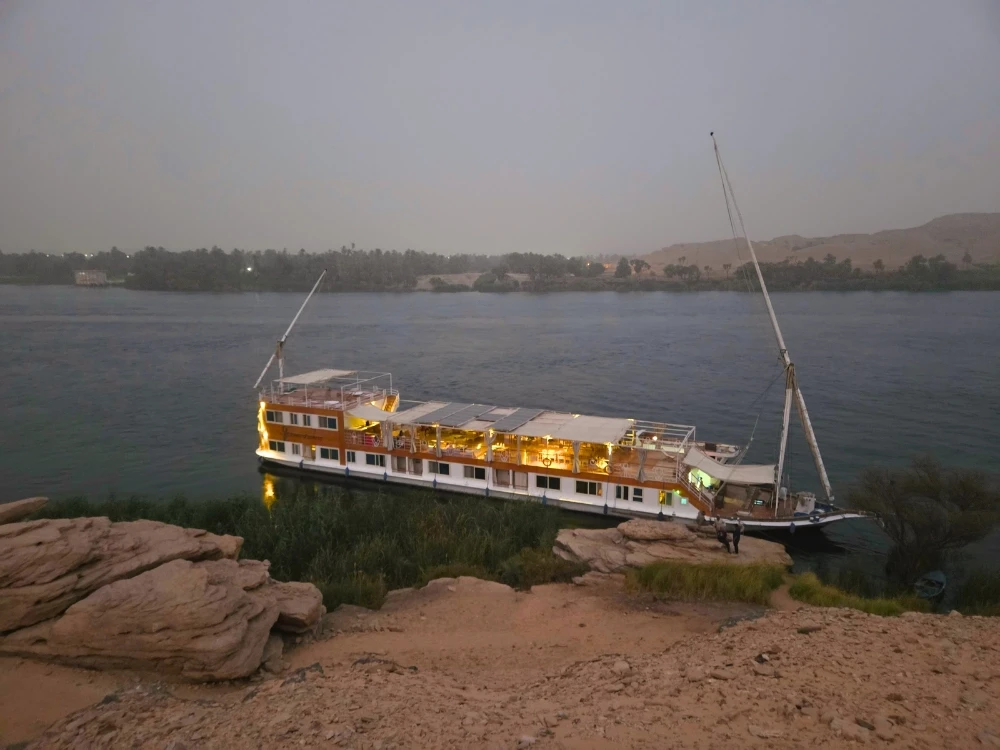 Dahabiya on the Nile (Source: Julien, Filovent customer)
In terms of sailing, a dahabiya is like nothing else. It has no engine of its own: it sails when the wind allows, mostly when heading south, and the rest of the time a small tug tows it from around thirty metres ahead, which keeps things quiet on board. There's no sailing at night: the boat moors at dusk and sets off again in the morning. The days therefore alternate between time on the river and stops ashore, where an Egyptologist guide meets passengers at each site. Having a guide makes all the difference, especially as visits are timed to arrive before the big cruise ships.
The rest is down to the organisation, and here it's all-inclusive: meals, guide, transfers and entrance fees for the sites on the programme are included in the price, which avoids the extras that pile up on standard cruises. You board in Aswan and disembark in Esna, where a minibus takes you on to Luxor. Only tips need to be budgeted separately: they are customary in Egypt, for the guide as well as the crew, and it's best to carry local currency in small notes.
3-day Nile cruise itinerary from Aswan
Boarding in Aswan
Day 1: Aswan → Kom Ombo (Temple of Sobek and Horus)
Day 2: Kom Ombo → Gebel el-Silsila → Edfu (Temple of Horus) → overnight in El Hegz
Day 3: El Hegz → Esna, then minibus transfer to Luxor
Disembarkation in Esna
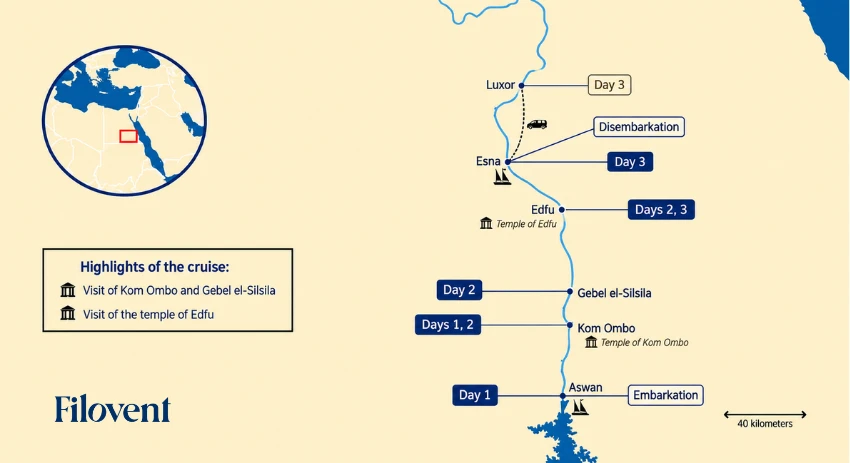 Nile cruise itinerary from Aswan to Esna
Day 1: Aswan to Kom Ombo (around 45 km of sailing)
The meeting point is on the east bank of Aswan in the late morning, after two days spent exploring the area, from the Temple of Philae to Abu Simbel. The transfer takes you to the boat, the crew welcomes passengers aboard, and the dahabiya casts off straight away. Lunch is served as the river is already widening.
The banks drift slowly by, date palms give way to cultivated fields, children wave from the riverbanks and grey herons glide just above the water. After several busy days on the road, the change of pace is immediate: on board there's nothing left to organise or haggle over, just Egypt to watch as it slips past.
The afternoon stop is Kom Ombo (a Ptolemaic temple built on a terrace overlooking the Nile, some forty kilometres north of Aswan). It's a unique monument in Egypt: it is dedicated to two gods at once, Sobek the crocodile god on one side and Horus the falcon on the other, with two entrances, two courtyards and two parallel sanctuaries. This duality made a strong impression on Julien: "It was a bit different from the usual gods you see in Egypt." The adjoining museum rounds off the visit with dozens of mummified crocodiles, adorned with jewellery and buried with full honours. That day, the thermometer read 44 °C: the April heat is felt far more ashore than on deck, where the boat's movement creates a constant breeze.
The dahabiya continues on its way in the late afternoon and moors for the night. Time for the first sunset on deck, the one that inspired the lines that open this article. Dinner on board, then passengers gather around the bar.
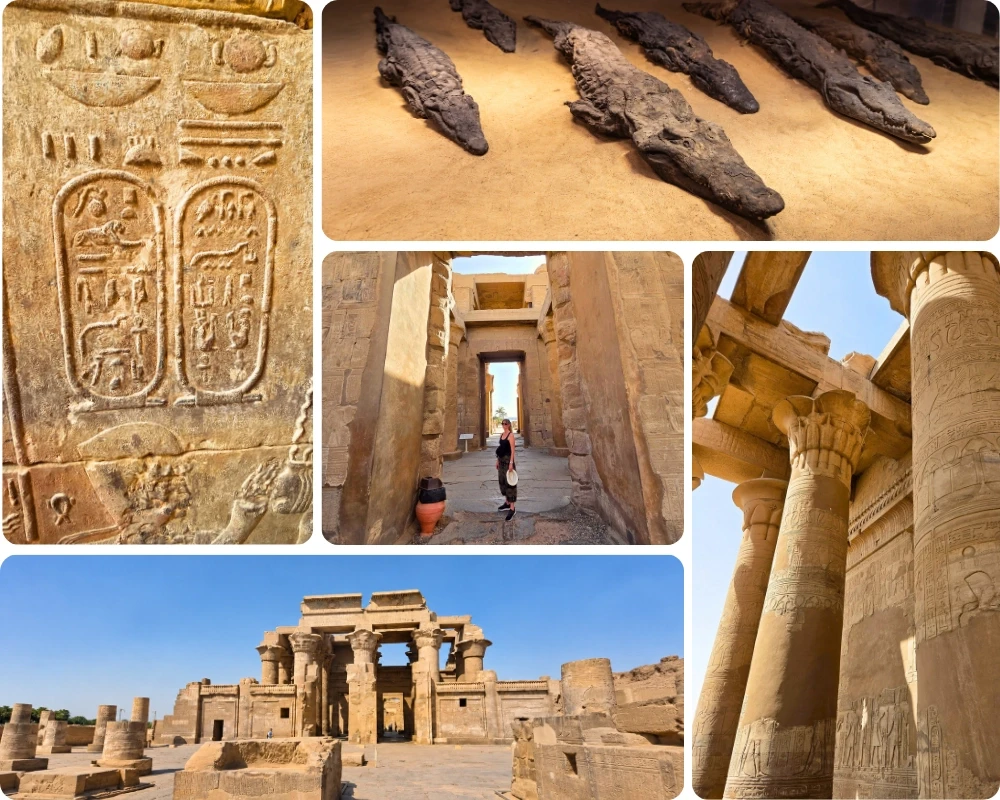
The Temple of Kom Ombo and its crocodile museum (Source: Julien, Filovent customer)
Day 2: Kom Ombo to Edfu via Gebel el-Silsila (around 80 km of sailing)
The morning begins with a stop the big cruise ships don't make: Gebel el-Silsila (the largest sandstone quarry of the Pharaonic era, where the river narrows between two cliffs). This is where the blocks for many of the great temples of the Nile Valley came from. You walk among the carved rock faces, where tool marks are still visible, past stelae, votive niches, decorated tombs and a small rock-cut temple. Standing in front of these quarry faces, the same question always comes to mind: how were blocks weighing several tonnes transported hundreds of kilometres? The site sees few visitors, which makes it one of the most enjoyable moments of the trip.
Back on board for lunch, then a long afternoon sailing north. This is what a dahabiya cruise is really about: a book, a mint tea, the shade of the deck, and the banks gliding by with nothing else to do but watch them.
The boat docks in the late afternoon. The Temple of Horus at Edfu (built by the Ptolemies between 237 and 57 BC and considered the best-preserved temple in Egypt) owes its exceptional condition to chance: buried under sand and houses for centuries, it escaped looting and damage. The pylons stand 36 metres high, the walls are covered in hieroglyphs from floor to ceiling, and the guide recounts the mythological battle between Horus and Seth, carved in full on the walls. It was the sheer size and state of preservation of the monument that impressed Julien most, along with the moment when the symbols stop being decoration and become a story.
Sailing resumes at the end of the day for a few kilometres, as far as the overnight mooring at El Hegz. Dinner on board, last evening, and the crew gets the party going.
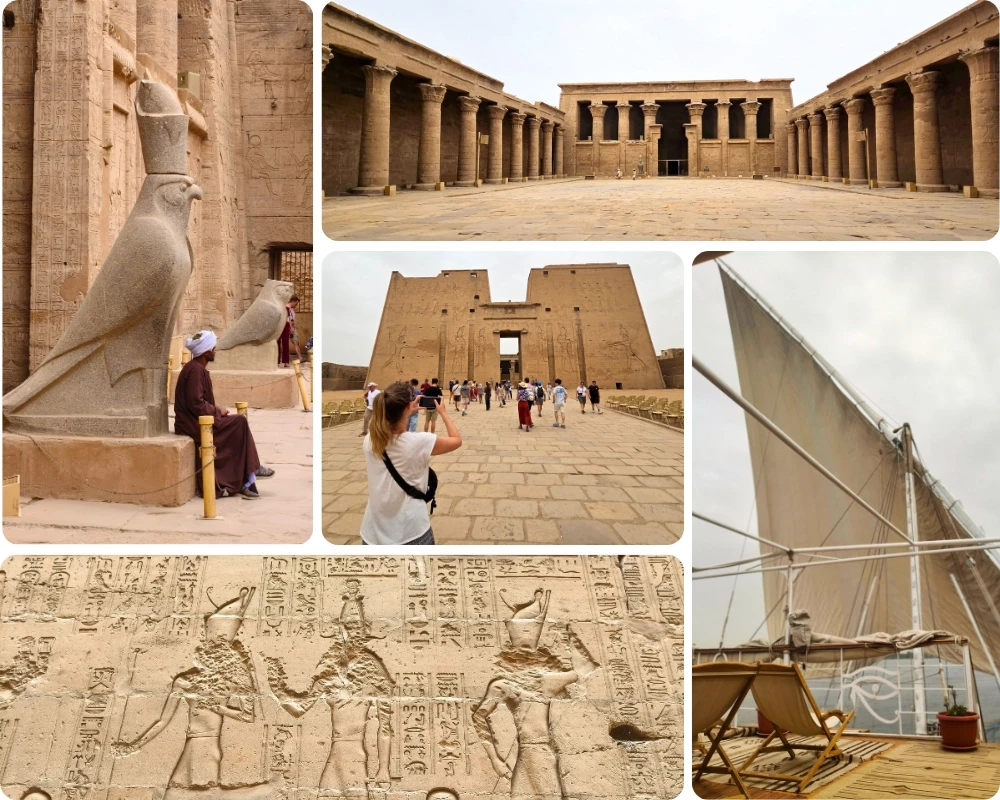
The Temple of Horus at Edfu, the best-preserved temple in Egypt (Source: Julien, Filovent customer)
Day 3: El Hegz to Esna, then on to Luxor by road (around 40 km of sailing)
Last morning on board, and the best surprise of the trip. There wasn't a breath of wind that day, so the crew hadn't planned to raise the sails. The passengers asked to see them, and the captain agreed: "There was no wind, so they didn't want to put the sails up. But we asked them and in the end they did put the sails up. And that was really nice." Watching those two great lateen sails unfurl above the deck, even with no wind to fill them, gives you a sense of what sailing on the Nile was like before engines.
Breakfast is served as the boat heads down towards Esna (a town in Upper Egypt known for its lock and the Temple of Khnum, some fifty kilometres south of Luxor). This is where the sailing ends and it's time to leave the boat and crew behind. A minibus then takes over for the journey to Luxor.
This is worth knowing before you book: on a dahabiya, the cruise doesn't necessarily go all the way to Luxor, and the final stretch is done by road, as on this 12-day itinerary in Egypt, which also ends in Esna. It takes nothing away from the itinerary, since the three major sites on this stretch are all visited over two nights, but it's good to know when comparing offers.
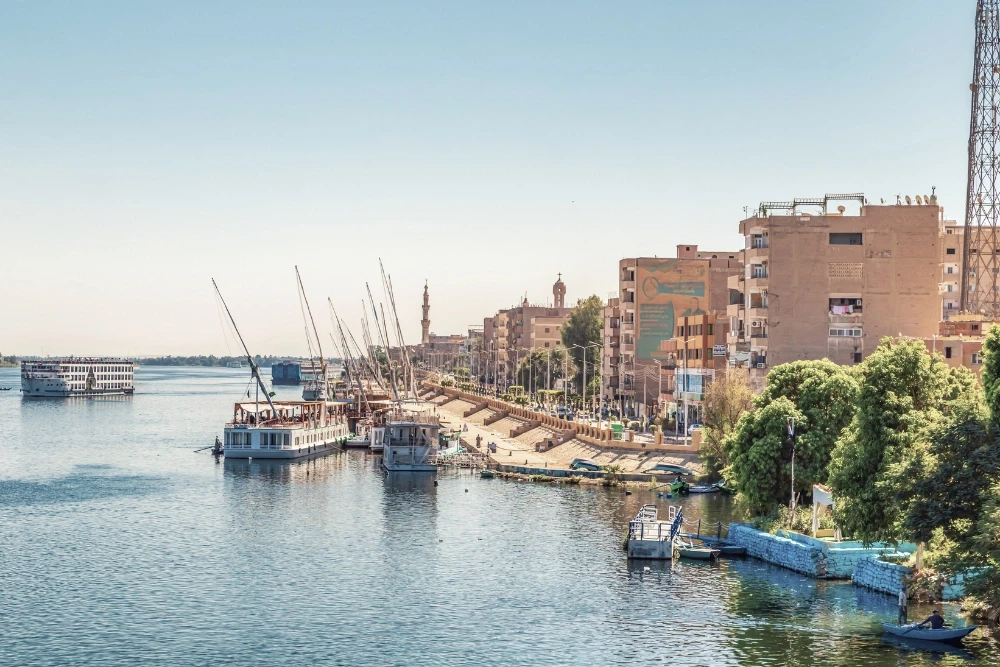 Esna, where the sailing ends (Source: Adobe Stock)
All in all, the short format turned out to be perfectly suited to what the couple were looking for. Three days is enough to see Kom Ombo, Gebel el-Silsila and Edfu without rushing, and to get a taste of life aboard a dahabiya. On a two-week trip split between Cairo, Aswan, Luxor and the Red Sea, this Nile cruise remains the most relaxing part of the holiday and the one Julien and his partner rated most highly.
How much does a dahabiya Nile cruise cost?
The cost of a cruise in Egypt depends first and foremost on the format you choose. Julien points this out himself on his website: the price ranges of €1,200 to €4,000 per person quoted almost everywhere refer to longer trips of five to seven nights, often on a privately chartered dahabiya. On a short cabin-based cruise, the gap with a standard ship narrows considerably. Here are the prices recorded on our dahabiya cruises, for two people, in a standard cabin on a full-board basis.
| Duration | Route | Price for two |
| 3 days / 2 nights | Aswan → Esna, then Luxor by road | €900 to €1,400 |
| 4 days / 3 nights | Aswan → Luxor | €1,500 to €2,200 |
| 5 days / 4 nights | Luxor → Aswan | €2,200 to €3,000 |
| 8 days / 7 nights | Luxor → Aswan, with extra stops | €2,500 to €4,400 |
| 10 days / 9 nights | Cairo, Esna, Aswan and Luxor | €3,200 to €4,600 |
Source: Filovent - Official data, price ranges recorded in September 2026 across all dahabiya cruises, for two people in a standard cabin.
Two factors really affect the price. First, duration, which remains the main price driver: it makes far more difference than the type of boat. Second, the season, with higher prices from December to February. Always check the details of the offer for whether site entrance fees are included, as they add up to several tens of euros per person on a full itinerary, and whether an Egyptologist guide is included. The format Julien chose, three days on a Nile cruise between Luxor and Aswan, sits at the lower end of the range.
When is the best time for a Nile cruise?
The Nile Valley has a desert climate: it hardly ever rains, so it all comes down to temperature. Here are the average temperatures recorded in Aswan, the starting point of the cruise.
| Season | Average temperatures (morning / afternoon) | On board and ashore |
| Winter (December to February) | 9 to 24 °C | The mildest conditions for sightseeing. Peak season: busier and prices at their highest. |
| Spring (March to May) | 15 to 39 °C | March offers the best balance. The heat builds quickly in April: tough at the stops but bearable on deck. |
| Summer (June to August) | 26 to 42 °C | Best avoided for visiting open-air sites, which offer no shade. |
| Autumn (September to November) | 16 to 40 °C | Temperatures drop noticeably from October. November is an excellent time to go. |
Our advice: from October to March, the days stay comfortable for visiting one temple after another. Julien and his partner travelled in mid-April and recorded 44 °C at Kom Ombo, a one-off peak well above the seasonal average. Their experience is telling: the heat weighs on you during the stops, but the deck stays pleasant thanks to the breeze from sailing, and the evenings are mild. If you're travelling in spring, pack a high-factor sun cream, as you burn quickly on the water.
Dahabiya or standard cruise ship?
On the same stretch of river between Aswan and Luxor, a large river cruiser and a Nile cruise on a traditional boat offer two very different experiences. Here are the differences that really matter when choosing.
| Criteria | Dahabiya | Standard cruise ship |
| Passengers | 10 to 32 depending on the boat | 80 to 150 |
| Propulsion | Lateen sails, tug when there's no wind, no engine noise | Engine |
| Stops | Classic sites plus stops the big ships can't reach, such as Gebel el-Silsila | Group visits on a fixed itinerary |
| Facilities | No pool, meals cooked on board, personalised service | Rooftop pool, restaurant, bar |
| Ideal for | Couples, small groups, travellers avoiding the crowds | Families, first-time visitors, tighter budgets |
If you're after peace and quiet, a small group and less-visited stops, the dahabiya is made for you, just as it was for Julien. If you prefer onboard facilities and a tight budget over a longer trip, a standard cruise ship is still a good option. Families with children who want a pool are usually better off on a standard ship.
Unforgettable memories
The sails raised on the last morning
A dahabiya sails when the wind allows and is towed the rest of the time. With no wind on the last day, the crew had no reason to raise the sails. They did it anyway, at the passengers' request, simply to show them. It's the memory Julien mentions first.
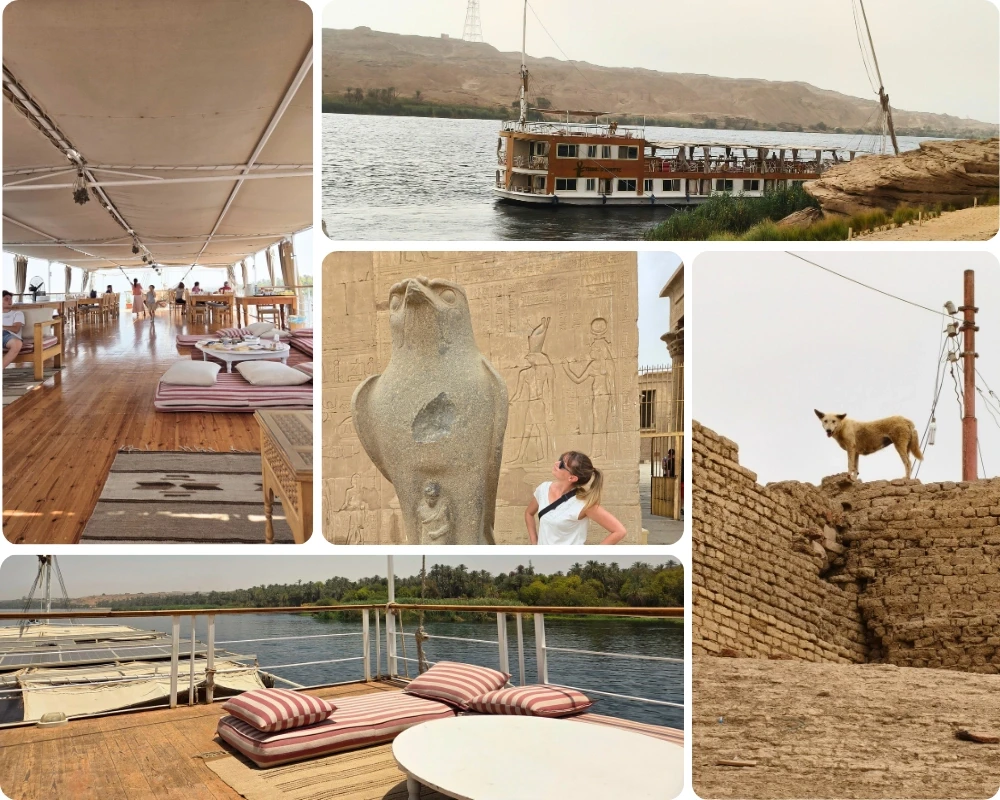 A few memories of the cruise (Source: Julien, Filovent customer)
The crocodile museum at Kom Ombo
Dozens of mummified crocodiles, adorned with jewellery and buried with full honours, in a temple dedicated to a god you rarely come across elsewhere in Egypt. A visit that stands apart from the rest of the itinerary, and all the more memorable for it.
Edfu, where the hieroglyphs come to life
In front of the walls of the Temple of Horus, the guide recounts the battle between Horus and Seth, carved from floor to ceiling. The symbols stop being mere decoration and become a story you can follow. For Julien, it was one of the most intellectually rewarding moments of his trip.
Gebel el-Silsila, away from the crowds
The sandstone quarries are left out of most tours, which is exactly what makes them one of the highlights of the itinerary: tool marks in the stone, inscriptions left by anonymous workers, and hardly anyone else around.
Sunsets on deck
The river turning to gold, the silent banks, a heron taking off. Every evening, the same scene and the same effect: a country you can finally take in at your own pace.
Fancy the same adventure?
Thinking about a dahabiya Nile cruise, with Ptolemaic temples, off-the-beaten-track stops and evenings on deck? Our Egypt specialists will help you find the right duration, season and type of boat for your trip.
Thanks
A big thank you to Julien and his partner for the time they gave us, for his detailed account and for the photos they kindly shared for this article! They tell the full story of their two-week trip to Egypt, from Cairo to the Red Sea, on their website egypte.osirynx.com.
Sources
- Telephone interview with Julien, Filovent customer, 21 September 2026.
- Julien, egypte.osirynx.com, accessed 22 September 2026.
- Filovent, Dream stops on the Nile: 3-day cruise from Aswan to Luxor, reference 178947, accessed 22 September 2026.