





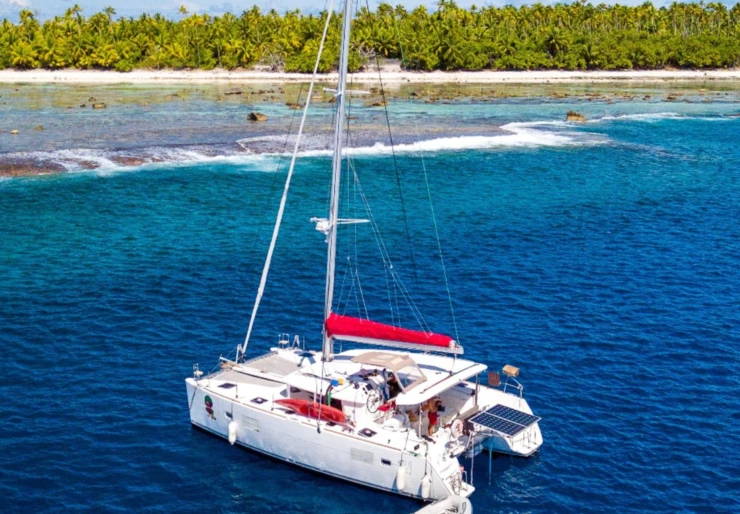
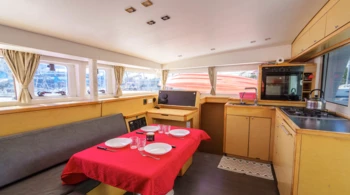
2016 12.2 m
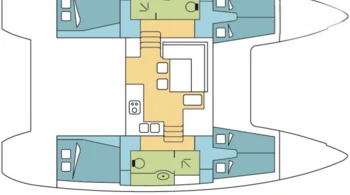
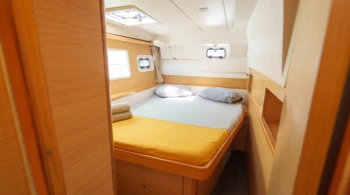
8 berth(s) 4 cabin(s) 2 Bathroom(s)
Main facilities
Solar panels Bimini Barbecue AIS (Automatic Identification System) EPIRB beacon Fully battened mainsail
With or without a skipper

With or without a skipper

see+
Charter conditions
Compulsory deposit refund if you take a professional skipper Nautical CV required Extensive nautical experience required or professional skipper Boating license Valid national identity card or passport required

Technical characteristics - Lagoon 400 S2

Model:
Lagoon 400 S2
Manufacturer:
Lagoon
Year of construction:
2016
Mainsail:
Fully battened mainsail
Total length of the boat:
12.2 m
Width (beam):
7.25 m
Draft:
1.21 m

Boat layout - Lagoon 400 S2

Approved berths:
8
Cabins with 1 double bed:
4
Bathrooms (toilet + shower):
2
Note: the level of comfort may vary from one cabin to another.
For rentals with a skipper, a cabin must be assigned for him, and access to a bathroom must be provided.

Equipments - Lagoon 400 S2

  • Solar panels
  • Bimini
See the full list of 33 facilities

Would you like a skipper or a hostess?

Extras

Extras Status Prices
Skipper (tip not included) see+
  • Please note that you must allocate a cabin to the crew member for sleeping
On request $313.40 / day
Cleaning see+
  • Partner information
  • Final cleaning
Compulsory $246.25 / booking
Sheets, bath towels, and beach towels Compulsory $50.37 / pers / week
Outboard motor 15 hp see+
  • Partner information
  • Dinghy 15 hp
Compulsory $100.74 / week
See the full list of 14 extras

Conditions

Important information
Extras Status Prices
Deposit Compulsory $8,394.75
In some destinations (Polynesia, Seychelles, BVI) the skipper requires to sleep in a double cabin.

Formalities - compulsory and other documents

  • Nautical CV required
  • Extensive nautical experience required or professional skipper
  • Boating license
  • Valid national identity card or passport required

Insurance

  • Compulsory deposit refund if you take a professional skipper
  • Insurance: all the boats offered are fully insured
  • However, we advise you to take out our Cancellation insurance and/or security deposit redemption insurance see+
  • The photos and information on this boat sheet are not contractual

Customer reviews

Overall rating

Good

10 customer reviews
note on 10

7,3

The boat

This boat has not yet been reviewed by a Filovent customer

The partner

Good

10 Partner reviews (for this destination)
note on 10

7,3
Criterion name Score
Boat quality
7,3
Reception and information
Very good

Frequently asked questions

What experience do you need to charter a yacht without a skipper?

The essentials

Setting off without a skipper calls for sailing skills that vary from one destination and one boat to another. One rule applies everywhere: you must be able to read a nautical chart and fix your position. The rest depends on where you are going. A license is mandatory in every country except France, where a sailboat can be chartered without one, whatever its size. A sailing résumé, on the other hand, is always requested: at Filovent, you complete it in your customer account after booking. Some areas also require a restricted radio operator's certificate (VHF), Croatia among them. If you have the slightest doubt, a Filovent advisor will review your file with you before you book.

The Two Non-Negotiable Skills

Chart and position: those are the two skills mentioned above, and every bareboat charter starts there. In practice, that means plotting a course, picking out a beacon or a shoal before you get close to it, and knowing where your boat is at any moment, even if the GPS quits on you. This is the bare minimum, even before the question of a license comes up. A skipper must also know how to handle the boat in the harbor, drop anchor, and plan the day around the weather.

Licenses: What the Law Says

The rule depends entirely on the country and the type of boat. In France, a sailboat can be chartered without any license at all, regardless of its length; for a powerboat of more than 6 hp, the French coastal license (permis plaisance option côtière) is mandatory. In the rest of the world, a license is almost always required: a coastal license is enough in the vast majority of cases, while an offshore license is only needed for the most demanding destinations (open-sea crossings, offshore passages).

Good to know: your license terms apply wherever you sail. A coastal license typically limits sailing to 6 nautical miles from a safe harbor, in France as well as abroad. A charter company may therefore refuse to hand over a boat for an offshore trip if your license does not cover the distance.

What Is the ICC (International Certificate of Competence)?

The International Certificate of Competence (ICC) is the most widely accepted boating credential worldwide. It is not a separate exam in most cases: it is the official equivalent of your national license, issued in a standardized format that charter companies recognize in many countries. If you sail outside your home waters, it is the single document most likely to be accepted at the base.

The Sailing Résumé: The Document That Really Decides

Beyond the legal paperwork, your sailing résumé is always requested, in France as everywhere else. It sets out: the types of boats you have skippered, their size, the areas you have sailed, your role on board (skipper or crew), and how often you sail.

At Filovent, you fill it in directly in your customer account, after booking. It is based on good faith: nobody will ask you for proof, but it is in your own interest to be honest. Finding yourself at the helm of a boat you cannot handle is a sure way to ruin your vacation.

What the Charter Company Actually Looks At

The charter company compares the experience you have declared with the boat you want to charter and checks that the two are consistent. In practice, you will not be handed a large catamaran if your only experience is on a 20-foot monohull. As a rule, you are expected to have already skippered a boat of a comparable size, including docking maneuvers and anchoring. There is no official number of hours, but having led several cruises as skipper will reassure the charter company.

The VHF (Radio) Certificate

In certain areas, a restricted radio operator's certificate (VHF) is required in addition to the license. Croatia asks for it as standard, and more and more Mediterranean areas are following suit. It certifies that you can operate the onboard radio, in particular to send a distress call. If your destination requires it, make sure you obtain it well before departure.

Every Destination Has Its Own Level of Demand

Destination-by-Destination Requirements

Not all destinations are equal. Here are the benchmarks by area to give you an idea of what will be asked of you (to be confirmed with the charter company and for the boat concerned):

DestinationLicenseVHF certificateRecommended level
France (sailboat)None (engine > 6 hp: coastal license)No (when sailing close to shore)Beginner-friendly, line-of-sight sailing
CroatiaCoastal license or ICCYes, mandatoryBeginner to intermediate
GreeceICC + qualified co-skipper often requiredOften requestedIntermediate (Cyclades: meltemi)
ItalyCoastal license or ICCVaries by areaIntermediate
Spain / BalearicsCoastal license or ICCVaries by areaIntermediate
TurkeyCoastal license or ICCOften requestedBeginner to intermediate
SeychellesOffshore licenseOften requestedExperienced, offshore
British Virgin Islands (BVI)No license required, but sailing résumé requestedNoBeginner to intermediate (sheltered waters, line-of-sight sailing)
Grenadines (St. Vincent to Grenada)No license required, but sailing résumé requestedNoExperienced (open-sea crossings, steady trade winds)
French PolynesiaNot required (French territory), but offshore experience essentialRecommendedExperienced, offshore

These benchmarks change over time and every charter company applies its own conditions: always check the exact requirements for your booking before you commit.

The Check-In on Embarkation Day: The Final Verification

On the day of embarkation, the charter company or its representative holds a technical briefing. They will show you around the boat and may assess your first maneuvers. If they feel you are not confident enough, they can require you to take a skipper for the first few days, until you find your feet.

Are You a Beginner or Short on Experience?

Not Enough Experience? Your Options

A bareboat charter is not the place to learn to sail. If your experience is limited, you have several options:

  1. Charter with a skipper: you enjoy the cruise and learn from them along the way, with no stress and no license formalities.
  2. Train at a sailing school: this is the real way to acquire the basics, then your license and your independence as a skipper.
  3. Choose a beginner-friendly destination: moderate winds, line-of-sight sailing, and short legs, for a confident first charter.

Unsure About Your File? Talk to Filovent

Every charter company sets its own requirements, and these can change. Not sure you have the right license, the right certificate or the experience expected? Do not book blind. A Filovent advisor will review your profile and point you toward the right level of boat and destination. For any questions, contact your Filovent advisor or our concierge team at +33 1 70 80 97 35.


Society Islands sailing times: Tahiti to Bora Bora and more

In short: from 30 minutes to 24 hours, depending on the islands

Between the Leeward Islands, expect 30 minutes to 6 hours of sailing: no leg is longer than about 30 nautical miles. Reaching the Windward Islands from the Leeward Islands, on the other hand, means a passage of 12 to 24 hours, usually overnight.

The Society Islands, in French Polynesia, are split into two groups: the Windward Islands to the east, with Tahiti and Moorea, and the Leeward Islands to the west, with Raiatea, Taha’a, Huahine, Bora Bora, and Maupiti.

Sailing times between the Society Islands

Filovent estimates for a cruising catamaran sailing at 6 knots in typical trade wind conditions (October 2026).

RouteDistanceAverage time
Raiatea ↔ Taha’a2 to 10 nm30 min to 2 hrs
Raiatea ↔ Huahine20 to 25 nm4 to 6 hrs
Taha’a ↔ Bora Bora20 nm4 to 5 hrs
Raiatea ↔ Bora Bora25 nm4 to 6 hrs
Huahine ↔ Taha’a28 nm5 to 6 hrs
Bora Bora ↔ Maupiti25 to 30 nm5 to 6 hrs
Tahiti ↔ Moorea12 nm2 to 3 hrs
Moorea ↔ Huahine85 nm12 to 15 hrs
Tahiti ↔ Raiatea120 nm18 to 22 hrs

Raiatea and Taha’a are the only islands in the archipelago to share a lagoon: you can sail from one to the other without heading out to sea, on calm, sheltered water that is ideal for snorkeling and diving.

What affects sailing times?

  • Wind direction: the trade winds blow from the east to southeast. Legs heading west (Huahine to Taha’a, Taha’a to Bora Bora) are sailed downwind (with the wind behind you), so they are quick and comfortable. Return legs heading east (Bora Bora to Raiatea, Raiatea to Huahine) are sailed upwind (against the wind, tacking back and forth) and take longer.
  • Type of boat: a power catamaran can cut passage times by up to half, depending on its cruising speed. A small monohull is slightly slower.
  • Sea state: from June to August, the maramu (a strengthened southeasterly trade wind) can build up a swell that slows down passages outside the lagoons.
  • Entering the lagoons: each island is reached through a pass in the reef, such as Teavapiti Pass off Raiatea. Allow time for the approach and for eyeball navigation (reading the water color to spot coral) to the anchorage, off a motu (a small reef islet) or on a mooring buoy, keeping the boat’s draft in mind.

How many days do you need to sail the Society Islands?

DurationIslands visited
7 daysRaiatea, Taha’a, Huahine, Bora Bora
10 daysRaiatea, Taha’a, Huahine, Bora Bora, Maupiti
14 daysLeeward Islands, Moorea, and Tahiti

A week is enough to sail around the four main Leeward Islands, with two to four hours of sailing a day on average, leaving time for swimming, snorkeling, and stopovers. It is the most popular itinerary for catamaran charter in French Polynesia, starting from Raiatea, near Uturoa, where most boats are based.

Frequently asked questions about sailing between the islands

Which route keeps sailing hours to a minimum?

From Raiatea, the most comfortable route is to:

  • head to Huahine first, while the crew is fresh, to get the upwind leg done early on;
  • sail downwind to Taha’a and then Bora Bora;
  • sail back upwind from Bora Bora to Taha’a (4 to 5 hrs), then finish in the sheltered lagoon of Raiatea and Taha’a before returning the boat.

Can you sail from Tahiti to Bora Bora?

Yes. Papeete and Bora Bora are about 140 nautical miles apart, which means 20 to 24 hours at sea, usually overnight. This passage suits trips of 14 days or more, such as some Tahiti cruise itineraries that link the Windward and Leeward Islands. Depending on the boat, you can set off from Papeete and drop the boat off in Raiatea (or vice versa) on a one-way charter, so you only make the crossing once. For a first trip, starting directly from Raiatea lets you spend all your time on board exploring the Leeward Islands.

Can you sail at night between the islands?

Longer passages (Moorea to Huahine, Tahiti to Raiatea) are sailed overnight to arrive in the morning. On a bareboat charter, check your contract to make sure the charter company allows night sailing. Entering the passes and navigating inside the lagoons, however, should only be done in daylight: coral heads need to be spotted by eye. Ideally, reach your anchorage before 4 p.m., while the sun is still high and the seabed is easy to read.

Can every boat reach Maupiti?

Not in all conditions. Onoiau Pass, to the south of Maupiti, is narrow and becomes dangerous in a southerly swell: the stop is decided the day before, depending on the weather, and must be approved by the charter company. Allow at least 10 days of sailing to include it.

Do you need a skipper to sail between the Society Islands?

Legs are short and anchorages are well marked: an experienced crew can sail bareboat. There is no US license to show, but the charter company will ask for a sailing resume, and an ASA 104 or US Sailing Bareboat Cruising certification makes approval easier. If no one on board has skippering experience, a cruise in French Polynesia with a skipper or full crew takes care of navigation and anchoring for you. Monohulls are also available for sailboat charter in French Polynesia.

When is the best time to sail the Society Islands?

  • April to October: dry season, steady trade winds, the ideal time for sailing.
  • November to March: hot, humid season with lighter winds and tropical showers. Sailing is still possible, but cyclone season runs from November to April: check forecasts from Météo-France, the French national weather service, before each passage.
Can I opt for an all-inclusive package for my yacht charter?

Yes, the all-inclusive package is part of our offering with certain partners! It is available for yacht charters that include at least a skipper and a hostess. It generally includes:

  • Full board (meals and non-alcoholic beverages)
  • Customs and anchorage fees
  • Consumables (diesel, gasoline, gas)

It does not include:

  • Flights (can be booked through our advisors, 20% above the public price, with free replacement in case of cancellation)

Please note:

  • This is a premium option with significant additional costs
  • In certain destinations (e.g., Polynesia), the skipper and hostess must stay in a cabin, which requires a larger boat

“Semi-inclusive” alternative:

  • Anonline provisioning service (groceries prepared and delivered on board on the day of embarkation)
  • You choose your provisions while saving time
  • More economical than all-inclusive, but does not cover fuel or other consumables
What is the horsepower of the motor on a dinghy during a sailboat charter?

The engine power of a dinghy generally ranges from 2.5 to 5 horsepower, depending on several factors, such as the size of the main boat. The larger the sailboat or catamaran, the more powerful and spacious the dinghy is likely to be.

As a general rule, most dinghies are equipped with an engine under 6 horsepower, as anything above that requires a boat license.

Exception: In the Bahamas or The Caribbean, trips between the anchorage and the shore can be longer due to coral reefs. It is therefore recommended to have a more powerful dinghy, between 10 and 15 horsepower, for greater comfort.

On some large sailboats, you can even find dinghies with 40-horsepower engines, allowing for activities like water skiing.

Need specific information? Contact our advisors to learn about the features of the dinghy included with your boat.

How much does a skipper cost?

Estimated rates:

  • Mediterranean: approx. €350/day
  • The Caribbean: approximately €290 per day

These rates apply only to the skipper’s services. They do not include his provisions, i.e., his meals during the cruise.

Please note:

You are responsible for providing meals for your skipper. You have two options:

  • Invite him to join you for a meal (on board or at a restaurant)
  • Pay him a meal allowance (approximately €20 per meal) if he eats on his own

It depends on your itinerary and your preferences: just remember to include the skipper in the logistical planning of your trip.

What is included in the yacht charter price?

The charter price includes:

  • Use of the boat for the selected duration.
  • Booking fees.
  • The dinghy is generally included, but the outboard motor is often offered as a paid option.
  • End-of-cruise cleaning is generally not included: this is a mandatory extra in 95% of cases, as indicated in your quote or contract.

Other fees may apply depending on the boat or destination: bedding, towels, visitor’s tax, port fees, skipper, fuel, etc. All this information is specified in advance.

Information about the partner

  • Filovent partner since 2009
  • Last booking with this partner in July 2026
  • 37 bookings with this partner

With Filovent, you can book your vacation by the sea with complete peace of mind

OUR COMMITMENTS
  • 30 years of experience An expert dedicated to your cruise project
    • This longevity is a guarantee of quality and reliability.
  • Total transparency A comprehensive overview of the boats of all the yacht charter companies present at each destination
    • Our goal is to tell our customers EVERYTHING about the quality of the boats, the partners and the risks associated with the cruise.
  • A single concierge service A friendly and responsive service by phone or email until you return from your cruise
    • Everything is done to ensure that the preparation of your cruise runs smoothly. A team of 6 people is dedicated to the Experience: Support, Contract Modifications, Advice, After-Sales Service.
  • Strong commitments Values that are close to our hearts
    • Filovent defends and promotes freedom and respect for all and for the customer, diversity, the environment, laws and rules.

Excellent

trustpilot-stars
TrustScore 4.3 / 5
All our reviews

Location

Prices

See the price list