





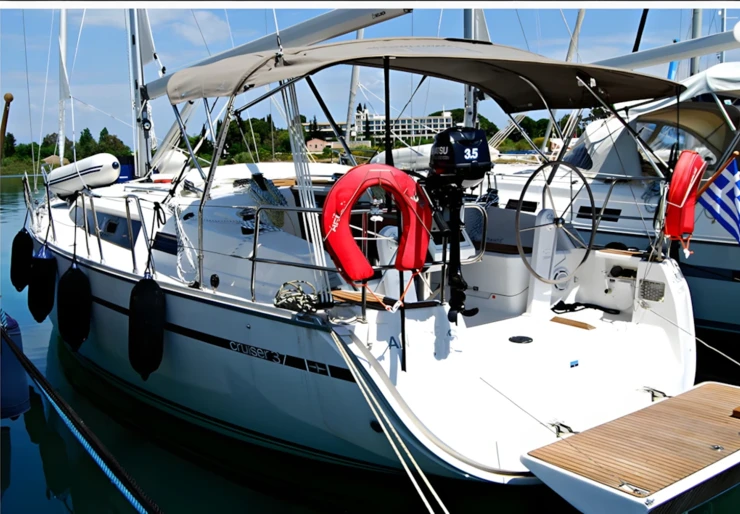
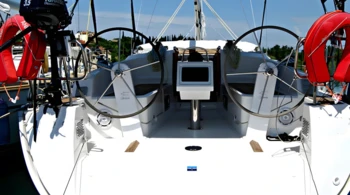
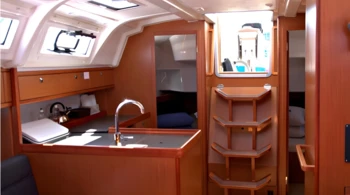
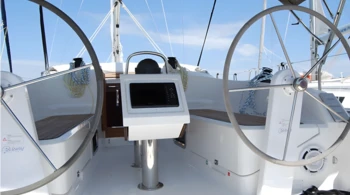
2015 11.7 m
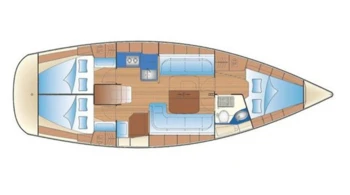
6 berth(s) 3 cabin(s) 1 Bathroom(s)
Main facilities
Bimini Deck shower Electric windlass Gas stove Hot water Maneuverability
With or without a skipper

With or without a skipper

see+
Charter conditions
Compulsory deposit refund if you take a professional skipper Nautical CV required Boating license Valid national identity card or passport required

Technical characteristics - Bavaria 37

Model:
Bavaria 37
Manufacturer:
Bavaria
Year of construction:
2015
Mainsail:
Mainsail on furler
Total length of the boat:
11.7 m
Width (beam):
3.68 m
Draft:
1.85 m

Boat layout - Bavaria 37

Approved berths:
6
Cabins with 1 double bed:
3
Bathrooms (toilet + shower):
1
Note: the level of comfort may vary from one cabin to another.
For rentals with a skipper, a cabin must be assigned for him, and access to a bathroom must be provided.

Would you like a skipper or a hostess?

Extras

Extras Status Prices
Skipper (tip not included) see+
  • Please note that you must allocate a cabin to the crew member for sleeping
On request $223.30 / day
Cleaning Compulsory $200.97 / booking
Sheets + hand towels Included
Dinghy and outboard motor Included
See the full list of 6 extras

Conditions

Important information
Extras Status Prices
Deposit Compulsory $2,791.25

Formalities - compulsory and other documents

  • Nautical CV required
  • Boating license
  • Valid national identity card or passport required

Insurance

  • Compulsory deposit refund if you take a professional skipper
  • Insurance: all the boats offered are fully insured
  • However, we advise you to take out our Cancellation insurance and/or security deposit redemption insurance see+
  • The photos and information on this boat sheet are not contractual

Customer reviews

The boat

This boat has not yet been reviewed by a Filovent customer

The partner

This partner has not yet been reviewed by a Filovent customer

Frequently asked questions

What experience do you need to charter a yacht without a skipper?

The essentials

Setting off without a skipper calls for sailing skills that vary from one destination and one boat to another. One rule applies everywhere: you must be able to read a nautical chart and fix your position. The rest depends on where you are going. A license is mandatory in every country except France, where a sailboat can be chartered without one, whatever its size. A sailing résumé, on the other hand, is always requested: at Filovent, you complete it in your customer account after booking. Some areas also require a restricted radio operator's certificate (VHF), Croatia among them. If you have the slightest doubt, a Filovent advisor will review your file with you before you book.

The Two Non-Negotiable Skills

Chart and position: those are the two skills mentioned above, and every bareboat charter starts there. In practice, that means plotting a course, picking out a beacon or a shoal before you get close to it, and knowing where your boat is at any moment, even if the GPS quits on you. This is the bare minimum, even before the question of a license comes up. A skipper must also know how to handle the boat in the harbor, drop anchor, and plan the day around the weather.

Licenses: What the Law Says

The rule depends entirely on the country and the type of boat. In France, a sailboat can be chartered without any license at all, regardless of its length; for a powerboat of more than 6 hp, the French coastal license (permis plaisance option côtière) is mandatory. In the rest of the world, a license is almost always required: a coastal license is enough in the vast majority of cases, while an offshore license is only needed for the most demanding destinations (open-sea crossings, offshore passages).

Good to know: your license terms apply wherever you sail. A coastal license typically limits sailing to 6 nautical miles from a safe harbor, in France as well as abroad. A charter company may therefore refuse to hand over a boat for an offshore trip if your license does not cover the distance.

What Is the ICC (International Certificate of Competence)?

The International Certificate of Competence (ICC) is the most widely accepted boating credential worldwide. It is not a separate exam in most cases: it is the official equivalent of your national license, issued in a standardized format that charter companies recognize in many countries. If you sail outside your home waters, it is the single document most likely to be accepted at the base.

The Sailing Résumé: The Document That Really Decides

Beyond the legal paperwork, your sailing résumé is always requested, in France as everywhere else. It sets out: the types of boats you have skippered, their size, the areas you have sailed, your role on board (skipper or crew), and how often you sail.

At Filovent, you fill it in directly in your customer account, after booking. It is based on good faith: nobody will ask you for proof, but it is in your own interest to be honest. Finding yourself at the helm of a boat you cannot handle is a sure way to ruin your vacation.

What the Charter Company Actually Looks At

The charter company compares the experience you have declared with the boat you want to charter and checks that the two are consistent. In practice, you will not be handed a large catamaran if your only experience is on a 20-foot monohull. As a rule, you are expected to have already skippered a boat of a comparable size, including docking maneuvers and anchoring. There is no official number of hours, but having led several cruises as skipper will reassure the charter company.

The VHF (Radio) Certificate

In certain areas, a restricted radio operator's certificate (VHF) is required in addition to the license. Croatia asks for it as standard, and more and more Mediterranean areas are following suit. It certifies that you can operate the onboard radio, in particular to send a distress call. If your destination requires it, make sure you obtain it well before departure.

Every Destination Has Its Own Level of Demand

Destination-by-Destination Requirements

Not all destinations are equal. Here are the benchmarks by area to give you an idea of what will be asked of you (to be confirmed with the charter company and for the boat concerned):

DestinationLicenseVHF certificateRecommended level
France (sailboat)None (engine > 6 hp: coastal license)No (when sailing close to shore)Beginner-friendly, line-of-sight sailing
CroatiaCoastal license or ICCYes, mandatoryBeginner to intermediate
GreeceICC + qualified co-skipper often requiredOften requestedIntermediate (Cyclades: meltemi)
ItalyCoastal license or ICCVaries by areaIntermediate
Spain / BalearicsCoastal license or ICCVaries by areaIntermediate
TurkeyCoastal license or ICCOften requestedBeginner to intermediate
SeychellesOffshore licenseOften requestedExperienced, offshore
British Virgin Islands (BVI)No license required, but sailing résumé requestedNoBeginner to intermediate (sheltered waters, line-of-sight sailing)
Grenadines (St. Vincent to Grenada)No license required, but sailing résumé requestedNoExperienced (open-sea crossings, steady trade winds)
French PolynesiaNot required (French territory), but offshore experience essentialRecommendedExperienced, offshore

These benchmarks change over time and every charter company applies its own conditions: always check the exact requirements for your booking before you commit.

The Check-In on Embarkation Day: The Final Verification

On the day of embarkation, the charter company or its representative holds a technical briefing. They will show you around the boat and may assess your first maneuvers. If they feel you are not confident enough, they can require you to take a skipper for the first few days, until you find your feet.

Are You a Beginner or Short on Experience?

Not Enough Experience? Your Options

A bareboat charter is not the place to learn to sail. If your experience is limited, you have several options:

  1. Charter with a skipper: you enjoy the cruise and learn from them along the way, with no stress and no license formalities.
  2. Train at a sailing school: this is the real way to acquire the basics, then your license and your independence as a skipper.
  3. Choose a beginner-friendly destination: moderate winds, line-of-sight sailing, and short legs, for a confident first charter.

Unsure About Your File? Talk to Filovent

Every charter company sets its own requirements, and these can change. Not sure you have the right license, the right certificate or the experience expected? Do not book blind. A Filovent advisor will review your profile and point you toward the right level of boat and destination. For any questions, contact your Filovent advisor or our concierge team at +33 1 70 80 97 35.


Bareboat Charter Greece: Best Sailing Area for Beginners

In short:

  • Ionian Islands: the easiest area for beginners. Sheltered waters, moderate wind, and very short hops between stops.
  • Saronic Gulf: ideal for a first week departing from Athens. Short passages, simple logistics.
  • Cyclades: the most spectacular islands, but with strong winds in summer. Book a captain, or go in May, June, or September.
  • License: the US has no federal boating license, so Greek charter bases ask the skipper for a recognized certification (ASA 104 Bareboat Cruising, US Sailing Bareboat Cruising, or an IPC/ICC) and a sailing resume, plus a second crew member with sailing experience. No certification? Book a skippered or crewed charter, available in all three areas.

The three areas compared

CriterionIonianSaronicCyclades
Recommended levelBeginnerBeginnerExperienced or with a captain
Summer wind7 to 21 knots (Beaufort force 3 to 5)7 to 21 knots (Beaufort force 3 to 5)17 to 33 knots (Beaufort force 5 to 7, meltemi)
Distance between stops5 to 15 nautical miles10 to 20 nautical miles10 to 30 nautical miles
Sea conditionsCalm to light chopLight chopChoppy to rough
Sheltered anchoragesVery manyManyFewer
SceneryGreen islands, turquoise covesPicturesque harbors, ancient sitesWhite villages, arid islands
AtmosphereNature, peace and quietAuthentic, close to AthensIconic, lively

Wind, the number one criterion

  • Ionian: northwesterly maestro, calm in the morning, picks up around noon and dies down in the evening.
  • Saronic: north to northeast wind, a weaker meltemi since the gulf is sheltered by Attica.
  • Cyclades: the meltemi, a dry north to northeast summer wind, blows hardest in July and August, often for several days in a row.

Good to know:

  • The meltemi can keep a boat in port for 1 to 3 days in the Cyclades.
  • In the Ionian, sail in the morning and you'll be at anchor before the afternoon breeze builds.

When is the best time to sail in Greece?

PeriodIonianSaronicCyclades
April to MayVery goodVery goodGood
JuneIdealIdealIdeal for beginners
July to AugustIdeal (busy)Good (busy)Captain recommended
SeptemberIdealIdealIdeal for beginners
OctoberGoodGoodGood

Price-wise, July and August are the most expensive months in all three areas. June and September offer the best balance of weather, price, and crowds.

Charter bases in Greece and getting there

  • Ionian: bases in Lefkada, Corfu, Preveza, and Kefalonia; airports in Preveza, Corfu, and Kefalonia.
  • Saronic: bases in Athens (Alimos) and Lavrio; Athens airport.
  • Cyclades: bases in Lavrio, Athens (Alimos), Paros, Syros, and Mykonos; airports in Athens, Paros, Mykonos, and Syros.
  • Lefkada and Athens have the largest charter fleets in the country.
  • Starting from Paros or Syros puts you in the heart of the Cyclades from day one, with no crossing from the mainland.
  • Charters usually run Saturday to Saturday.

Each area in detail

Ionian Islands

  • Strengths: waters sheltered by the mainland, plenty of coves, and islands very close to one another.
  • Watch out for: very busy anchorages in August, so arrive early.
  • Sample one-week route from Lefkada: Lefkada → Meganisi → Kalamos → Kastos → Ithaca → Kefalonia (Fiskardo) → Lefkada.
  • Sailing time: 1 to 3 hours a day.

Compare the models available for a sailboat charter in the Ionian Islands.

Saronic Gulf

  • Strengths: direct departure from Athens, lively harbors, and few transfers.
  • Watch out for: ferry traffic around Athens and Aegina, and crowded docks in high season on Hydra.
  • Sample one-week route from Alimos: Alimos → Aegina → Poros → Hydra → Poros → Agistri → Alimos.
  • Sailing time: 2 to 4 hours a day.

Cyclades

  • Strengths: whitewashed villages on Sifnos and Serifos, clear water, and fewer crowds in the Western Cyclades than around Mykonos.
  • Watch out for: the summer meltemi and open-water crossings. Build 1 to 2 spare days into your plan.
  • Sample one-week route from Lavrio (Western Cyclades): Lavrio → Kea → Kythnos → Serifos → Sifnos → Kythnos → Lavrio.
  • Sailing time: 3 to 5 hours a day.

No license, or no wish to take the helm? A cruise in the Cyclades lets you book a single cabin and explore the islands with a crew on board.

Frequently asked questions

Catamaran or monohull sailboat for a first yacht charter?

CriterionCatamaranMonohull
StabilityVery stable, little heelingHeels under sail
SpaceVery spaciousMore compact
AnchoringShallow draft, access to covesDeeper draft
BudgetHigherMore affordable
Ideal forFamilies, groups, and the CycladesCouples, avid sailors

In the Cyclades, a catamaran's stability makes the meltemi far more comfortable: explore our catamaran charter in the Cyclades.

How many days should you plan?

  • Ionian: 7 days.
  • Saronic: 3 to 7 days.
  • Cyclades: 7 days for the Western Cyclades from Lavrio, 10 to 14 days to go further, with extra time in case of meltemi.

Can you combine two areas?

  • Saronic and Cyclades: yes, from Athens or Lavrio, over 10 to 14 days.
  • Ionian and Cyclades: possible as a one-way charter of 14 days or more through the Corinth Canal (toll payable). The canal has closed several times since 2021, so check its status before you book.

What about a large group?

  • All three areas work well, by booking several boats that sail together (flotilla).
  • Large catamarans can accommodate 10 to 12 guests.
  • In all three areas, harbors have room for a flotilla to moor side by side, so your group can spend the evenings together.
Meltemi Winds in Greece: When They Blow & Islands to Avoid

The meltemi is a dry, steady northerly wind that blows across the Aegean Sea from mid-May to the end of September, peaking in July and August. It typically reaches Force 4 to 6 on the Beaufort scale (Bft), or 11 to 27 knots, with gusts of Force 7 or 8 (28 to 40 knots). In August, the central and eastern Cyclades (Mykonos, Tinos, Andros, Naxos, Paros, Ios, Amorgos, Santorini) are the most exposed. The Ionian Islands and the Saronic Gulf remain the most sheltered areas.

What is the meltemi?

The meltemi (meltemi in Greek, also known as the etesian wind) is caused by the pressure difference between an area of high pressure over the Balkans and a thermal low over Turkey. Air flows from north to south across the Aegean.

  • Direction: northeasterly in the northern Aegean, northerly in the Cyclades, northwesterly toward the Dodecanese and Crete.
  • Associated weather: clear skies, dry air, tempered heat.
  • Sea state: short, steep seas, especially in the straits between the islands.

When does the meltemi blow?

MonthFrequencyTypical strength
MayOccasionalForce 3 to 4
JuneModerateForce 4 to 5
JulyHighForce 5 to 6, gusts of 7
AugustPeakForce 5 to 7, gusts of 8
SeptemberDecliningForce 4 to 5
OctoberRareForce 3 to 4

The meltemi follows a fairly predictable pattern:

  • During the day: it picks up in the late morning, peaks in the afternoon and often eases in the evening.
  • Length of an episode: usually 3 to 7 days, sometimes longer in high summer.
  • Lulls: windows of 1 to 3 days of light wind often separate two episodes.

For a yacht charter in Greece in July or August, these cycles matter as much as the sailing area: a lull of 1 to 3 days is often enough to make an exposed crossing.

Which islands should you avoid in August?

AreaExposureIslands affected
Central and eastern CycladesVery highMykonos, Tinos, Andros, Naxos, Paros, Ios, Amorgos, Santorini
Western CycladesHighSyros, Kythnos, Serifos, Sifnos, Milos
Northern DodecaneseHighPatmos, Leros, Kalymnos, Kos (north coast)
Southern Dodecanese and SporadesModerateKos (south coast), Symi, Rhodes, Skiathos, Skopelos
Saronic Gulf and ArgolisLowAegina, Poros, Hydra, Spetses
Ionian IslandsVery lowCorfu, Paxos, Lefkada, Kefalonia, Ithaca, Zakynthos

The islands themselves are less of a problem than the crossings between them: the Kafireas Strait (between Evia and Andros), the passage between Mykonos and Tinos and the channel between Naxos and Paros are known for rough seas when the meltemi is in full force.

Where to sail in Greece in August?

  • Ionian Islands: the best choice in August, with a moderate thermal breeze in the afternoon and short distances. A yacht charter in the Ionian Islands is ideal for families or first-time crews: short legs, often under 15 nautical miles, and plenty of sheltered anchorages.
  • Saronic Gulf: close to Athens, generally sheltered, with short island-hopping passages.
  • Southern Dodecanese: moderate exposure and short legs between Nisyros, Tilos, Symi and Rhodes.
  • Cyclades: best kept for experienced crews, or planned for June and September.

Filovent’s advisors will point you toward the most suitable departure base for your sailing dates and your crew’s experience.

How to sail with the meltemi

  • Plan your route to sail downwind (wind behind you) rather than upwind (beating into the wind): head south at the start of the week, then return in short legs early in the morning, or choose a one-way charter when the base allows it.
  • Set off early in the morning and arrive before the wind builds in the afternoon.
  • Allow 1 to 2 spare days in your schedule in case you get stuck in port.
  • Anchor on the south coasts of the islands, sheltered from the swell, but watch out for gusts funneling down from the high ground on mountainous islands (Amorgos, Ios, Andros).
  • Check the forecast every day, for example on the website of the National Observatory of Athens (meteo.gr) or the Hellenic National Meteorological Service (emy.gr).
  • Opt for a skippered yacht charter if your crew lacks experience in strong winds.

Frequently asked questions about the meltemi

Is the meltemi dangerous?

It is not dangerous for an experienced crew on a well-prepared boat, but it makes sailing physically demanding and uncomfortable. Before skippering yourself, check the boating license requirements in Greece and assess your ability in strong winds. In strong winds, the Greek port authorities may ban departures; the threshold depends on the type and size of the boat.

Catamaran or monohull in the meltemi?

A catamaran heels very little and is more comfortable at anchor, but it points less well into the wind. A monohull performs better upwind in a heavy sea. Either way, your route matters more than the type of boat.

Can a meltemi episode be forecast?

Yes, usually 3 to 5 days in advance. Weather models and the Poseidon system run by the Greek institute HCMR (poseidon.hcmr.gr) predict its arrival and strength reliably, so you can adapt your route day by day.

Should you avoid the Cyclades in summer?

Not necessarily. June and September remain the best months. In July and August, departing from Lavrio or Athens, favor Kea, Kythnos and Syros, which are less exposed than Mykonos or Naxos, and save long crossings for calmer days.

Can I opt for an all-inclusive package for my yacht charter?

Yes, the all-inclusive package is part of our offering with certain partners! It is available for yacht charters that include at least a skipper and a hostess. It generally includes:

  • Full board (meals and non-alcoholic beverages)
  • Customs and anchorage fees
  • Consumables (diesel, gasoline, gas)

It does not include:

  • Flights (can be booked through our advisors, 20% above the public price, with free replacement in case of cancellation)

Please note:

  • This is a premium option with significant additional costs
  • In certain destinations (e.g., Polynesia), the skipper and hostess must stay in a cabin, which requires a larger boat

“Semi-inclusive” alternative:

  • Anonline provisioning service (groceries prepared and delivered on board on the day of embarkation)
  • You choose your provisions while saving time
  • More economical than all-inclusive, but does not cover fuel or other consumables
What is the horsepower of the motor on a dinghy during a sailboat charter?

The engine power of a dinghy generally ranges from 2.5 to 5 horsepower, depending on several factors, such as the size of the main boat. The larger the sailboat or catamaran, the more powerful and spacious the dinghy is likely to be.

As a general rule, most dinghies are equipped with an engine under 6 horsepower, as anything above that requires a boat license.

Exception: In the Bahamas or The Caribbean, trips between the anchorage and the shore can be longer due to coral reefs. It is therefore recommended to have a more powerful dinghy, between 10 and 15 horsepower, for greater comfort.

On some large sailboats, you can even find dinghies with 40-horsepower engines, allowing for activities like water skiing.

Need specific information? Contact our advisors to learn about the features of the dinghy included with your boat.

How much does a skipper cost?

Estimated rates:

  • Mediterranean: approx. €350/day
  • The Caribbean: approximately €290 per day

These rates apply only to the skipper’s services. They do not include his provisions, i.e., his meals during the cruise.

Please note:

You are responsible for providing meals for your skipper. You have two options:

  • Invite him to join you for a meal (on board or at a restaurant)
  • Pay him a meal allowance (approximately €20 per meal) if he eats on his own

It depends on your itinerary and your preferences: just remember to include the skipper in the logistical planning of your trip.

Information about the partner

  • Filovent partner since 2025
  • Last booking with this partner in November 2025
  • 1 booking with this partner

With Filovent, you can book your vacation by the sea with complete peace of mind

OUR COMMITMENTS
  • 30 years of experience An expert dedicated to your cruise project
    • This longevity is a guarantee of quality and reliability.
  • Total transparency A comprehensive overview of the boats of all the yacht charter companies present at each destination
    • Our goal is to tell our customers EVERYTHING about the quality of the boats, the partners and the risks associated with the cruise.
  • A single concierge service A friendly and responsive service by phone or email until you return from your cruise
    • Everything is done to ensure that the preparation of your cruise runs smoothly. A team of 6 people is dedicated to the Experience: Support, Contract Modifications, Advice, After-Sales Service.
  • Strong commitments Values that are close to our hearts
    • Filovent defends and promotes freedom and respect for all and for the customer, diversity, the environment, laws and rules.

Excellent

trustpilot-stars
TrustScore 4.3 / 5
All our reviews

Location

Prices

See the price list