





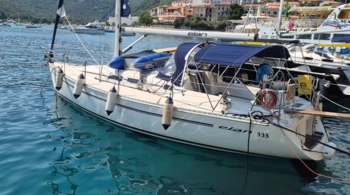
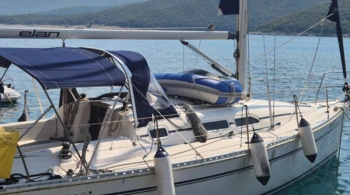
2003 10.9 m
4 berth(s) 2 cabin(s) 1 Bathroom(s)
Main facilities
Bimini CD player Electric windlass Genoa on furler Oven Gas stove
With or without a skipper

With or without a skipper

see+
Charter conditions
Compulsory deposit refund if you take a professional skipper VHF certificate Nautical CV required Boating license Valid national identity card or passport required

Technical characteristics - Elan 333

Model:
Elan 333
Manufacturer:
Elan
Year of construction:
2003
Mainsail:
Mainsail on furler
Total length of the boat:
10.9 m
Width (beam):
3.46 m
Draft:
1.5 m / 1.9 m

Boat layout - Elan 333

Approved berths:
4
Daily capacity:
4
Cabins with 1 double bed:
2
Bathrooms (toilet + shower):
1
Note: the level of comfort may vary from one cabin to another.
For rentals with a skipper, a cabin must be assigned for him, and access to a bathroom must be provided.

Equipments - Elan 333

  • Oven
  • Gas stove
See the full list of 23 facilities

Would you like a skipper or a hostess?

Conditions

Important information
Extras Status Prices
Deposit Compulsory $1,339.80

Formalities - compulsory and other documents

  • VHF certificate
  • Nautical CV required
  • Boating license
  • Valid national identity card or passport required

Insurance

  • Compulsory deposit refund if you take a professional skipper
  • Insurance: all the boats offered are fully insured
  • However, we advise you to take out our Cancellation insurance and/or security deposit redemption insurance see+
  • The photos and information on this boat sheet are not contractual

Customer reviews

The boat

This boat has not yet been reviewed by a Filovent customer

The partner

This partner has not yet been reviewed by a Filovent customer

Frequently asked questions

What experience do you need to charter a yacht without a skipper?

The essentials

Setting off without a skipper calls for sailing skills that vary from one destination and one boat to another. One rule applies everywhere: you must be able to read a nautical chart and fix your position. The rest depends on where you are going. A license is mandatory in every country except France, where a sailboat can be chartered without one, whatever its size. A sailing résumé, on the other hand, is always requested: at Filovent, you complete it in your customer account after booking. Some areas also require a restricted radio operator's certificate (VHF), Croatia among them. If you have the slightest doubt, a Filovent advisor will review your file with you before you book.

The Two Non-Negotiable Skills

Chart and position: those are the two skills mentioned above, and every bareboat charter starts there. In practice, that means plotting a course, picking out a beacon or a shoal before you get close to it, and knowing where your boat is at any moment, even if the GPS quits on you. This is the bare minimum, even before the question of a license comes up. A skipper must also know how to handle the boat in the harbor, drop anchor, and plan the day around the weather.

Licenses: What the Law Says

The rule depends entirely on the country and the type of boat. In France, a sailboat can be chartered without any license at all, regardless of its length; for a powerboat of more than 6 hp, the French coastal license (permis plaisance option côtière) is mandatory. In the rest of the world, a license is almost always required: a coastal license is enough in the vast majority of cases, while an offshore license is only needed for the most demanding destinations (open-sea crossings, offshore passages).

Good to know: your license terms apply wherever you sail. A coastal license typically limits sailing to 6 nautical miles from a safe harbor, in France as well as abroad. A charter company may therefore refuse to hand over a boat for an offshore trip if your license does not cover the distance.

What Is the ICC (International Certificate of Competence)?

The International Certificate of Competence (ICC) is the most widely accepted boating credential worldwide. It is not a separate exam in most cases: it is the official equivalent of your national license, issued in a standardized format that charter companies recognize in many countries. If you sail outside your home waters, it is the single document most likely to be accepted at the base.

The Sailing Résumé: The Document That Really Decides

Beyond the legal paperwork, your sailing résumé is always requested, in France as everywhere else. It sets out: the types of boats you have skippered, their size, the areas you have sailed, your role on board (skipper or crew), and how often you sail.

At Filovent, you fill it in directly in your customer account, after booking. It is based on good faith: nobody will ask you for proof, but it is in your own interest to be honest. Finding yourself at the helm of a boat you cannot handle is a sure way to ruin your vacation.

What the Charter Company Actually Looks At

The charter company compares the experience you have declared with the boat you want to charter and checks that the two are consistent. In practice, you will not be handed a large catamaran if your only experience is on a 20-foot monohull. As a rule, you are expected to have already skippered a boat of a comparable size, including docking maneuvers and anchoring. There is no official number of hours, but having led several cruises as skipper will reassure the charter company.

The VHF (Radio) Certificate

In certain areas, a restricted radio operator's certificate (VHF) is required in addition to the license. Croatia asks for it as standard, and more and more Mediterranean areas are following suit. It certifies that you can operate the onboard radio, in particular to send a distress call. If your destination requires it, make sure you obtain it well before departure.

Every Destination Has Its Own Level of Demand

Destination-by-Destination Requirements

Not all destinations are equal. Here are the benchmarks by area to give you an idea of what will be asked of you (to be confirmed with the charter company and for the boat concerned):

DestinationLicenseVHF certificateRecommended level
France (sailboat)None (engine > 6 hp: coastal license)No (when sailing close to shore)Beginner-friendly, line-of-sight sailing
CroatiaCoastal license or ICCYes, mandatoryBeginner to intermediate
GreeceICC + qualified co-skipper often requiredOften requestedIntermediate (Cyclades: meltemi)
ItalyCoastal license or ICCVaries by areaIntermediate
Spain / BalearicsCoastal license or ICCVaries by areaIntermediate
TurkeyCoastal license or ICCOften requestedBeginner to intermediate
SeychellesOffshore licenseOften requestedExperienced, offshore
British Virgin Islands (BVI)No license required, but sailing résumé requestedNoBeginner to intermediate (sheltered waters, line-of-sight sailing)
Grenadines (St. Vincent to Grenada)No license required, but sailing résumé requestedNoExperienced (open-sea crossings, steady trade winds)
French PolynesiaNot required (French territory), but offshore experience essentialRecommendedExperienced, offshore

These benchmarks change over time and every charter company applies its own conditions: always check the exact requirements for your booking before you commit.

The Check-In on Embarkation Day: The Final Verification

On the day of embarkation, the charter company or its representative holds a technical briefing. They will show you around the boat and may assess your first maneuvers. If they feel you are not confident enough, they can require you to take a skipper for the first few days, until you find your feet.

Are You a Beginner or Short on Experience?

Not Enough Experience? Your Options

A bareboat charter is not the place to learn to sail. If your experience is limited, you have several options:

  1. Charter with a skipper: you enjoy the cruise and learn from them along the way, with no stress and no license formalities.
  2. Train at a sailing school: this is the real way to acquire the basics, then your license and your independence as a skipper.
  3. Choose a beginner-friendly destination: moderate winds, line-of-sight sailing, and short legs, for a confident first charter.

Unsure About Your File? Talk to Filovent

Every charter company sets its own requirements, and these can change. Not sure you have the right license, the right certificate or the experience expected? Do not book blind. A Filovent advisor will review your profile and point you toward the right level of boat and destination. For any questions, contact your Filovent advisor or our concierge team at +33 1 70 80 97 35.

Are marinas in Croatia well equipped?

Yes, Croatia’s marinas are among the best equipped in the Mediterranean. In 2025, the coast had 86 marinas (official Croatian statistics), including 21 dry marinas, and the ACI network operates 22 of them. Every marina with in-water slips offers water, electricity, restrooms and showers, and help with docking. The only real catch is the price: in 2026, a night in a marina costs between $90 and $460 in high season, depending on the size of the boat. To keep costs down, most crews alternate between marinas, town harbors, mooring balls and anchorages.

What amenities do Croatian marinas offer?

Croatian marinas are built for recreational boating and charter yachts. The level of service mostly depends on their size.

AmenityAvailability
Water and 230 V shore power at the dockAll marinas
Showers and restroomsAll marinas
Front desk and docking assistanceAll marinas
Wi-FiMost marinas
Laundry, convenience store, restaurantLarge marinas
Fuel dockSome marinas
Holding tank pump-outRare

Onboard outlets use European two-pin plugs at 230 V, which are different from US plugs. You will need a US to EU plug adapter to charge your devices on board, and your chargers must support 230 V (most phone and laptop chargers do).

Which marinas are the best equipped?

ACI marinas are a safe bet for a sailboat charter in Croatia as well as a catamaran vacation. This long-established network covers the entire coast, from Istria to Dubrovnik, with facilities designed for charter yachts.

  • Large marinas (Split, Trogir, Dubrovnik…): full services, stores, restaurants and laundry on site. Split has several of them, which makes it a convenient starting point for a catamaran charter in Split.
  • Small marinas and island marinas: basic amenities, more limited services.
  • Blue Flag marinas: this annual award recognizes water quality, environmental management and safety, as at ACI Umag, ACI Rovinj and ACI Pula in Istria.

Are the marinas open year-round?

Most of them, yes. Of the ACI marinas, four only open in summer: Palmižana, Piškera, Rab and Žut. If you are planning to sail in spring or fall, often considered the best time to visit Croatia by boat, ask our advisors which marinas are open along your route.

What is a marina stop like in Croatia?

Do you need to reserve a slip in advance?

Off-season, it is usually not necessary. In July and August, it is best to reserve a few days ahead at the most popular marinas, especially around Hvar, Vis and Southern Dalmatia, toward Dubrovnik.

  • With a captain: they handle the reservation.
  • Through the base manager: they know the local marinas and can call ahead for you.
  • On your own: the ACI app shows available slips and lets you book directly.

In high season, arriving in mid-afternoon gives you more choice of slips.

How do you dock in a Croatian marina?

In Croatia, as everywhere in the Mediterranean, boats dock stern-to, without finger piers.

  • Hail the marina on VHF before entering: they will assign you a slip.
  • A marinero will be waiting on the dock to take your stern lines.
  • At the bow, the boat is held by a lazy line, a rope attached to a weight on the seabed, which the marinero hands to you.
  • Bring gloves: lazy lines are often slippery and covered in shells.
  • Put fenders out on both sides before entering the harbor.

Shore lines (tied to a tree or a rock) are prohibited in Croatia.

Are the nights at the charter base included?

For the vast majority of charters, the first and last nights at the departure marina are included at no extra charge. Check-in is on Saturday in the late afternoon, between 5 and 6 p.m., and check-out the following Saturday morning, between 9 and 10 a.m. Conditions vary by charter company: our advisors will confirm what applies to your boat.

How much does a night in a marina cost in Croatia?

Croatia is one of the most expensive destinations in the Mediterranean for marina nights. In high season 2026, expect to pay from $90 a night for a monohull to $460 for a very large catamaran. The price depends on the size of the boat, the marina and the region. With a catamaran charter in Croatia, slips cost more than for a monohull, since the boat takes up more width at the dock.

RegionAverage price per night
Kvarner$125
Zadar$135
Istria$135
Šibenik$150
Split$160
Dubrovnik$170

Average 2026 prices for a 43 ft (13 m) boat in high season.

Prices vary widely from one marina to another, even within the same region. Our advisors can give you an estimate for your boat and your route.

Town harbor, mooring ball or anchorage: what are the alternatives to a marina?

Type of stopAmenitiesPrice per night in 2026
MarinaWater, electricity, showers, services$90 to $460
Town harborOften water and electricityCheaper than a marina
Mooring ball in a concession bayNone$2 to $5 per meter
AnchoringNoneFree

Anchoring is free in most coves. It becomes chargeable in concession bays, where you tie up to a mooring ball, and in national parks. The concession holder must be able to show you their permit.

Over a week, most crews sailing in Croatia split their nights like this:

  • 1 to 2 nights in a marina, to rest, take on water and recharge the batteries;
  • 1 to 2 nights in a town harbor, steps from the old towns;
  • 2 to 4 nights on a mooring ball or at anchor in the most beautiful coves: Vis, Lastovo and the Kornati are among the must-see stops in Croatia.

With a captain, alternate one night at anchor and one night in port: at anchor, they have to stay alert all night, whereas in a marina they can fully rest.

What to know before you go

  • Documents: on arrival, the marina may ask for the boat’s papers and the crew list.
  • Fuel: around 70 fuel docks along the coast can be reached by boat. Some close from time to time, so it is best to call ahead and not wait until the last day to fill up. Spare fuel cans are not allowed.
  • National parks: a ticket is required as soon as you anchor, swim or spend the night in the park. In the Kornati, ACI Piškera is the only marina inside the park.
  • Draft: on a monohull, some stops require you to check the depth in advance. Our advisors will tell you whether your route is affected.
  • Pets: when they are allowed on board, a cleaning fee of $230 to $460 applies, regardless of the size of the animal. Conditions depend on the charter company, so check with our advisors.
  • During your trip: our concierge service liaises with the base manager for any questions while you are sailing.
Can I opt for an all-inclusive package for my yacht charter?

Yes, the all-inclusive package is part of our offering with certain partners! It is available for yacht charters that include at least a skipper and a hostess. It generally includes:

  • Full board (meals and non-alcoholic beverages)
  • Customs and anchorage fees
  • Consumables (diesel, gasoline, gas)

It does not include:

  • Flights (can be booked through our advisors, 20% above the public price, with free replacement in case of cancellation)

Please note:

  • This is a premium option with significant additional costs
  • In certain destinations (e.g., Polynesia), the skipper and hostess must stay in a cabin, which requires a larger boat

“Semi-inclusive” alternative:

  • Anonline provisioning service (groceries prepared and delivered on board on the day of embarkation)
  • You choose your provisions while saving time
  • More economical than all-inclusive, but does not cover fuel or other consumables
What is the horsepower of the motor on a dinghy during a sailboat charter?

The engine power of a dinghy generally ranges from 2.5 to 5 horsepower, depending on several factors, such as the size of the main boat. The larger the sailboat or catamaran, the more powerful and spacious the dinghy is likely to be.

As a general rule, most dinghies are equipped with an engine under 6 horsepower, as anything above that requires a boat license.

Exception: In the Bahamas or The Caribbean, trips between the anchorage and the shore can be longer due to coral reefs. It is therefore recommended to have a more powerful dinghy, between 10 and 15 horsepower, for greater comfort.

On some large sailboats, you can even find dinghies with 40-horsepower engines, allowing for activities like water skiing.

Need specific information? Contact our advisors to learn about the features of the dinghy included with your boat.

How much does a skipper cost?

Estimated rates:

  • Mediterranean: approx. €350/day
  • The Caribbean: approximately €290 per day

These rates apply only to the skipper’s services. They do not include his provisions, i.e., his meals during the cruise.

Please note:

You are responsible for providing meals for your skipper. You have two options:

  • Invite him to join you for a meal (on board or at a restaurant)
  • Pay him a meal allowance (approximately €20 per meal) if he eats on his own

It depends on your itinerary and your preferences: just remember to include the skipper in the logistical planning of your trip.

What is included in the yacht charter price?

The charter price includes:

  • Use of the boat for the selected duration.
  • Booking fees.
  • The dinghy is generally included, but the outboard motor is often offered as a paid option.
  • End-of-cruise cleaning is generally not included: this is a mandatory extra in 95% of cases, as indicated in your quote or contract.

Other fees may apply depending on the boat or destination: bedding, towels, visitor’s tax, port fees, skipper, fuel, etc. All this information is specified in advance.

Information about the partner

New Filovent partner, no business history yet.

With Filovent, you can book your vacation by the sea with complete peace of mind

OUR COMMITMENTS
  • 30 years of experience An expert dedicated to your cruise project
    • This longevity is a guarantee of quality and reliability.
  • Total transparency A comprehensive overview of the boats of all the yacht charter companies present at each destination
    • Our goal is to tell our customers EVERYTHING about the quality of the boats, the partners and the risks associated with the cruise.
  • A single concierge service A friendly and responsive service by phone or email until you return from your cruise
    • Everything is done to ensure that the preparation of your cruise runs smoothly. A team of 6 people is dedicated to the Experience: Support, Contract Modifications, Advice, After-Sales Service.
  • Strong commitments Values that are close to our hearts
    • Filovent defends and promotes freedom and respect for all and for the customer, diversity, the environment, laws and rules.

Excellent

trustpilot-stars
TrustScore 4.3 / 5
All our reviews

Location

Prices

See the price list