






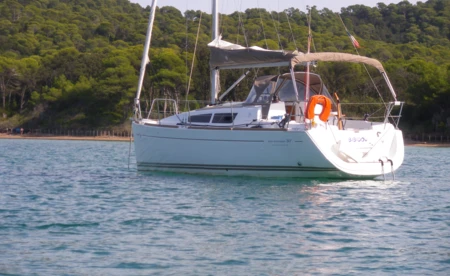
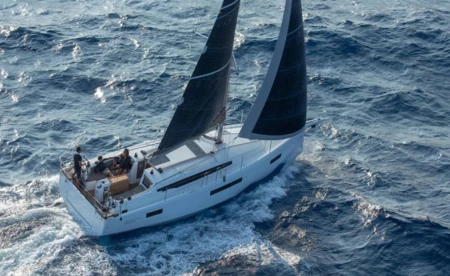
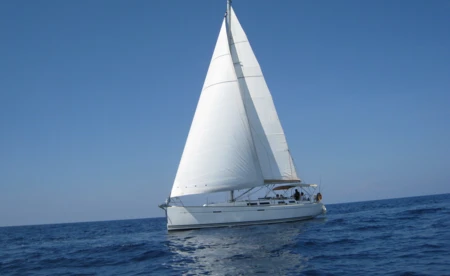
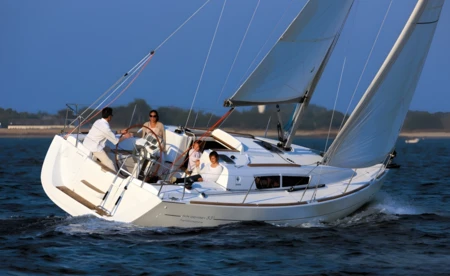

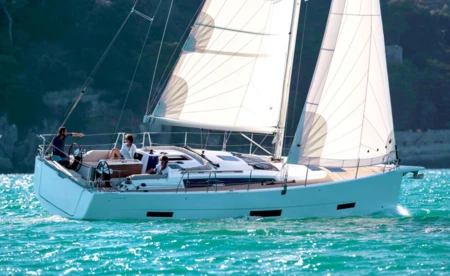

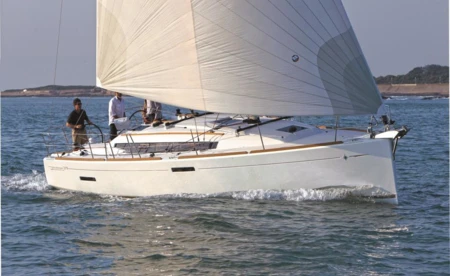
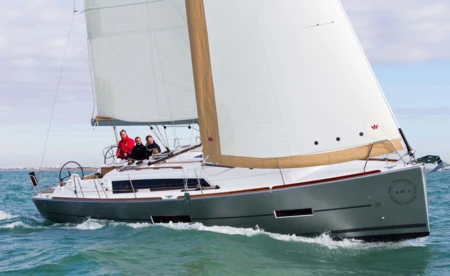
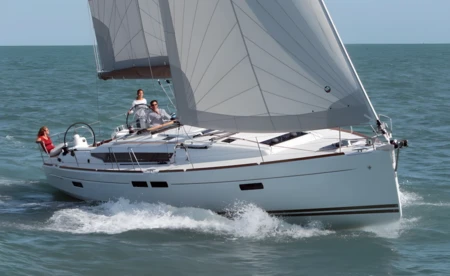
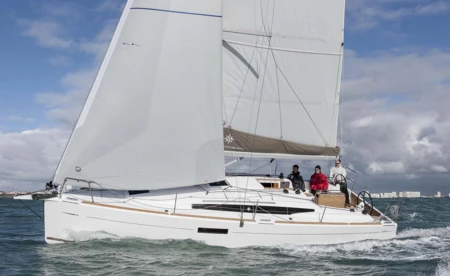
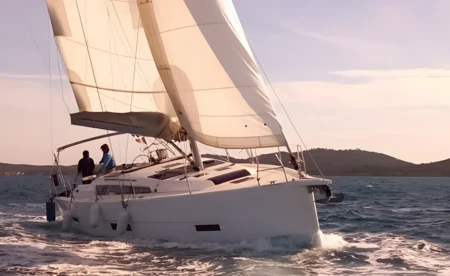
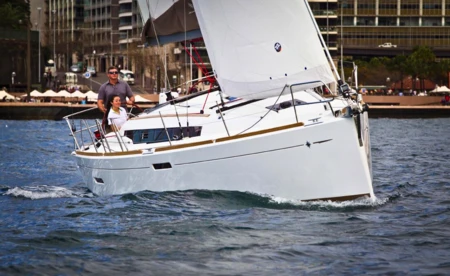
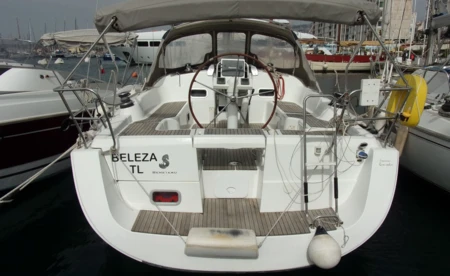
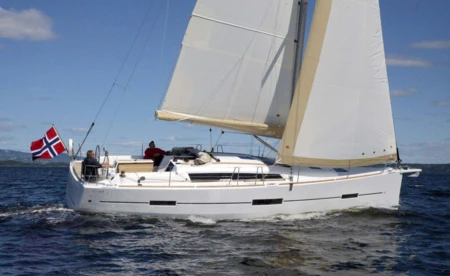
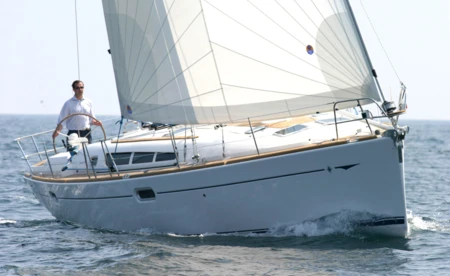
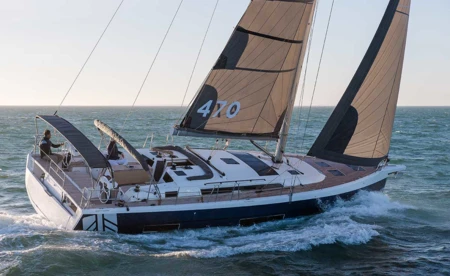
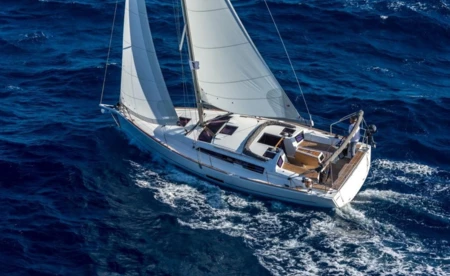
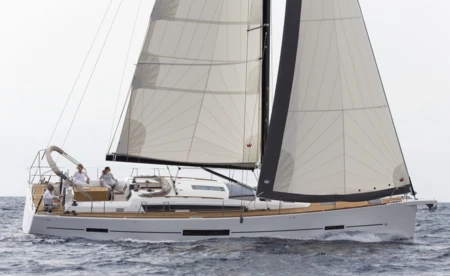
A monohull is a sailboat with a single hull and a ballasted keel. It is the most widely chartered type of cruising boat in the world, in sizes ranging from 28 to 60 feet.
One hull, a ballasted keel, a rig that is simple to trim: sailing in its purest form, with real feel on the helm and the widest choice of home ports and cruising grounds.
From a 30-footer for two to a 55-foot yacht with crew, this type of sailboat suits every budget and every level of experience, in the Mediterranean as much as in the tropics.
Why charter a monohull for your sailing vacation?
- The feel under sail: a monohull heels, passes the wind straight to the helm and points far closer to the wind than a multihull. You feel the boat accelerate in the gusts, you sheet in the mainsail, you trim the furling genoa and you gain ground to windward.
- A far more affordable budget: for the same number of berths, a monohull costs around half as much as a catamaran according to the rates in our catalog. The deposit is lower, dockage is usually charged by length rather than by area, and fuel consumption stays modest with a single engine. For the same money you sail one or two weeks where a catamaran allows only one.
- Behavior in a seaway: its weight and hull shape let it absorb chop and swell smoothly, without the sharp motion sometimes felt between two hulls. The ballasted keel also gives it a righting moment that brings it back upright on its own after a heavy heel. Two separate qualities that make it predictable close-hauled and on a demanding passage alike.
- Easy dockage: at 10 to 16 feet of beam, a monohull finds a slip anywhere, even in August in the crowded harbors of the Cyclades or Sardinia, rafting up alongside another boat if need be. A multihull has to reserve its slip and pay a beam supplement.
- The choice of fleet: monohulls make up most of the charter fleet worldwide, even though the catamaran now dominates in the Caribbean, the Seychelles and Polynesia. You therefore have access to more home ports, more recent models, more dates still open in peak season and more late availability. Sailboat charter in the French Mediterranean shows the scale of it, with dozens of boats in the bay of Hyères alone.
- A boat to learn on: a monohull is where you really learn to trim sails, put in a reef and anchor on the windlass. A week with a professional skipper is often enough to gain the confidence to set off on your own the following year.
- A tailored experience: at Filovent the monohull range runs from 28 to 60 feet, bareboat, with a skipper, with a hostess or with full crew. The same boat serves a sporty week with friends and a quiet family cruise.
Monohull or catamaran: which should you choose?
The monohull costs around half as much for the same number of berths and gives far more feel under sail. The catamaran offers more space, more stability and a shallow draft. For a crew of sailors, the monohull; for a family looking for comfort, the catamaran.
| Monohull | Catamaran | |
| Weekly price for the same berths | Baseline | Roughly double |
| Feel on the helm | Heel, close-hauled angles | Level, wider wind angles |
| Living space | Compact salon, snug cabins | Very generous salon and cockpit |
| Draft (40 feet) | 6 to 7.5 feet | 3.5 to 4.5 feet |
| Dockage | Available everywhere, no supplement | Must be booked, beam supplement |
| Ideal crew | Sailors, couples, friends | Families, groups, non-sailors |
What types of monohull are available to charter?
The main families of sailing monohulls
- The fixed-keel cruising yacht: the most chartered model, between 32 and 50 feet. Its ballasted keel provides stability and directional stability, while the layout gives priority to the salon and the double cabins. Expect a draft of 6 to 7.5 feet on a 40-footer. It is the default choice in the Mediterranean, the Caribbean and the Indian Ocean.
- The lifting-keel or centerboard yacht: its retractable keel brings the draft under 3 feet and opens up sandy bottoms, estuaries and shallow shelter. Essential in Brittany, the Baltic, the Bahamas or anywhere with a large tidal range.
- The performance yacht: fine hull lines, a powerful rig, oversized winches and twin wheels. These boats put speed and the pleasure of helming first, for experienced crews who want to cover miles rather than sit at anchor.
- The large crewed monohull: beyond 55 feet the maneuvers become a professional matter and the yacht is chartered with its skipper, sometimes with a hostess and a cook. Individual cabins, private heads, a broad swim platform aft and a full range of water-sports gear: the level of service reaches that of a yacht.
The charter options available
- The bareboat monohull: you are the skipper. You choose your route, your anchorages and your pace, and you sign the boat's inventory at check-in and at check-out. It is the most affordable and the freest option.
- The monohull with skipper or hostess: the professional skipper takes responsibility for the navigation and knows the area, its winds and its best shelter. The hostess handles the meals and life on board. You remain the charterer of the boat and keep control of the program.
- The cabin cruise: you book a cabin, on your own or as a couple, on a yacht shared with other travelers. The crew takes care of the sailing, the itinerary and the catering. A good way in for anyone discovering sailing with no previous experience.
How much does it cost to charter a monohull?
What is the price of a monohull charter? Expect $1,050 to $2,300 per week in low season and $3,700 to $7,500 in high season, depending on the size of the boat and the destination.
The rate depends on four main factors: the size of the boat, its year of build, the destination and the time of year.
2026 weekly rates – monohull of 30 to 40 feet (2 to 3 cabins), bareboat
| High season | Low season | |
| Mediterranean | $4,000 | $1,500 |
| Caribbean | $3,700 | $3,000 |
Source: Filovent – official data taken from our boat catalog.
2026 weekly rates – monohull of 40 to 50 feet (3 to 5 cabins), bareboat
| High season | Low season | |
| Mediterranean | $6,400 | $2,300 |
| Caribbean | $5,800 | $4,600 |
Source: Filovent – official data taken from our boat catalog.
These figures are indicative and move with the availability of the fleet. Our destination specialists will send you the exact rates and the best current offers on request.
- The price includes: the charter of the yacht, its sails, the engine, the onboard electronics (depth sounder, autopilot, chart plotter), the dinghy and its outboard, bedding and dishes.
- The price does not include: additional insurance, harbor and mooring fees along the way, fuel, the skipper and hostess, the mandatory end-of-charter package, provisioning (the food and drink taken on board) and water-sports extras.
Our specialists' advice: book your high-season monohull between November and February. That is when the fleet is complete, when the newer models are still open and when the bases apply their early-booking discounts, often 10 to 15 % of the weekly rate.
Where can you sail on a monohull charter?
- The Mediterranean: the monohull's historic playground, with home ports spread across the whole basin. The Cyclades and the Dodecanese offer steady wind and sheltered anchorages, Croatia lines up islands a few hours apart, and the Balearics and Sardinia combine clear coves with lively harbor towns. Sailboat charter in Corsica remains the most direct departure from France, between Cap Corse, the Agriates desert and the Gulf of Porto. Barely any tide, harbors close together, weather you can read: the ideal area for a first bareboat charter.
- The Caribbean: steady trade winds, water at 80°F, anchorages within sight of one another. The Grenadines and the Martinique to Saint Lucia arc are sailed downwind, sunny and free of complications. The British Virgin Islands form a cruising ground of their own, with their own entry and exit formalities. The season for sailboat charter in the Caribbean runs from December to May, in other words right through the European winter.
- The Atlantic and northern Europe: Brittany, Scotland, the Swedish archipelago, the Lofoten Islands. Further south, sailboat charter in La Rochelle opens the way to the Charente straits, the Île de Ré and the Île d'Yeu. This is where the lifting-keel monohull proves its worth against a large tidal range and shifting depths, with the depth sounder under constant watch. Tides to plan for, low light, bare landscapes: more technical sailing, for crews after something other than the postcard.
- The Indian Ocean and the Pacific: the Seychelles, Thailand and French Polynesia can also be explored by monohull, often with a local skipper who knows the passes and the coral heads. Sailboat charter in the Seychelles concentrates the essentials on the Mahé, Praslin and La Digue triangle, a few hours' sailing from one another. Elsewhere the islands lie further apart and legs are measured in half days at sea, where the monohull's seakeeping counts as much as comfort at anchor.
When is the best time to sail a monohull?
Which month is best for chartering a monohull in the Mediterranean? June and September: settled thermal wind, warm water, quieter harbors and rates 30 to 50 % below those of August.
In the Mediterranean the window runs from April to October. In the Caribbean the season runs from December to May, with a stronger trade wind in January and February: 15 to 25 knots steady, gusting higher. In northern Europe, aim for June to September for the length of the days. In the Indian Ocean and Polynesia, go for the dry season, from May to October.
Frequently asked questions about monohull charter
What is the difference between a sailboat and a monohull?
Sailboat refers to the means of propulsion, monohull to the architecture of the hull. A catamaran is therefore a sailboat, but never a monohull.
Who is a monohull charter for?
For anyone who wants to sail as much as swim. The monohull suits couples, families and crews of friends willing to live in a more compact space than a catamaran offers, in exchange for real feel under sail and a contained budget. Beginners are not ruled out: with a skipper on board, a first week on a monohull remains the best sailing school there is.
Can you charter a monohull without a license?
Not bareboat: the skipper must hold a valid certificate of competence. Without one, two options remain open, a charter with a skipper and a cabin cruise, where a professional takes care of the sailing.
What license and experience do you need to be skipper?
The skipper must produce a valid certificate of competence, together with a sailing résumé setting out the miles covered, the areas sailed and the size of the boats already handled. Some countries also require a radio certificate. If your experience does not match the boat you have in mind, there are two solutions: choose a smaller monohull or take a skipper on board for the week.
What size of monohull for 6 people?
A 42 to 46-footer with 3 double cabins. That size gives each couple its own cabin, provides two heads and a salon where six can sit around the table, while staying manageable for two in harbor.
What is the draft of a charter monohull?
From 6 to 7.5 feet for a 40-foot fixed-keel yacht, against less than 3 feet with the keel lifted. It is the figure to check before sailing in Brittany, the Baltic or the Bahamas.
How many miles do you cover in a week?
Between 150 and 250 nautical miles in the Mediterranean, meaning 3 to 5 hours of sailing a day and a different port every evening. Beyond 300 miles, the week turns into a delivery trip rather than a cruise.
How long should you charter a monohull for?
The Saturday to Saturday week remains the norm, because it matches the turnaround rhythm at the bases. In high season, departures are almost exclusively over seven days. Out of season, particularly in the Mediterranean, short options of three or four days become possible. For distant destinations, ten to fifteen days make the flight worthwhile and genuinely widen the itinerary.
Can you charter a monohull at the last minute?
Yes, and it is one of the advantages of the monohull fleet: its size makes cancellations frequent, and the bases release boats until a few days before departure, often at a reduced rate. In July and August, stay flexible on the home port rather than on the dates.
Should you take out cancellation insurance or deposit coverage?
Both are strongly recommended. Our cancellation insurance covers the whole crew, whereas an individual policy or a credit card guarantee protects only the holder. Deposit coverage reduces your financial exposure to a token amount in the event of damage arising from the sailing: on a monohull the deposit ranges from $1,750 for a small boat to $5,800 for a 50-footer, held for the whole of the charter.
How do you complete the booking of your monohull?
As soon as your inquiry reaches us, an adviser calls you to pin down your plans: area, dates, level of experience and make-up of the crew. They then send you a selection of available monohulls, with customer reviews and the particularities of each base. Once the boat is chosen, a deposit paid from your customer account secures the booking straight away.
Good to know
| Number of boats available | 5 385 |
|---|---|
| Types of service | Skipper, Hostess, Chef (meals not included), Sailor, Engineer, Mechanic, Masseuse |
| Average price per week | $25,860 |
| Minimum weekly price | $699 |
| Maximum price per week | $115,016,743 |